1960Experiment
Markov proposes deep underwater neutrino detection
At the 1960 Rochester Conference, Moisey Markov proposed installing detectors deep in a lake or the sea to observe the Cherenkov light of muons produced by neutrino interactions. The large overburden of water would shield against cosmic-ray muons, and the transparent medium could be instrumented over huge volumes. This idea underlies DUMAND, Baikal, AMANDA, ANTARES, IceCube and KM3NeT. It is often cited as the birth of high-energy neutrino astronomy.
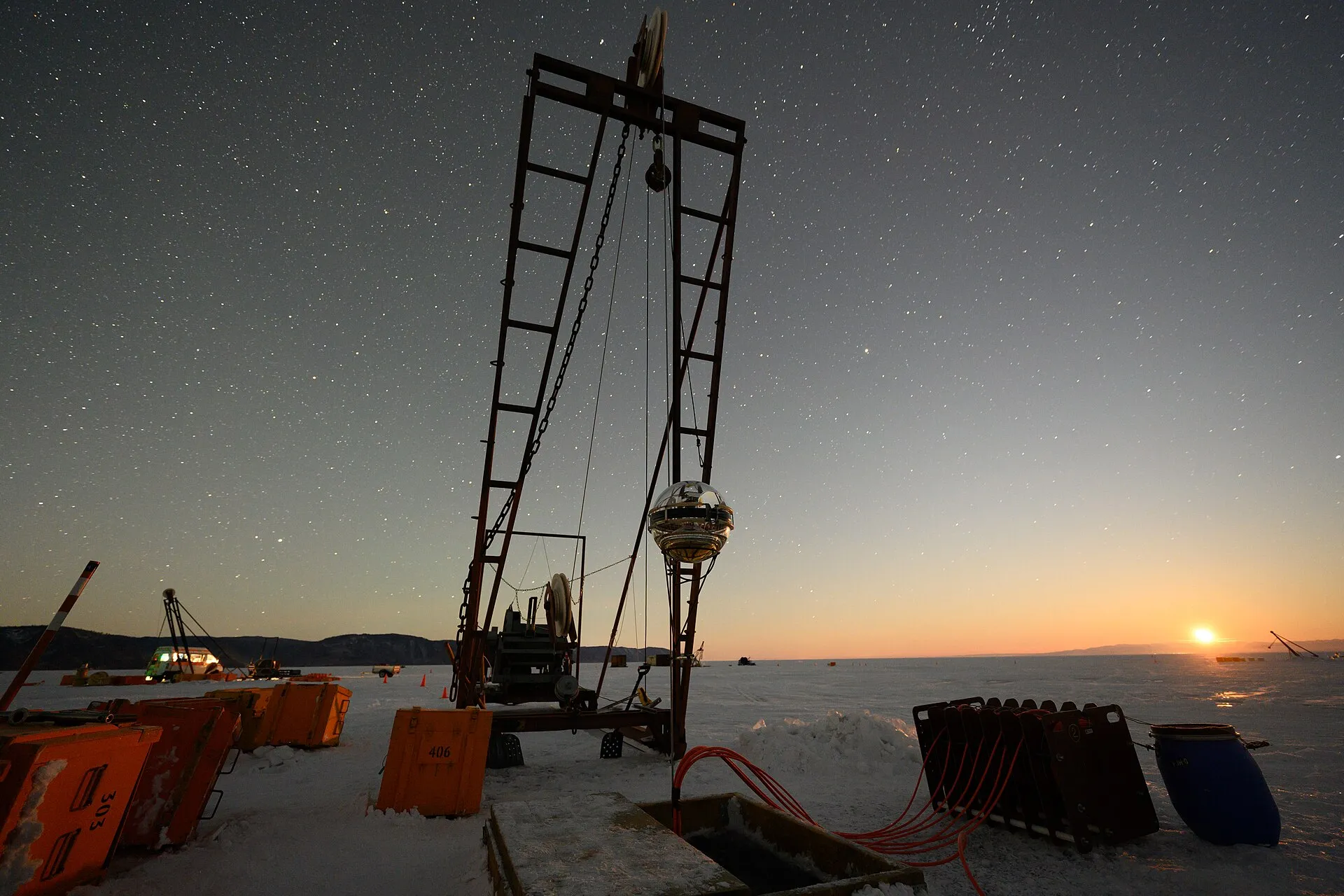
- Date
- 1960
- Kind of event
- Experiment
- People involved
- Moisey Alexandrovich Markov
- Experiments
- DUMAND, Baikal-GVD, IceCube Neutrino Observatory, KM3NeT
The situation before
In 1960 neutrinos had been detected only from a nuclear reactor. Physicists suspected that cosmic accelerators, the unknown sources of the highest-energy cosmic rays, must also produce neutrinos, and that neutrinos would point straight back to their sources because they are neither deflected by magnetic fields nor absorbed on the way. The obstacle was size. High-energy neutrino fluxes from space are tiny, so a detector would need a target mass far beyond anything that could be built in a laboratory, and it would have to be shielded from the much larger flux of cosmic-ray muons.
What happened
At the 1960 International Conference on High Energy Physics in Rochester, Moisey Markov of the Lebedev Physical Institute in Moscow proposed a different approach: use nature itself as the detector. He suggested installing light detectors deep in a lake or the sea, or in a deep mine, to register muons produced when neutrinos interact in the water or rock around them. A charged muon travelling faster than light in water emits Cherenkov radiation, so a sparse array of photodetectors spread through a large transparent volume could record its track. Placing the array under kilometres of water would remove most downward-going cosmic-ray muons, and looking for upward-going muons would use the whole Earth as a filter.
Markov and his student Igor Zheleznykh developed the idea in a paper in Nuclear Physics in 1961, estimating rates of neutrino interactions at high energy. Kenneth Greisen in the United States had published similar considerations in 1960.
Reaction
The idea was far ahead of the available technology. It took until the 1970s for the DUMAND project to plan a deep-ocean array off Hawaii, and until the 1990s for the first working detectors: the Baikal telescope in Lake Baikal, AMANDA in the Antarctic ice and later ANTARES in the Mediterranean. Each of them follows Markov's basic scheme of Cherenkov detection in a natural medium.
Why it matters
Markov's proposal is widely regarded as the birth of high-energy neutrino astronomy. Its full realisation came with IceCube, which instruments a cubic kilometre of Antarctic ice and in 2013 reported the first astrophysical neutrinos. In 2026 the Nobel Prize in Physics was awarded to Francis Halzen for his decisive contribution to IceCube and the discovery of high-energy astrophysical neutrinos, a direct line back to the Rochester talk. KM3NeT in the Mediterranean and Baikal-GVD continue the same approach today.
Frequently asked questions
What did Moisey Markov propose in 1960?
To detect high-energy neutrinos by placing light detectors deep in a lake or the sea and recording the Cherenkov light of muons produced by neutrino interactions.
Why deep underwater?
The water above shields the detector from cosmic-ray muons, and a large transparent volume can be instrumented cheaply to reach the huge target mass needed.
Which detectors follow Markov's idea?
DUMAND (planned), Baikal, AMANDA, ANTARES, IceCube, KM3NeT and Baikal-GVD.
Original papers
- ProposalM. A. Markov, On high energy neutrino physics, in: Proc. 10th Int. Conf. on High-Energy Physics (Rochester 1960), p. 578
Concepts
Mentioned in 1 page
Lessons 1
Last updated: · Editorial standard
Cite this page
Text
Neutrino Atlas (2026). “1960: Markov proposes deep underwater neutrino detection”. Retrieved 22 November 2026, from https://neutrino-atlas.com/timeline/1960-markov-underwater-telescope/BibTeX
@misc{neutrinoatlas2026arkovunderwatertelescope,
  title        = {1960: Markov proposes deep underwater neutrino detection},
  author       = {{Neutrino Atlas}},
  year         = {2026},
  url          = {https://neutrino-atlas.com/timeline/1960-markov-underwater-telescope/},
  note         = {Accessed 2026-11-22},
  language     = {english}
}