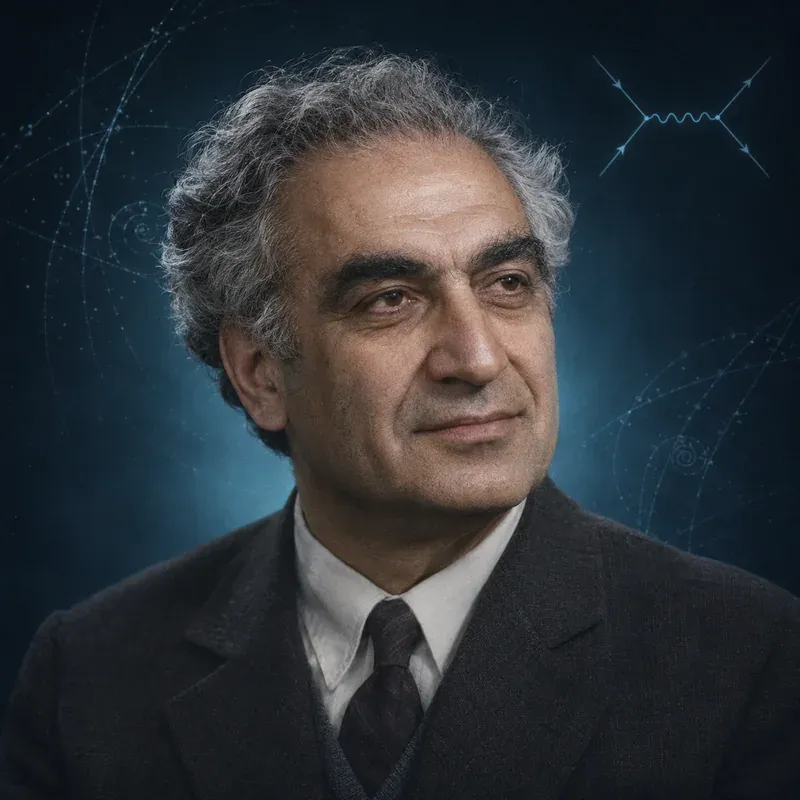
 Illustration
Gurgen Askaryan
Askaryan predicted in 1962 that a particle shower in a dense medium develops a net negative charge of order 20 per cent, because atomic electrons are knocked into the shower and positrons annihilate. This moving charge excess emits Cherenkov radiation coherently at radio wavelengths, so the radio power grows with the square of the shower energy. The effect, confirmed at SLAC in 2000, is the basis of radio detection of ultra-high-energy neutrinos in ice with RICE, ANITA, ARA, ARIANNA and RNO-G, which can monitor far larger volumes than optical detectors. He also founded radiation acoustics and, with Boris Dolgoshein, proposed in 1977 detecting the sound pulses produced by neutrino-induced showers in water.
- Born
- 14 December 1928
Moscow, Soviet Union - Died
- 2 March 1997
Moscow, Russia - Nationality
- Soviet / Armenian
- Field
- Theoretical and applied physics (particle detection, radiation acoustics, nonlinear optics)
- Institutions
- Moscow State University, Lebedev Physical Institute, Moscow
Early life and education
Gurgen Ashotovich Askaryan was born in Moscow in 1928 into an Armenian family. He entered the physics department of Moscow State University at eighteen and graduated in 1952. The following year he joined the Lebedev Physical Institute of the Academy of Sciences, where he worked for the rest of his life, receiving his PhD in 1957 and the higher doctor of science degree only in 1992. He worked on an unusually wide range of problems, from particle detection to plasma physics and laser optics. Colleagues credited him with an early, unpublished idea for a superheated-liquid track detector, a principle later realised independently in the bubble chamber.
The Askaryan effect
A high-energy particle entering a dense material starts an electromagnetic shower of electrons, positrons and photons. Askaryan noticed in 1961–62 that such a shower cannot stay electrically neutral. Photons in the shower knock atomic electrons out of the medium by Compton scattering and pull them along, while positrons annihilate in flight with electrons of the material. The result is a pancake of excess negative charge, about a fifth of the particles in the shower, moving faster than light in the medium. Like any such charge it emits Cherenkov radiation. At wavelengths longer than the shower's transverse size, roughly 10 centimetres in ice, the emission from all particles adds coherently, so the radio power scales with the square of the shower energy instead of linearly.
The prediction waited almost four decades for a direct test. In 2000 a team led by David Saltzberg and Peter Gorham sent bunches of photons from the SLAC accelerator into a target of silica sand and observed nanosecond radio pulses with the predicted polarisation and coherence. Later beam tests repeated the measurement in rock salt and ice.
Radio and acoustic neutrino detection
Because ice is transparent to radio waves over hundreds of metres to a kilometre, the Askaryan effect allows enormous volumes to be monitored with sparse antennas. This is the principle of radio detection of ultra-high-energy neutrinos and of the search for cosmogenic neutrinos: RICE placed antennas in holes at the South Pole, ANITA flew a balloon payload over Antarctica, and ARA, ARIANNA and RNO-G operate stations in Antarctica and Greenland. The radio array planned for IceCube-Gen2 builds on the same idea.
Askaryan also founded radiation acoustics. Energy deposited by a particle cascade heats a thin cylinder of liquid, which expands and emits a short pressure pulse. In 1977 he and Boris Dolgoshein proposed using this effect for acoustic detection of neutrinos in the ocean. The idea was studied for DUMAND and tested with hydrophone arrays in the Mediterranean, but the signal is weak and acoustic detection remains experimental.
Other work
In 1962 Askaryan also described the self-focusing of intense light beams in media whose refractive index rises with intensity, a basic effect of nonlinear optics that he later saw confirmed with lasers. He died in Moscow in 1997.
Known for
- Prediction of coherent radio emission from particle showers, the Askaryan effect (1962)
- Founding radiation acoustics and proposing acoustic detection of high-energy neutrinos
- Discovery of the self-focusing of intense light beams
- Early idea of a superheated-liquid particle detector
Chronology
- 1952Graduates from Moscow State University
- 1953Joins the Lebedev Physical Institute
- 1957PhD at the Lebedev Institute
- 1962Predicts coherent radio emission from showers
- 1977Proposes acoustic registration of high-energy neutrinos with Dolgoshein
- 2000Askaryan effect observed in a beam test at SLAC
Original papers
- G. A. Askaryan, Excess negative charge of an electron-photon shower and its coherent radio emission, Sov. Phys. JETP 14, 441 (1962)
- G. A. Askaryan, B. A. Dolgoshein, Acoustic registration of high-energy neutrinos, JETP Lett. 25, 213 (1977)
Experiments
- RICE (Radio Ice Cherenkov Experiment)
- ANITA
- ARA (Askaryan Radio Array)
- ARIANNA
- RNO-G (Radio Neutrino Observatory Greenland)
Connected people
Frequently asked questions
What is the Askaryan effect?
Coherent radio Cherenkov emission from the net negative charge that builds up in a particle shower in a dense medium. Its power grows with the square of the shower energy, which makes radio detection of very energetic neutrinos possible.
Has the Askaryan effect been used to detect neutrinos?
Radio experiments in Antarctica and Greenland use it to search for neutrinos above about 10¹⁷ eV. They have set limits on the cosmogenic neutrino flux, but no neutrino has yet been confirmed this way.
Mentioned in 6 pages
Last updated: · Editorial standard
Cite this page
Text
Neutrino Atlas (2026). “Gurgen Askaryan”. Retrieved 22 November 2026, from https://neutrino-atlas.com/people/gurgen-askaryan/BibTeX
@misc{neutrinoatlas2026peoplegurgenaskaryan,
  title        = {Gurgen Askaryan},
  author       = {{Neutrino Atlas}},
  year         = {2026},
  url          = {https://neutrino-atlas.com/people/gurgen-askaryan/},
  note         = {Accessed 2026-11-22},
  language     = {english}
}