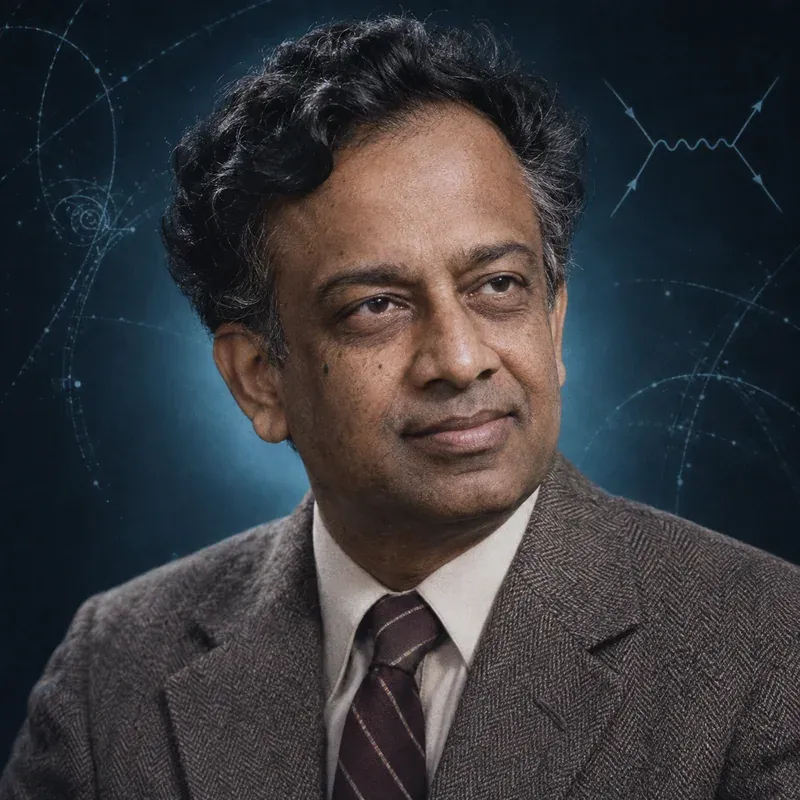
 Illustration
E. C. George Sudarshan
As a graduate student of Robert Marshak at Rochester, Sudarshan analysed all beta-decay and meson-decay data in 1957 and concluded, against several contemporary experiments, that the universal weak interaction must be of V-A form with two-component (chiral) fermions. Their paper was presented at the Padua-Venice conference (22-27 September 1957) and a short version appeared in Physical Review in 1958; Feynman later acknowledged their priority. The V-A structure implies a left-handed neutrino.
- Born
- 16 September 1931
Pallom, Kottayam, Travancore, British India - Died
- 13 May 2018
Austin, Texas, USA - Nationality
- Indian-American
- Field
- theoretical physics
- Institutions
- University of Rochester, Harvard University, Syracuse University, University of Texas at Austin
Early life and education
Ennackal Chandy George Sudarshan was born on 16 September 1931 in Pallom, near Kottayam, in the princely state of Travancore (today Kerala). He graduated with honours from Madras Christian College in 1951 and took a master's degree at the University of Madras in 1952. He then worked briefly with Homi Bhabha and others at the Tata Institute of Fundamental Research in Bombay before moving to the University of Rochester as a graduate student of the American theorist Robert Marshak. He received his PhD at Rochester in 1958.
Path to neutrino physics
Sudarshan arrived in Rochester at the moment the structure of the weak interaction was thrown open. Fermi's theory allowed five possible forms of the four-fermion coupling, labelled S, P, V, A and T after their behaviour under Lorentz transformations. In 1956–57 the discovery of parity violation showed that the interaction mixes left and right, and the experiments of the time did not agree on which combination nature uses. Several measurements, notably the electron–neutrino angular correlation in the decay of helium-6, pointed towards scalar and tensor couplings.
Key contributions
In 1957 Sudarshan, as Marshak's student, went systematically through the data on nuclear beta decay, muon decay and pion decay. He concluded that only one form is consistent with all of them once a few experiments are set aside: an equal mixture of vector and axial-vector couplings with opposite sign, the V−A interaction. Its physical content is that only the left-handed chirality component of each fermion takes part. A massless neutrino produced by such an interaction is always left-handed, and an antineutrino always right-handed.
Sudarshan and Marshak argued that the conflicting experiments, including the helium-6 result, must be wrong. Their paper 'The nature of the four-fermion interaction' was presented at the conference on mesons and newly discovered particles in Padua and Venice in September 1957; a shorter version appeared in Physical Review in March 1958. Richard Feynman and Murray Gell-Mann arrived at the same form independently, and their paper appeared first, in January 1958. New measurements soon showed that the helium-6 result was in error, and the universal V−A interaction became the standard description of weak processes until the electroweak theory explained it as the exchange of a left-handed W boson. In 1963 Feynman credited Sudarshan and Marshak with the discovery, adding that he and Gell-Mann had made it widely known.
Later work
After a postdoctoral period at Harvard with Julian Schwinger, Sudarshan taught at Rochester and Syracuse and from 1969 at the University of Texas at Austin, where he remained for the rest of his career. He also directed the Institute of Mathematical Sciences in Chennai for five years in the 1980s and worked at the Indian Institute of Science in Bangalore.
In quantum optics he introduced in 1963 a representation of light fields, now called the Glauber–Sudarshan P representation, which became a standard tool for describing coherent and non-classical light. When Roy Glauber received a share of the 2005 Nobel Prize for work in this area, several physicists wrote to the Swedish Academy arguing that Sudarshan should have shared it. With Baidyanath Misra he described in 1977 the quantum Zeno effect, in which frequent observation slows the decay of an unstable system. He also studied hypothetical faster-than-light particles (tachyons) and open quantum systems.
His honours include India's Padma Bhushan (1976) and Padma Vibhushan (2007), the Majorana Prize (2006) and the Dirac Medal of the International Centre for Theoretical Physics (2010). He died in Austin on 13 May 2018.
Legacy
The V−A structure Sudarshan identified as a graduate student is still how every neutrino charged-current interaction is written. It explains why only left-handed neutrinos are seen in experiments, why the right-handed neutrino is absent from the minimal Standard Model, and why neutrino helicity was among the first properties of the particle to be measured.
Known for
- V−A theory of the weak interaction (with Marshak, 1957)
- Glauber–Sudarshan P representation
- Quantum Zeno effect (with Misra)
- Tachyons
Chronology
- 1957V−A theory presented at the Padua–Venice conference (September)
- 1958Sudarshan–Marshak Phys. Rev. paper (1 March)
- 1958V−A paper in Physical Review
- 2010ICTP Dirac Medal
Original papers
- E.C.G. Sudarshan, R.E. Marshak, The nature of the four-fermion interaction, Proc. Padua-Venice Conf. on Mesons and Newly Discovered Particles (1957), p. V-14
- E.C.G. Sudarshan, R.E. Marshak, Chirality invariance and the universal Fermi interaction, Phys. Rev. 109, 1860 (1958)
Connected people
Frequently asked questions
Who discovered the V−A theory, Sudarshan and Marshak or Feynman and Gell-Mann?
Both pairs found it independently in 1957. Sudarshan and Marshak presented it first, at the Padua–Venice conference in September 1957; Feynman and Gell-Mann published first, in January 1958. Feynman later credited Sudarshan and Marshak.
Did Sudarshan win a Nobel Prize?
No. Several physicists argued that his work on the quantum theory of optical coherence deserved recognition when the 2005 Nobel Prize was awarded for that field.
What does V−A mean for neutrinos?
It means that the weak interaction acts only on the left-handed component of particles. As a result, neutrinos produced in weak processes are left-handed and antineutrinos right-handed; see V−A.
On the timeline
Mentioned in 12 pages
Lessons 1
Milestones 3
Last updated: · Editorial standard
Cite this page
Text
Neutrino Atlas (2026). “E. C. George Sudarshan”. Retrieved 22 November 2026, from https://neutrino-atlas.com/people/e-c-g-sudarshan/BibTeX
@misc{neutrinoatlas2026peopleecgsudarshan,
  title        = {E. C. George Sudarshan},
  author       = {{Neutrino Atlas}},
  year         = {2026},
  url          = {https://neutrino-atlas.com/people/e-c-g-sudarshan/},
  note         = {Accessed 2026-11-22},
  language     = {english}
}