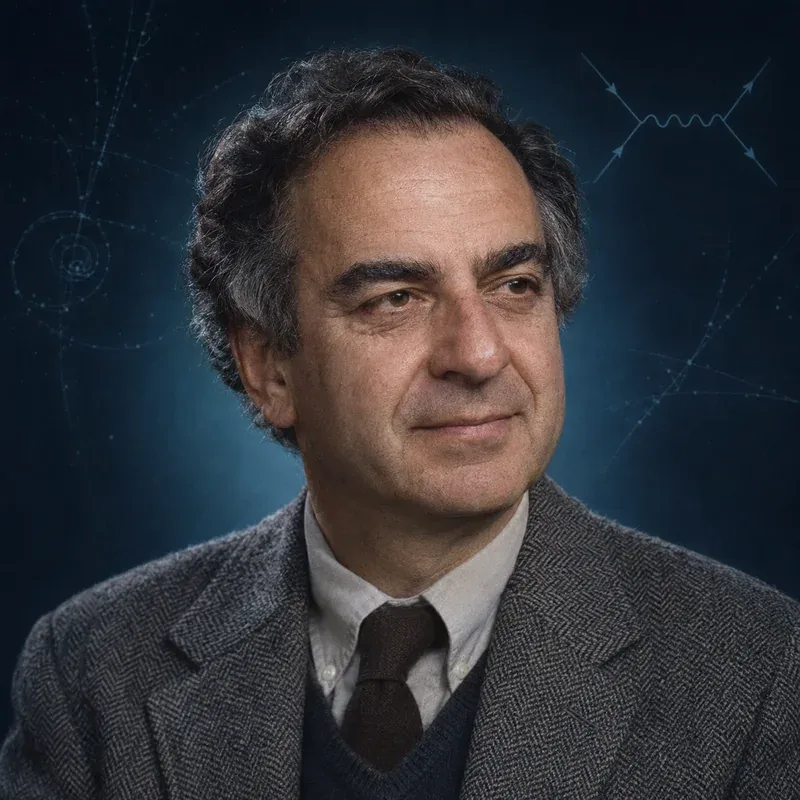
 Illustration
Nicholas P. Samios
Samios led Brookhaven bubble-chamber groups that exposed the 7-foot cryogenic bubble chamber to the AGS neutrino beam. In 1975 this programme reported a neutrino-induced event with a Λ and several pions that violated the ΔS = ΔQ rule unless a charmed baryon had been produced, with a mass near 2.43 GeV — the first evidence for a charmed baryon. Such charged-current production of charm by neutrinos became an important test of the GIM mechanism and the quark model. He received the 2001 Bruno Pontecorvo Prize for outstanding contributions to particle physics.
- Born
- 15 March 1932
New York City, USA - Nationality
- American
- Field
- Experimental particle physics
- Institutions
- Columbia University (BA 1953, PhD 1957), Brookhaven National Laboratory (from 1959; director 1982–1997), RIKEN BNL Research Center (director from 2003)
Education and early discoveries
Nicholas Peter Samios was born on 15 March 1932 in New York City. He studied at Columbia College, graduating in 1953, and received his PhD from Columbia University in 1957. After teaching at Columbia he joined the physics department of Brookhaven National Laboratory in 1959, where bubble chambers at the new Alternating Gradient Synchrotron were opening up hadron spectroscopy.
In 1964 a Brookhaven team including Samios found the Ω⁻, a baryon made of three strange quarks whose existence and mass had been predicted by the eightfold way of Murray Gell-Mann. The discovery established SU(3) flavour symmetry and paved the way to the quark model.
Charm from neutrinos
Brookhaven's 7-foot cryogenic bubble chamber was also exposed to the AGS neutrino beam. In 1975 the group reported one striking event among 335 neutrino interactions: a final state containing a Λ hyperon and several pions whose charges and strangeness were impossible for ordinary charged-current scattering. The authors concluded that either a selection rule of the weak interaction was broken or a charmed baryon had been produced and had decayed, with a most likely mass of 2426 ± 12 MeV.
The interpretation as charm proved correct. Neutrinos turn a d or s quark into a c quark through the W boson, so neutrino beams became one of the cleanest ways to produce charm, later exploited in deep-inelastic experiments. The result also supported the GIM mechanism, which had required a fourth quark to suppress flavour-changing neutral currents. Samios also introduced the notation used for charmed baryons such as Λc⁺ and Σc⁺⁺.
Laboratory director
Samios chaired Brookhaven's physics department from 1975 to 1981 and was laboratory director from 1982 to 1997, overseeing the construction of RHIC, where the quark–gluon plasma was later observed. From 2003 he directed the RIKEN BNL Research Center. His honours include the E. O. Lawrence Award (1980), the Panofsky Prize (1993) and the Pontecorvo Prize (2001).
Known for
- Discovery of the Ω⁻ baryon (1964)
- First charmed baryon, observed in a neutrino interaction (1975)
- Director of Brookhaven National Laboratory (1982–1997)
- Realisation of the Relativistic Heavy Ion Collider (RHIC)
- Bruno Pontecorvo Prize (2001)
Chronology
- 1957PhD, Columbia University
- 1959Joins Brookhaven National Laboratory
- 1964Discovery of the Ω⁻
- 1975Charmed-baryon candidate in a neutrino interaction
- 1982Becomes director of Brookhaven
- 1993Panofsky Prize
- 2001Bruno Pontecorvo Prize
- 2003Director of the RIKEN BNL Research Center
Original papers
- V. E. Barnes et al., Observation of a Hyperon with Strangeness Minus Three, Phys. Rev. Lett. 12, 204 (1964)DOI 10.1103/PhysRevLett.12.204
- E. G. Cazzoli et al., Evidence for ΔS = −ΔQ Currents or Charmed-Baryon Production by Neutrinos, Phys. Rev. Lett. 34, 1125 (1975)DOI 10.1103/PhysRevLett.34.1125
Experiments
- BNL 7-foot bubble chamber
- AGS neutrino beam
- RHIC
Connected people
Frequently asked questions
What did Samios discover with neutrinos?
In 1975 his Brookhaven group observed a neutrino-induced event in the 7-foot bubble chamber that was best explained by the production of a charmed baryon, the first evidence for such a particle.
What is the Ω⁻?
A baryon of three strange quarks, discovered at Brookhaven in 1964; its predicted existence and mass confirmed Gell-Mann's SU(3) classification of hadrons.
Last updated: · Editorial standard
Cite this page
Text
Neutrino Atlas (2026). “Nicholas P. Samios”. Retrieved 22 November 2026, from https://neutrino-atlas.com/people/nicholas-samios/BibTeX
@misc{neutrinoatlas2026peoplenicholassamios,
  title        = {Nicholas P. Samios},
  author       = {{Neutrino Atlas}},
  year         = {2026},
  url          = {https://neutrino-atlas.com/people/nicholas-samios/},
  note         = {Accessed 2026-11-22},
  language     = {english}
}