1934Theory
Bethe and Peierls estimate a tiny cross-section
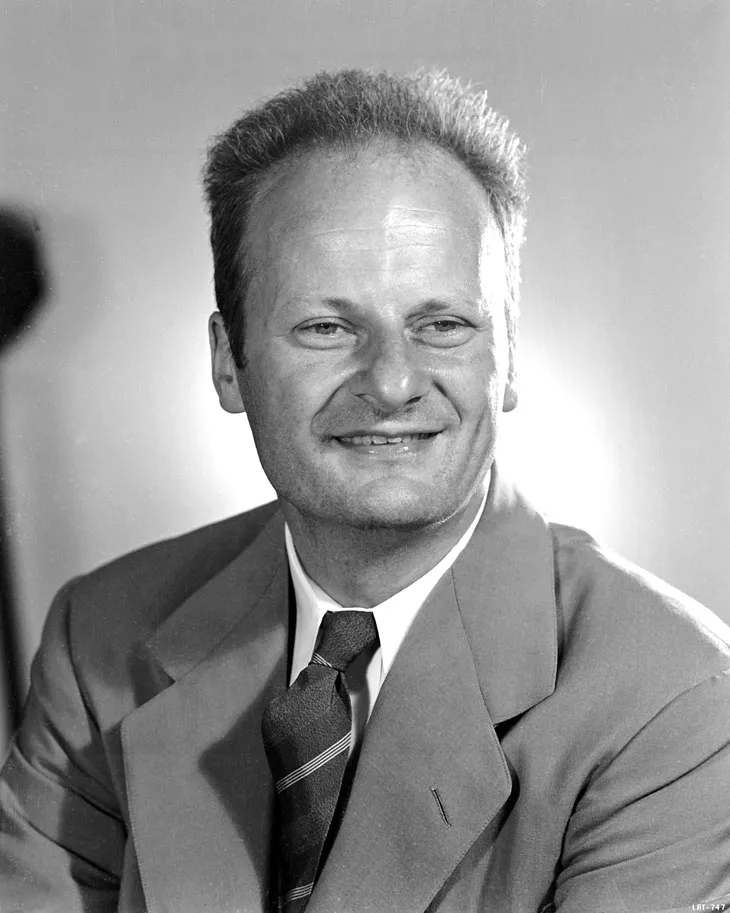
Using Fermi's theory, Hans Bethe and Rudolf Peierls estimated in Nature that a neutrino would interact with matter with a cross-section below about 10⁻⁴⁴ cm². A neutrino could therefore pass through light-years of solid matter without interacting. They concluded that 'there is no practically possible way of observing the neutrino'. Only the intense fluxes of nuclear reactors two decades later proved them too pessimistic.
- Date
- April 1934
- Kind of event
- Theory
- People involved
- Hans Bethe, Rudolf Peierls
The situation before
Enrico Fermi's theory of beta decay, published at the turn of 1933 to 1934, made the neutrino a particle with calculable properties. An obvious next question was whether it could be caught. If a nucleus can emit a neutrino in beta decay, the reverse process should also occur: a neutrino striking a nucleus could turn a proton into a neutron, or a neutron into a proton, and create a positron or an electron. Measuring that would prove the neutrino exists.
What happened
Hans Bethe and Rudolf Peierls, both young theorists who had left Germany in 1933 and were then working in Manchester, answered the question in a short letter to Nature titled "The neutrino", published in spring 1934 in volume 133. Their argument was simple. The same interaction governs emission and absorption, so its strength can be read off from the measured lifetimes of beta-active nuclei. A nucleus that takes minutes to emit one neutrino reveals how feeble the coupling is.
From this they estimated that the cross-section for absorbing a neutrino of a few MeV, the effective target area a nucleus offers, is below about 10⁻⁴⁴ cm². That is roughly twenty orders of magnitude smaller than the geometric size of a nucleus. The corresponding mean free path in solid matter is enormous, vastly more than the diameter of the Earth. Their conclusion was blunt: there is "no practically possible way of observing the neutrino".
Reaction
The estimate was accepted as sound and it shaped attitudes for two decades. Most physicists regarded the neutrino as real because Fermi's theory worked, but direct detection seemed out of reach. Experimental effort turned instead to indirect evidence: measuring the recoil of nuclei that emit a neutrino, as James Allen did in 1942.
Why it matters
Bethe and Peierls were right about the number and wrong about the practical consequence. Their reasoning assumed ordinary laboratory sources. What changed the picture was flux: nuclear reactors from the 1940s onward emit vast numbers of antineutrinos, of the order of 10¹³ per square centimetre per second close to the core. With such a source, a detector containing many protons can register a handful of inverse beta decay events per hour.
In 1956 Clyde Cowan and Frederick Reines did exactly that at Savannah River and reported a cross-section of about 6 × 10⁻⁴⁴ cm², in line with the theory Bethe and Peierls had used. The tiny cross-section remains the defining challenge of neutrino physics and explains why detectors are so large and located deep underground.
Frequently asked questions
What did Bethe and Peierls calculate?
They estimated in 1934 that a neutrino of a few MeV is absorbed by a nucleus with a cross-section below about 10⁻⁴⁴ cm², which means it would pass through enormous amounts of matter without interacting.
Were they wrong to say neutrinos could not be observed?
Their physics was correct. They did not anticipate nuclear reactors, whose huge antineutrino flux made detection possible in 1956.
Original papers
- TheoryH. Bethe and R. Peierls, The "Neutrino", Nature 133, 532 (1934)DOI 10.1038/133532a0
Concepts
Mentioned in 2 pages
Last updated: · Editorial standard
Cite this page
Text
Neutrino Atlas (2026). “1934: Bethe and Peierls estimate a tiny cross-section”. Retrieved 22 November 2026, from https://neutrino-atlas.com/timeline/1934-bethe-peierls-cross-section/BibTeX
@misc{neutrinoatlas2026bethepeierlscrosssection,
  title        = {1934: Bethe and Peierls estimate a tiny cross-section},
  author       = {{Neutrino Atlas}},
  year         = {2026},
  url          = {https://neutrino-atlas.com/timeline/1934-bethe-peierls-cross-section/},
  note         = {Accessed 2026-11-22},
  language     = {english}
}