1933Theory
Pauli presents the neutrino at the Solvay Conference
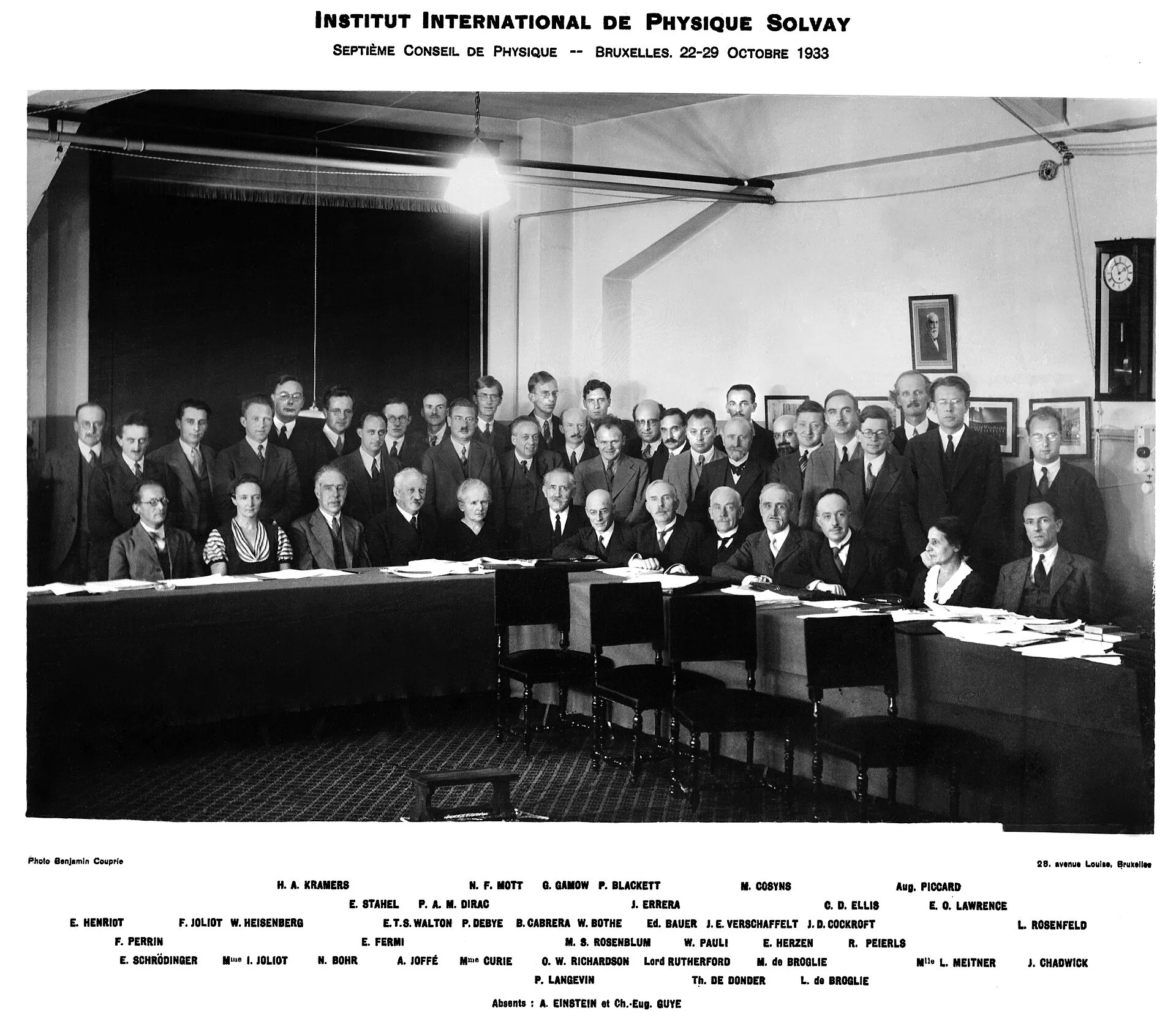
At the seventh Solvay Conference in Brussels in October 1933, Pauli discussed his hypothesis publicly for the first time, after having mentioned it only in letters and talks. The meeting was devoted to the atomic nucleus and brought together the leading nuclear physicists of the time. Fermi attended and shortly afterwards built his theory of beta decay around the neutrino.
- Date
- 1933
- Kind of event
- Theory
- People involved
- Wolfgang Pauli, Enrico Fermi, Niels Bohr
The situation before
For almost three years Wolfgang Pauli's neutral particle existed only in his letter of December 1930 and in a few talks, notably in Pasadena in June 1931 and at a nuclear physics conference in Rome in October 1931. He had not published it. Meanwhile the field had changed rapidly. The neutron had been discovered in 1932, the positron in the same year, and nuclei were now seen as built from protons and neutrons. The continuous beta spectrum remained unexplained, and Niels Bohr still considered that energy might not be conserved in nuclear processes.
What happened
The seventh Solvay Conference on Physics met in Brussels from 22 to 29 October 1933 on the theme "Structure and properties of atomic nuclei". It brought together the leading nuclear physicists of the day, including Bohr, Pauli, Enrico Fermi, James Chadwick, Werner Heisenberg, Marie Curie, Irène Curie and Frédéric Joliot, and Lise Meitner.
In the discussion of beta decay Pauli stated his hypothesis publicly. His remarks, printed in the conference proceedings in 1934, were the first time the idea appeared in print under his name. Compared with the letter of 1930 the proposal had matured. Pauli now spoke of a particle emitted in beta decay rather than one permanently stored in the nucleus, and he insisted that energy, momentum and angular momentum are conserved in each individual decay, with the neutral particle carrying away the difference. Its spin should be 1/2 and its mass small, possibly zero.
- Date and place: 22–29 October 1933, Brussels.
- Theme: structure and properties of atomic nuclei.
- Pauli's statement: a light neutral spin-1/2 particle emitted with the electron; conservation laws hold in every decay.
- Publication: conference proceedings, 1934.
Reaction
The conference did not settle the question by vote, and Bohr did not immediately abandon his doubts. But the hypothesis now had a public form that others could build on. Fermi, who had been thinking about beta decay, worked out a full theory within weeks, and in December 1933 published a first short version in La Ricerca Scientifica, built around the neutrino. At about the same time Francis Perrin in Paris argued from the shape of beta spectra near their upper end that the neutrino mass must be very small compared with the electron mass. In Paris, the Joliot-Curies' work on positron emission discussed at the conference led a few months later, in January 1934, to their discovery of artificial radioactivity.
Why it matters
Solvay 1933 was the point at which the neutrino moved from a private speculation to an accepted working hypothesis. Fermi's theory, which followed directly, gave it a quantitative role and made predictions for decay rates and spectrum shapes that could be tested. It also allowed Hans Bethe and Rudolf Peierls in 1934 to estimate how weakly the particle interacts with matter. Experimental proof would take another 23 years.
Frequently asked questions
When did Pauli first present the neutrino publicly?
At the seventh Solvay Conference in Brussels in October 1933. His remarks were published in the proceedings in 1934, the first appearance of the idea in print under his name.
What changed compared with Pauli's 1930 letter?
Pauli no longer described the particle as a permanent constituent of the nucleus but as emitted in beta decay, and he stressed exact conservation of energy, momentum and angular momentum in each decay.
What followed the conference?
Within weeks Enrico Fermi published his theory of beta decay, which built the neutrino into a quantitative description of the process.
Original papers
- ProposalW. Pauli, Discussion du rapport de M. Heisenberg, in: Structure et propriétés des noyaux atomiques, Rapports et discussions du septième Conseil de physique Solvay, Gauthier-Villars, Paris, p. 324 (1934)
Mentioned in 1 page
Lessons 1
Last updated: · Editorial standard
Cite this page
Text
Neutrino Atlas (2026). “1933: Pauli presents the neutrino at the Solvay Conference”. Retrieved 22 November 2026, from https://neutrino-atlas.com/timeline/1933-solvay-pauli/BibTeX
@misc{neutrinoatlas2026timeline1933solvaypauli,
  title        = {1933: Pauli presents the neutrino at the Solvay Conference},
  author       = {{Neutrino Atlas}},
  year         = {2026},
  url          = {https://neutrino-atlas.com/timeline/1933-solvay-pauli/},
  note         = {Accessed 2026-11-22},
  language     = {english}
}