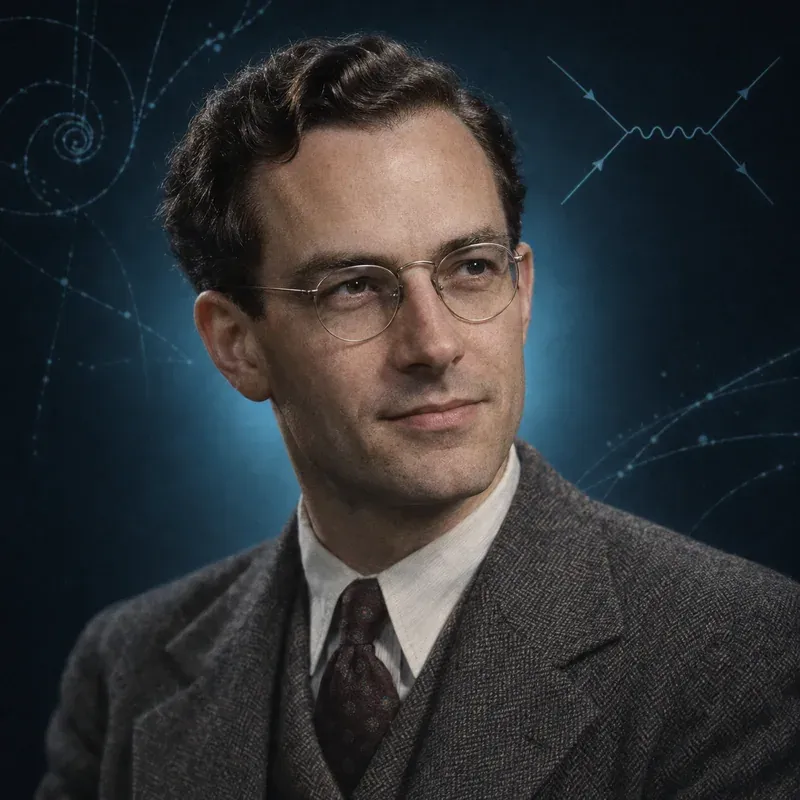
 Illustration
H. Richard Crane
In 1938, with J. Halpern, Crane used a cloud chamber to measure electron and nuclear recoil momenta in beta decay and reported momentum imbalance as experimental evidence for an unseen neutrino. His 1948 Reviews of Modern Physics article on energy-momentum relations in beta decay and the search for the neutrino was the standard review of indirect evidence before the reactor experiments.
- Born
- 4 November 1907
Turlock, California, USA - Died
- 19 April 2007
Chelsea, Michigan, USA - Nationality
- American
- Field
- experimental physics
- Institutions
- Caltech, University of Michigan, MIT Radiation Laboratory
Early life and education
Horace Richard Crane was born on 4 November 1907 in Turlock, California. He studied at Caltech, receiving his BS in 1930 and his PhD in 1934 under Charles Lauritsen with a thesis on artificial radioactivity, a field then only a year old. In 1935 he moved to the University of Michigan, where he remained for the rest of his career, becoming full professor in 1946, later department chair, and emeritus in 1978.
Looking for the invisible particle
In the 1930s the neutrino existed only on paper: Wolfgang Pauli had proposed it in 1930 to save energy conservation in beta decay, and Enrico Fermi built his theory on it in 1934. Detecting it directly seemed hopeless, so experimenters looked for its fingerprint in the motion of the visible decay products. If a nucleus emits only an electron, nucleus and electron must fly apart back to back with equal and opposite momentum. If a third, unseen particle is also emitted, the two visible momenta no longer balance.
In 1938 Crane and J. Halpern used a cloud chamber to photograph both the beta electron and the recoiling nucleus in the same decays and reconstruct their momenta. They reported an imbalance consistent with a third particle carrying away momentum and energy, one of the first experiments that went beyond the energy spectrum and tested the neutrino through energy-momentum relations. The measurement was difficult and not precise, but it opened the line of nuclear recoil experiments that James S. Allen and others refined over the next decade.
Crane's 1948 article in Reviews of Modern Physics, 'The energy and momentum relations in the beta-decay, and the search for the neutrino', gathered all the indirect evidence then available. It was the standard summary of the field until Clyde Cowan and Frederick Reines detected reactor antineutrinos directly in 1956.
Later work and legacy
Crane invented the race-track synchrotron and from the 1950s led the Michigan programme that made the first measurement of the magnetic moment and spin of free electrons and positrons, the ancestor of today's precision g−2 experiments. His honours include the Davisson–Germer Prize (1967), the Oersted Medal (1976) and the National Medal of Science (1986). He died on 19 April 2007 in Chelsea, Michigan, aged 99.
Known for
- Crane–Halpern recoil evidence for the neutrino (1938)
- 1948 review of searches for the neutrino
- Electron g-2 / magnetic moment measurements
- Race-track synchrotron
Chronology
- 1938Crane–Halpern recoil experiment
- 1948Review 'The energy and momentum relations in the beta-decay, and the search for the neutrino'
- 1986National Medal of Science
Original papers
- H.R. Crane, J. Halpern, The experimental evidence for the existence of a neutrino, Phys. Rev. 53, 789 (1938)DOI 10.1103/PhysRev.53.789
- H.R. Crane, The energy and momentum relations in the beta-decay, and the search for the neutrino, Rev. Mod. Phys. 20, 278 (1948)DOI 10.1103/RevModPhys.20.278
Experiments
- Beta-decay recoil experiments
Connected people
Frequently asked questions
What did Crane contribute to neutrino physics?
With Halpern in 1938 he measured electron and nuclear recoil momenta in beta decay and found an imbalance pointing to an unseen particle; his 1948 review summarised all indirect evidence before the neutrino was detected directly.
Why use recoil momenta?
In a two-body decay the visible products must balance each other; any missing momentum shows that another particle was emitted, even if it cannot be seen.
Mentioned in 2 pages
Last updated: · Editorial standard
Cite this page
Text
Neutrino Atlas (2026). “H. Richard Crane”. Retrieved 22 November 2026, from https://neutrino-atlas.com/people/h-richard-crane/BibTeX
@misc{neutrinoatlas2026peoplehrichardcrane,
  title        = {H. Richard Crane},
  author       = {{Neutrino Atlas}},
  year         = {2026},
  url          = {https://neutrino-atlas.com/people/h-richard-crane/},
  note         = {Accessed 2026-11-22},
  language     = {english}
}