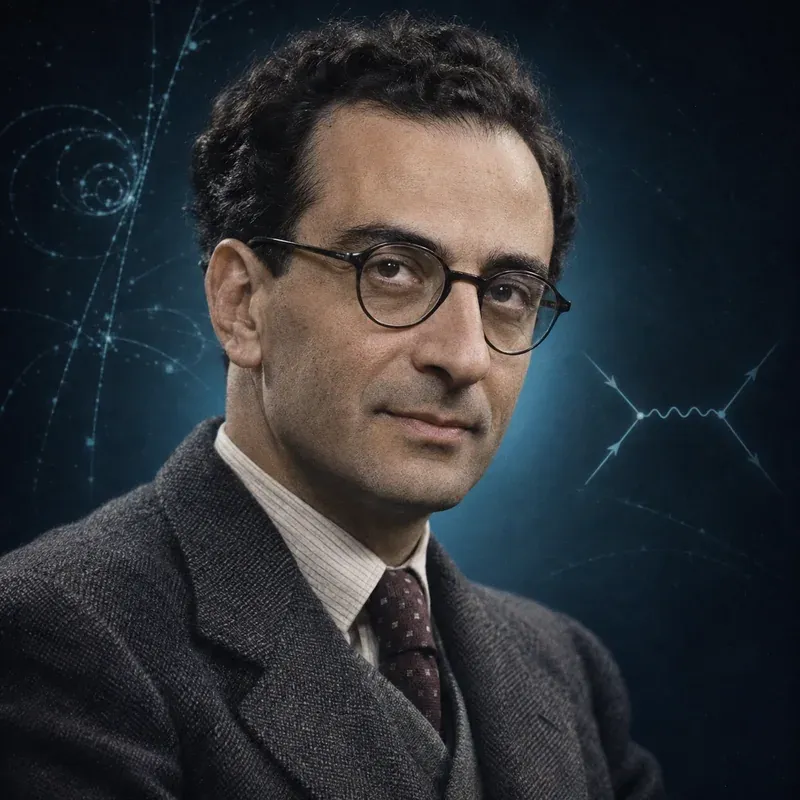
 Illustration
Giulio Racah
In 1937, right after Majorana, Racah pointed out that a Majorana neutrino emitted in beta decay could induce a reaction (e.g. producing an electron) that would be forbidden for a Dirac neutrino - the first proposal of an experimental way to distinguish the two. He analysed inverse beta decay with free neutrino fluxes; he did not, contrary to some accounts, propose neutrinoless double-beta decay itself.
- Born
- 9 February 1909
Florence, Italy - Died
- 28 August 1965
Florence, Italy - Nationality
- Italian-Israeli
- Field
- theoretical physics, atomic spectroscopy
- Institutions
- University of Florence, University of Rome, University of Pisa, Hebrew University of Jerusalem
Early life and education
Giulio Racah was born in Florence in 1909 and took his doctorate at the University of Florence in 1930. He then continued his training in Rome in the circle around Enrico Fermi. In 1937 he was appointed professor of physics at the University of Pisa.
The 1937 paper on Majorana neutrinos
In 1937 Ettore Majorana showed that a neutral fermion could be its own antiparticle. Within the same year Racah published 'Sulla simmetria tra particelle e antiparticelle' in Il Nuovo Cimento and drew a practical consequence: if the particle emitted with an electron in beta decay is a Majorana neutrino, that same particle can be absorbed by another nucleus and produce an electron, ν + (A, Z) → (A, Z+1) + e⁻. For a Dirac neutrino this reaction is forbidden, because the particle emitted alongside the electron is an antineutrino, which can only produce a positron.
This was the first proposal of an experimental way to tell the two possibilities apart, the question now called Dirac versus Majorana. Racah treated inverse beta decay induced by a free flux of neutrinos. He did not consider a process with a virtual neutrino inside a single nucleus. That step, neutrinoless double beta decay, was taken by Wendell Furry in 1939, although Racah is sometimes credited with it by mistake.
Jerusalem and atomic spectroscopy
After the Italian racial laws of 1938, Racah emigrated in 1939 to British Mandate Palestine and became professor of theoretical physics at the Hebrew University of Jerusalem. There he developed the tensor-algebra methods that classify the energy levels of atoms with open electron shells. Racah coefficients and the related algebra of angular momentum became standard tools in atomic, nuclear and particle physics; with his cousin Ugo Fano he wrote the monograph 'Irreducible Tensorial Sets' (1959). He served as dean of the Faculty of Sciences, as rector, and in 1961–1962 as acting president of the university. He received the Weizmann Prize (1953) and the Israel Prize in exact sciences (1958).
Legacy
Racah died in 1965 during a visit to Florence, apparently asphyxiated by gas from a faulty heater. The physics institute of the Hebrew University bears his name. In neutrino physics his short 1937 paper is remembered as the first attempt to turn Majorana's mathematical idea into a testable statement about lepton number.
Known for
- Particle–antiparticle symmetry and Majorana neutrino reactions (1937)
- Racah algebra / W-coefficients
- Classification of atomic energy levels
Chronology
- 1937'Sulla simmetria tra particelle e antiparticelle'
- 1939Professor at the Hebrew University of Jerusalem
- 1958Israel Prize
Original papers
- G. Racah, Sulla simmetria tra particelle e antiparticelle, Nuovo Cimento 14, 322 (1937)
Connected people
Frequently asked questions
Did Giulio Racah propose neutrinoless double beta decay?
No. Racah proposed in 1937 that a Majorana neutrino from one beta decay could be absorbed by another nucleus to produce an electron. Neutrinoless double beta decay, with a virtual neutrino inside one nucleus, was first discussed by Wendell Furry in 1939.
On the timeline
Mentioned in 7 pages
Last updated: · Editorial standard
Cite this page
Text
Neutrino Atlas (2026). “Giulio Racah”. Retrieved 22 November 2026, from https://neutrino-atlas.com/people/giulio-racah/BibTeX
@misc{neutrinoatlas2026peoplegiulioracah,
  title        = {Giulio Racah},
  author       = {{Neutrino Atlas}},
  year         = {2026},
  url          = {https://neutrino-atlas.com/people/giulio-racah/},
  note         = {Accessed 2026-11-22},
  language     = {english}
}