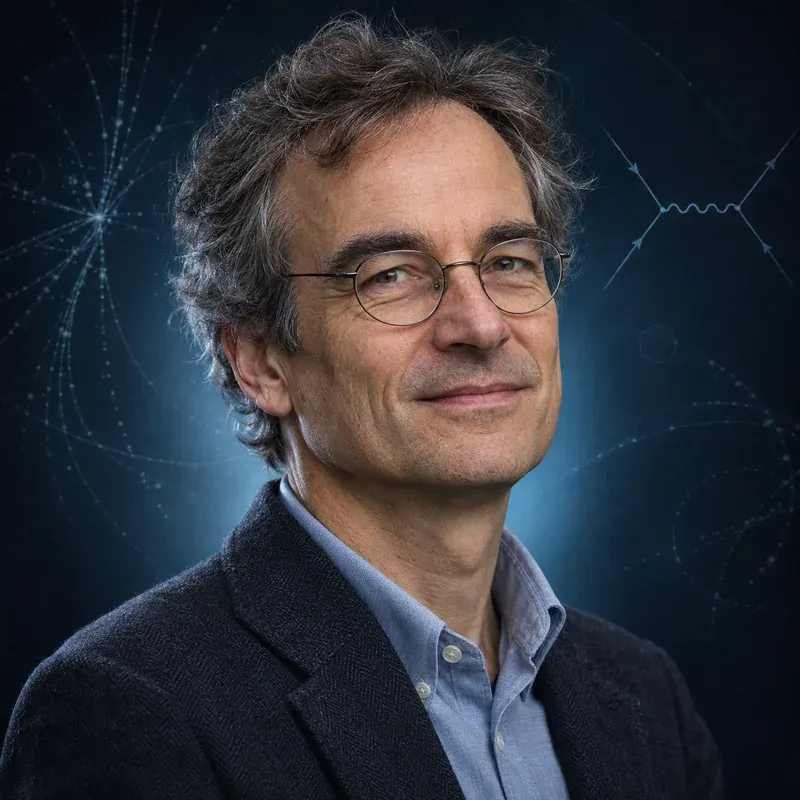
 Illustration
Stefan Schönert
Schönert was the founding and long-term spokesperson (2004–2014) of GERDA at Gran Sasso, which operated bare enriched-germanium detectors directly in liquid argon and reached a background-free regime; its final 2020 result set a half-life limit above 10²⁶ years for neutrinoless double beta decay of ⁷⁶Ge and did not confirm the Klapdor-Kleingrothaus claim. Since 2017 he has been European spokesperson of the successor experiment LEGEND.
- Nationality
- German
- Field
- Experimental astroparticle physics
- Institutions
- University of Hannover, Technical University of Munich (PhD; chair since 2010), University of Milan, Laboratori Nazionali del Gran Sasso
Career
Stefan Schönert is a German experimental astroparticle physicist. He studied at the University of Hannover and the Technical University of Munich (TUM), where he also took his doctorate. Research fellowships took him to the University of Milan and to the Gran Sasso National Laboratory, and he was a guest professor at the University of Tokyo. He then led an independent research group at the Max Planck Institute for Nuclear Physics in Heidelberg, an institute with a long tradition in low-background neutrino experiments such as GALLEX and Borexino. Since 2010 he has held the Chair of Experimental Astroparticle Physics at TUM; he became a Max Planck Fellow in 2016 and received an ERC Advanced Grant in 2018.
GERDA
Schönert's main work is the search for neutrinoless double beta decay, a nuclear decay that would emit two electrons and no neutrinos. Observing it would show that neutrinos are Majorana particles and that lepton number is not conserved. In germanium-76 the signal would be a sharp peak at 2039 keV in the summed electron energy, so the challenge is to remove almost all radioactive background near that energy.
He was founding spokesperson of GERDA from 2004 to 2014. Instead of housing enriched germanium detectors in copper cryostats, GERDA immersed the bare crystals directly in liquid argon, which cools them, shields them and, in the second phase, acts as an active veto: background events that also deposit energy in the argon make it scintillate and are rejected. Combined with pulse-shape discrimination, this gave a background index of 5.2 × 10⁻⁴ counts per keV, kg and year, low enough that GERDA expected less than one background event in its signal window over the full exposure. The final result in 2020, with 127.2 kg·yr, set a lower half-life limit of 1.8 × 10²⁶ years (90% C.L.). Already in 2013 the first-phase data had disfavoured the claim of a signal by Hans Klapdor-Kleingrothaus from the Heidelberg–Moscow experiment.
LEGEND
Since 2017 Schönert has been European spokesperson of LEGEND, which merges the GERDA and MAJORANA Demonstrator communities. Its first stage, LEGEND-200, runs in the upgraded GERDA infrastructure at Gran Sasso; a tonne-scale stage is planned to push the half-life sensitivity beyond 10²⁸ years, covering the region expected for inverted mass ordering.
Known for
- Founding spokesperson of GERDA (2004–2014)
- European spokesperson of LEGEND (from 2017)
- Bare germanium detectors in liquid argon for 0νββ
Chronology
- 2004GERDA founded; spokesperson
- 2010Chair of Experimental Astroparticle Physics, TUM
- 2016Max Planck Fellow
- 2017LEGEND European spokesperson
- 2018ERC Advanced Grant
- 2020GERDA final results
Original papers
- GERDA Collaboration (M. Agostini et al.), Final results of GERDA on the search for neutrinoless double-β decay, Phys. Rev. Lett. 125, 252502 (2020)DOI 10.1103/PhysRevLett.125.252502
Experiments
Connected people
Frequently asked questions
What did GERDA find?
No signal of neutrinoless double beta decay in germanium-76. Its final limit, T½ > 1.8 × 10²⁶ years, was reached in a practically background-free regime, as the experiment had been designed to do.
Why put germanium crystals directly into liquid argon?
The argon replaces material that would otherwise add radioactivity, shields against external radiation and, through its scintillation light, tags background events.
On the timeline
Mentioned in 3 pages
Last updated: · Editorial standard
Cite this page
Text
Neutrino Atlas (2026). “Stefan Schönert”. Retrieved 22 November 2026, from https://neutrino-atlas.com/people/stefan-schonert/BibTeX
@misc{neutrinoatlas2026peoplestefanschonert,
  title        = {Stefan Schönert},
  author       = {{Neutrino Atlas}},
  year         = {2026},
  url          = {https://neutrino-atlas.com/people/stefan-schonert/},
  note         = {Accessed 2026-11-22},
  language     = {english}
}