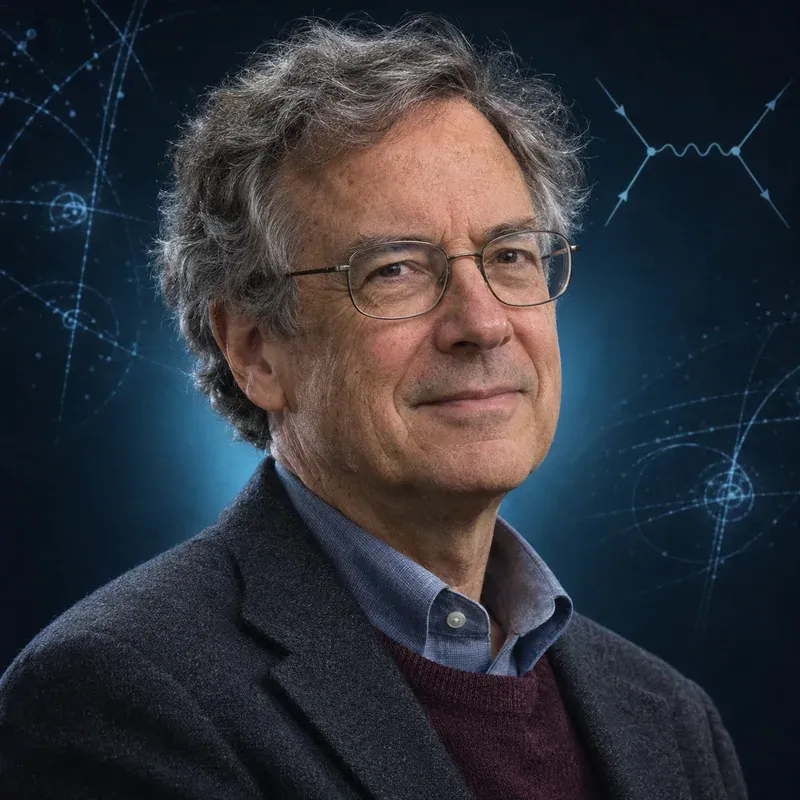
 Illustration
Wick C. Haxton
Haxton's work spans the solar neutrino problem, neutrino oscillations in matter, neutrino-nucleus interactions in supernovae and nucleosynthesis, and the nuclear physics of double beta decay; his 2004 Bethe Prize recognised contributions to neutrino astrophysics. He directed the Institute for Nuclear Theory (1991–2006) and led early efforts to turn the Homestake mine into an underground laboratory.
- Born
- 21 August 1949
Santa Cruz, California, USA - Nationality
- American
- Field
- Theoretical nuclear physics and nuclear astrophysics
- Institutions
- UC Santa Cruz (BA 1971), Stanford University (PhD 1976), University of Mainz, Los Alamos National Laboratory
Education and career
Wick C. Haxton studied physics and mathematics at the University of California, Santa Cruz (BA 1971) and earned his PhD at Stanford in 1976 with a thesis on semileptonic weak interactions in complex nuclei. He worked at the Institute for Nuclear Physics in Mainz (1975–1977), was an Oppenheimer Fellow in the Theoretical Division at Los Alamos, and moved via Purdue to the University of Washington in 1984. There he directed the national Institute for Nuclear Theory from 1991 to 2006. Since 2009 he has been professor of physics at UC Berkeley and senior faculty scientist at Lawrence Berkeley National Laboratory.
Key contributions
Haxton's work sits where nuclear physics meets neutrino physics. For the solar neutrino problem he gave in 1986 a widely used analytic treatment of the MSW effect in the Sun, 'Adiabatic conversion of solar neutrinos' (Phys. Rev. Lett. 57, 1271), which clarified when the flavour change is adiabatic and when neutrinos jump between states. With Stan Woosley and colleagues he described the 'ν-process' (1990): in a supernova, the enormous neutrino flux knocks nucleons out of nuclei in the outer shells and thereby creates rare isotopes such as boron-11 and fluorine-19. He has worked extensively on neutrino–nucleus cross sections for detectors and on the nuclear matrix elements that link a measured neutrinoless double beta decay rate to neutrino mass. His 2013 review with Hamish Robertson and Aldo Serenelli, 'Solar neutrinos: status and prospects', summarises the standard solar model, the solar metallicity problem and the role of CNO neutrinos.
Underground science
Haxton led early efforts to turn the former Homestake gold mine in South Dakota, site of Raymond Davis's chlorine experiment, into a Deep Underground Science and Engineering Laboratory. He stepped back after the mine flooded in 2003; the site later became the Sanford Underground Research Facility, which hosts the far detector of DUNE.
Recognition
He received the APS Hans A. Bethe Prize in 2004 for contributions to neutrino astrophysics and nuclear theory, was elected to the U.S. National Academy of Sciences in 1999 and the American Philosophical Society in 2024, and is a co-editor of the Annual Review of Nuclear and Particle Science.
Known for
- Solar neutrino theory and neutrino oscillations in matter
- Neutrino-nucleus interactions and supernova nucleosynthesis
- Neutrinoless double beta decay theory
- Early leader of the Homestake DUSEL effort
- APS Bethe Prize 2004
Chronology
- 1976PhD, Stanford
- 1991Director, Institute for Nuclear Theory (to 2006)
- 1999Elected to U.S. National Academy of Sciences
- 2004APS Hans A. Bethe Prize
- 2009Professor at UC Berkeley
Original papers
- W. C. Haxton, R. G. Hamish Robertson and A. M. Serenelli, Solar neutrinos: status and prospects, Annu. Rev. Astron. Astrophys. 51, 21 (2013)arXiv:1208.5723
Experiments
Connected people
Frequently asked questions
What is the neutrino process in supernovae?
In a core-collapse supernova, neutrinos streaming out of the core excite nuclei in the outer layers, which then emit a proton or neutron. Haxton and colleagues showed in 1990 that this can produce rare isotopes such as boron-11 and fluorine-19.
What did Wick Haxton do for the Homestake mine?
He led the early scientific effort to convert the mine into a deep underground laboratory, the forerunner of today's Sanford Underground Research Facility.
Mentioned in 4 pages
Last updated: · Editorial standard
Cite this page
Text
Neutrino Atlas (2026). “Wick C. Haxton”. Retrieved 22 November 2026, from https://neutrino-atlas.com/people/wick-haxton/BibTeX
@misc{neutrinoatlas2026peoplewickhaxton,
  title        = {Wick C. Haxton},
  author       = {{Neutrino Atlas}},
  year         = {2026},
  url          = {https://neutrino-atlas.com/people/wick-haxton/},
  note         = {Accessed 2026-11-22},
  language     = {english}
}