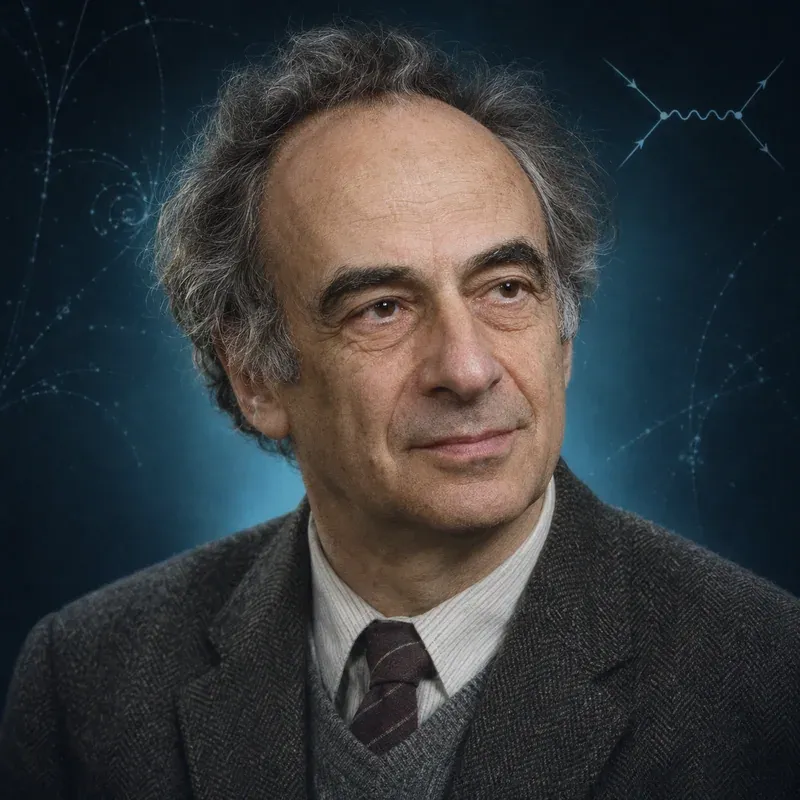
 Illustration
Lev Borisovich Okun
Okun was one of the leading theorists of the weak interaction, and his textbooks taught several generations how neutrinos enter the theory of beta decay, muon decay and neutral currents. In 1957, with Boris Ioffe and Alexei Rudik, he showed that the parity violation seen in beta decay also implies violation of charge-conjugation symmetry. In 1986, with Mikhail Voloshin and Mikhail Vysotsky, he proposed that a neutrino magnetic moment of about 10⁻¹¹ to 10⁻¹⁰ Bohr magnetons would let the Sun's magnetic field turn left-handed electron neutrinos into undetectable right-handed states, which could explain the solar neutrino deficit and a possible variation with solar activity. The idea started a large body of work on neutrino spin and spin-flavour precession in magnetic fields.
- Born
- 7 July 1929
Sukhinichi, Soviet Union - Died
- 23 November 2015
Moscow, Russia - Nationality
- Soviet / Russian
- Field
- Theoretical particle physics
- Institutions
- Moscow Engineering Physics Institute, Institute for Theoretical and Experimental Physics (ITEP), Moscow, Moscow Institute of Physics and Technology
Early life and education
Lev Borisovich Okun was born in 1929 in Sukhinichi, a small town south-west of Moscow. He studied at the Moscow Mechanical Institute, later the Moscow Engineering Physics Institute, graduating in 1953, and was a student of Arkady Migdal. In 1954 he joined the Institute for Theoretical and Experimental Physics (ITEP) in Moscow as a graduate student of Isaak Pomeranchuk. He received his doctorate in 1956 and his doctor of science degree in 1961, and ITEP remained his scientific home for six decades; for more than thirty years he headed its laboratory of theoretical physics.
Weak interactions
Okun's early papers came during the upheaval of 1956–57, when parity violation was discovered. With Boris Ioffe and Alexei Rudik he showed that the observed parity violation in beta decay also requires violation of charge conjugation, provided time reversal holds. With Bruno Pontecorvo he estimated the mass difference of the neutral kaons from second-order weak processes. In 1962, in a plenary talk at the international high-energy conference at CERN, he introduced the word 'hadron' for strongly interacting particles; it was quickly adopted. He also developed, following Shoichi Sakata, an early composite model of hadrons.
His monograph 'Weak Interaction of Elementary Particles' (Russian 1963, English 1965) was for years the standard text on the weak interaction. Its successor, 'Leptons and Quarks', published in the early 1980s, presented the electroweak theory with its neutrinos, neutral currents and W and Z bosons, and was reissued decades later. Colleagues recalled that he always aimed for clarity and simplicity in explaining physics.
Neutrino magnetic moment and the Sun
In the mid-1980s the solar neutrino problem was unsolved, and some analyses of the Homestake data suggested that the measured rate fell when the Sun was magnetically active. In 1986 Okun, Mikhail Voloshin and Mikhail Vysotsky proposed an explanation based on a neutrino magnetic moment. A moment of roughly 10⁻¹¹ to 10⁻¹⁰ Bohr magnetons would make the spin of an electron neutrino precess in the strong magnetic field of the Sun's convective zone, turning part of the left-handed flux into right-handed neutrinos that do not interact in detectors. The model predicted a flux that varies with the solar cycle. The anticorrelation was not confirmed, and the LMA-MSW solution later explained the deficit, but the paper opened the study of spin-flavour precession, extended by Evgeny Akhmedov and others to resonant conversion in matter. Laboratory and astrophysical limits on the neutrino magnetic moment are still compared against the values it suggested.
Other work and honours
With Igor Kobzarev and Pomeranchuk, Okun discussed hypothetical 'mirror particles' that interact with ordinary matter almost only through gravity, an early dark matter idea. Late in life he wrote widely read essays on the concept of mass in relativity. In 1981 he became the first Soviet physicist on CERN's Scientific Policy Committee. His honours included the Matteucci Medal (1988), the Bruno Pontecorvo Prize (1996), the Landau Gold Medal (2002) and the Pomeranchuk Prize (2008). He died in Moscow in 2015.
Known for
- Textbooks 'Weak Interaction of Elementary Particles' and 'Leptons and Quarks'
- Coining the term 'hadron' (1962)
- Neutrino magnetic moment solution of the solar neutrino problem (1986, with Voloshin and Vysotsky)
- Proof with Ioffe and Rudik that parity violation in beta decay implies C violation (1957)
- Mirror-particle hypothesis (with Kobzarev and Pomeranchuk)
Chronology
- 1954Joins ITEP as a graduate student of Isaak Pomeranchuk
- 1957Shows with Ioffe and Rudik that P violation implies C violation
- 1962Introduces the term 'hadron'
- 1963Publishes 'Weak Interaction of Elementary Particles'
- 1986Neutrino magnetic moment explanation of the solar neutrino problem
- 1996Bruno Pontecorvo Prize
Original papers
- M. B. Voloshin, M. I. Vysotsky, L. B. Okun, Sov. J. Nucl. Phys. 44, 440 (1986) [neutrino magnetic moment and solar neutrinos]
- L. B. Okun, Leptons and Quarks (North-Holland, Amsterdam, 1982)
Experiments
Connected people
Frequently asked questions
What did Okun propose about solar neutrinos?
With Voloshin and Vysotsky he suggested in 1986 that a neutrino magnetic moment could flip electron neutrinos into sterile right-handed states in the Sun's magnetic field, reducing the detected flux and making it vary with solar activity.
Did Okun invent the word 'hadron'?
Yes. He introduced it in a plenary talk at the 1962 International Conference on High Energy Physics at CERN.
Mentioned in 1 page
Terms 1
Last updated: · Editorial standard
Cite this page
Text
Neutrino Atlas (2026). “Lev Borisovich Okun”. Retrieved 22 November 2026, from https://neutrino-atlas.com/people/lev-okun/BibTeX
@misc{neutrinoatlas2026peoplelevokun,
  title        = {Lev Borisovich Okun},
  author       = {{Neutrino Atlas}},
  year         = {2026},
  url          = {https://neutrino-atlas.com/people/lev-okun/},
  note         = {Accessed 2026-11-22},
  language     = {english}
}