2016Experiment
NOvA reports its first oscillation results
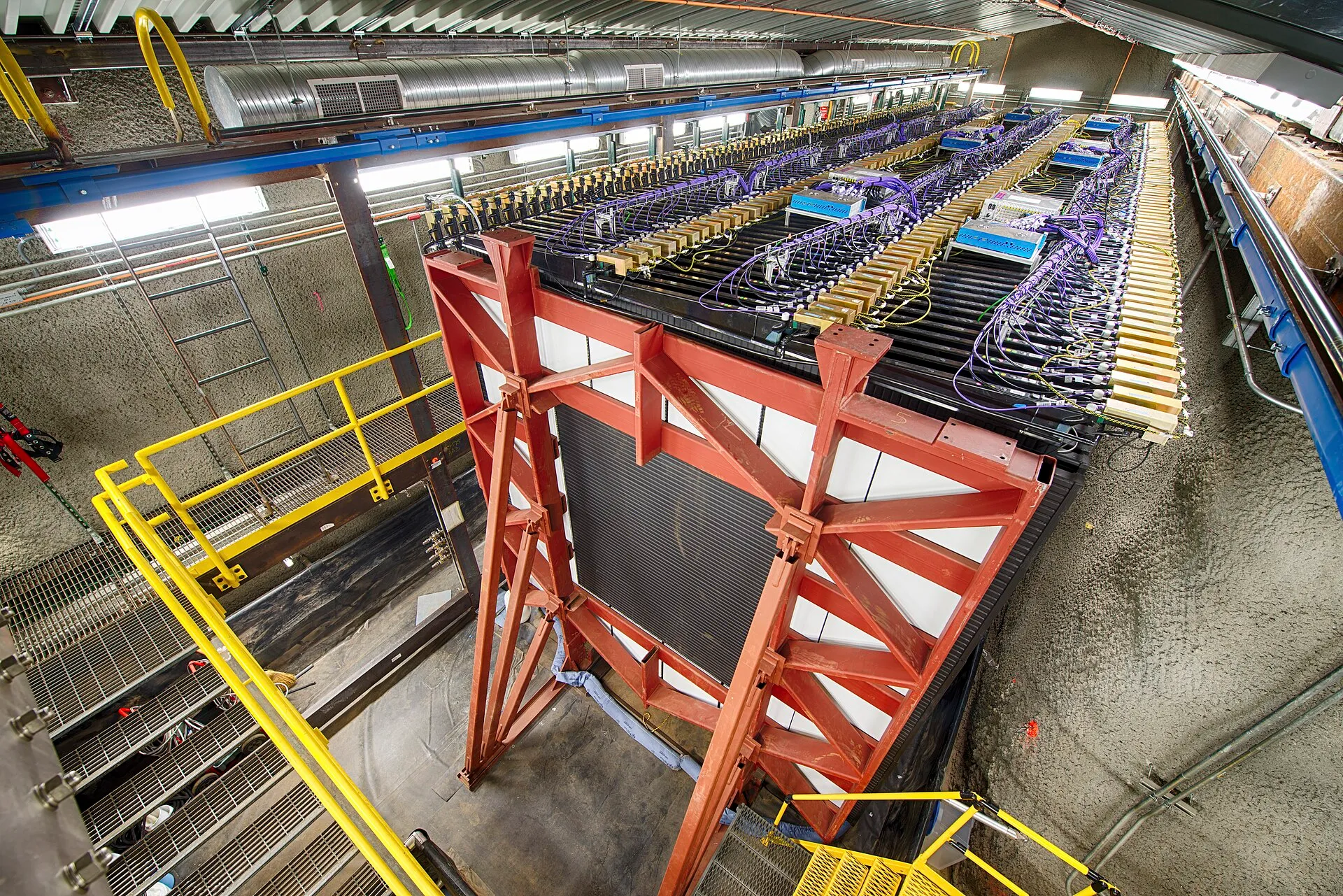
NOvA, with a 14,000-tonne liquid-scintillator far detector at Ash River, Minnesota, 810 km from Fermilab and 14 mrad off the NuMI beam axis, published its first results in early 2016. It observed electron-neutrino appearance and muon-neutrino disappearance. Its long baseline gives sensitivity to matter effects and thus to the mass ordering, complementing T2K.
- Date
- 2016
- Kind of event
- Experiment
- People involved
- Gary J. Feldman, Mark D. Messier
Background
By 2012 reactor experiments had shown that θ13 is fairly large, so a muon-neutrino beam should produce a measurable number of electron neutrinos over a long distance. That appearance channel is sensitive to δCP and, through matter effects in the Earth, to the mass ordering. T2K in Japan had a baseline of 295 km. NOvA, led by co-spokespersons Gary Feldman and Mark Messier, was designed with a much longer baseline of 810 km to make matter effects larger.
What happened
NOvA's far detector at Ash River in northern Minnesota is built from about 344,000 plastic cells filled with liquid scintillator, 14,000 tonnes in total, sitting near the surface. A 300-tonne near detector of the same design sits underground at Fermilab. Both are placed 14 milliradians off the axis of the NuMI beam, which gives a narrow energy spectrum peaked near 2 GeV, close to the first oscillation maximum at 810 km. The far detector was completed in 2014, while the beam power was being raised toward 700 kW.
The first results were presented in August 2015 and published in 2016 as two papers in Physical Review Letters and Physical Review D. They used 2.74 × 10²⁰ protons on target, equivalent to the full detector, collected from February 2014 to May 2015.
- Muon-neutrino disappearance: 33 events were observed where about 201 would have been expected without oscillation, giving a value of the mass splitting Δm²32 near 2.5 × 10⁻³ eV², consistent with T2K and MINOS.
- Electron-neutrino appearance: the primary selection found 6 events with an expected background of 0.99, a 3.3σ excess. A second selection method found 11 events with a background of about 1.1.
Reaction
The results showed that the detector, the beam and the analysis worked as intended, after more than a decade of planning and construction. With six events, the data could say little yet about δCP or the ordering, but the slight excess of electron neutrinos already pointed in the same direction as T2K's data, toward normal ordering and δCP near −π/2. The collaboration had fixed the primary selection before looking at the data; the second, overlapping selection served as a cross-check.
Consequences
NOvA accumulated data for over a decade. In 2019 it observed electron-antineutrino appearance at more than 4σ. Later NOvA results showed a weaker preference for normal ordering than T2K and less agreement on δCP, a mild tension that motivated a joint analysis. The first joint fit of T2K and NOvA data was published in Nature in 2025. The decisive measurements are expected from DUNE and Hyper-Kamiokande.
Frequently asked questions
When did NOvA publish its first results?
First results were presented in August 2015 and published in early 2016 in Physical Review Letters and Physical Review D.
What did NOvA observe first?
It saw muon neutrinos disappear (33 events instead of about 201) and electron neutrinos appear (6 events over a background of about 1) over 810 km.
Why does NOvA use an off-axis beam?
Placing the detectors 14 mrad off the beam axis yields a narrow energy spectrum near 2 GeV, matched to the oscillation maximum at 810 km.
Original papers
- First resultP. Adamson et al. (NOvA Collaboration), First measurement of muon-neutrino disappearance in NOvA, Phys. Rev. D 93, 051104 (2016)DOI 10.1103/PhysRevD.93.051104arXiv:1601.05037
- First resultP. Adamson et al. (NOvA Collaboration), First Measurement of Electron Neutrino Appearance in NOvA, Phys. Rev. Lett. 116, 151806 (2016)DOI 10.1103/PhysRevLett.116.151806arXiv:1601.05022
Concepts
Mentioned in 1 page
Lessons 1
Last updated: · Editorial standard
Cite this page
Text
Neutrino Atlas (2026). “2016: NOvA reports its first oscillation results”. Retrieved 22 November 2026, from https://neutrino-atlas.com/timeline/2016-nova-first-results/BibTeX
@misc{neutrinoatlas2026line2016novafirstresults,
  title        = {2016: NOvA reports its first oscillation results},
  author       = {{Neutrino Atlas}},
  year         = {2026},
  url          = {https://neutrino-atlas.com/timeline/2016-nova-first-results/},
  note         = {Accessed 2026-11-22},
  language     = {english}
}