2018Discovery
Blazar TXS 0506+056 linked to a neutrino
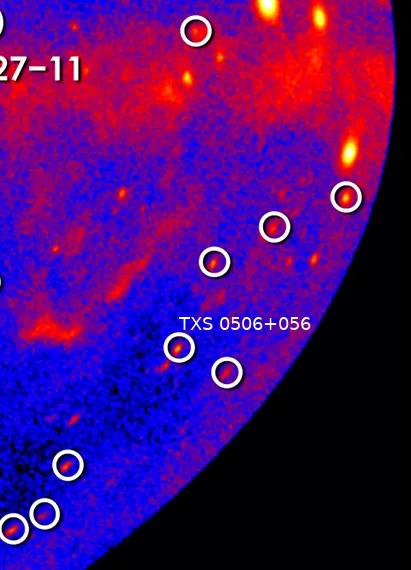
On 22 September 2017 IceCube issued a real-time alert for a muon neutrino of about 290 TeV, and the Fermi-LAT and MAGIC telescopes found the blazar TXS 0506+056 flaring in gamma rays in that direction. In two Science papers on 12 July 2018 the coincidence was assessed at about 3σ, and an archival search found an independent 3.5σ neutrino excess from the same source in 2014–2015. It was the first evidence for an identified source of high-energy cosmic neutrinos and a landmark of multimessenger astronomy.
- Date
- 12 July 2018
- Kind of event
- Discovery
- People involved
- Francis Halzen
- Experiments
- IceCube Neutrino Observatory
The situation before
Since 2013 IceCube had known that a diffuse flux of high-energy astrophysical neutrinos reaches the Earth, but none of the events could be tied to a source. To catch a source in the act, IceCube began in April 2016 to send automatic real-time alerts whenever it recorded a single high-energy muon track that was likely to be of cosmic origin. Telescopes around the world could then search the reported direction for something unusual. Blazars, active galaxies whose jets point toward Earth, were among the favoured candidates, but searches for neutrinos from known blazars had so far found nothing.
What happened
On 22 September 2017 at 20:54 UTC IceCube recorded a muon track from a neutrino later estimated to have about 290 TeV. The automated alert, IceCube-170922A, went out 43 seconds later, followed a few hours later by a refined direction. On 28 September the Fermi Large Area Telescope team reported that a known gamma-ray blazar, TXS 0506+056, lay within the error region and was in an active, flaring state. The MAGIC telescopes on La Palma then detected gamma rays above 100 GeV from the same source. In total about twenty observatories followed up the alert from radio to gamma rays.
The findings were presented at a press conference at the US National Science Foundation on 12 July 2018 and published in two papers in Science. The first, signed by IceCube, Fermi-LAT, MAGIC and many other teams, estimated that the chance of such a coincidence was about 3σ. The second, by IceCube alone, searched almost ten years of archival data in the direction of TXS 0506+056. It found an independent excess of about 13 ± 5 neutrino events between September 2014 and March 2015, at 3.5σ, a period in which the blazar showed no particular gamma-ray flare. Spectroscopic measurements published soon afterwards put the source at a redshift of about 0.34, several billion light-years away.
Reaction
The result was widely celebrated as the first evidence for an identified source of high-energy cosmic neutrinos, and as a landmark of multimessenger astronomy only a year after the joint detection of gravitational waves and light from a neutron-star merger. Francis Halzen, IceCube's principal investigator, and his colleagues were careful to describe the evidence as compelling but not a 5σ discovery. Because neutrinos are produced when protons are accelerated and collide, the observation also pointed to blazars as possible accelerators of at least some cosmic rays.
Why it matters
TXS 0506+056 changed the field in three ways. It showed that real-time alerts and rapid follow-up work. It identified a type of source that can produce high-energy neutrinos. And it raised new questions: the 2014–2015 neutrino flare without a matching gamma-ray flare was hard to explain with simple models, and stacking analyses showed that bright gamma-ray blazars can account for only a small part of the diffuse neutrino flux.
Later evidence pointed to other kinds of sources. In 2022 IceCube reported an excess of neutrinos from the nearby active galaxy NGC 1068 at 4.2σ, a source whose gamma rays seem to be absorbed, and in 2023 neutrino emission from the plane of the Milky Way. Telescopes such as KM3NeT and Baikal-GVD in the Northern Hemisphere and the planned IceCube-Gen2 aim to find more sources and settle the origin of the cosmic neutrino flux.
Frequently asked questions
What is TXS 0506+056?
A blazar, an active galaxy with a jet pointing toward Earth, at a redshift of about 0.34. In 2018 it became the first identified candidate source of high-energy cosmic neutrinos.
How significant was the evidence?
The coincidence of the 2017 neutrino with the gamma-ray flare was about 3σ, and an independent archival neutrino excess from 2014–2015 was 3.5σ. Neither alone reached the 5σ discovery threshold.
Are blazars the main source of cosmic neutrinos?
Probably not. Stacking analyses show that bright gamma-ray blazars produce only a small part of the diffuse flux. Other sources, such as the active galaxy NGC 1068, have since been identified.
Original papers
- DiscoveryM. G. Aartsen et al. (IceCube Collaboration et al.), Multimessenger observations of a flaring blazar coincident with high-energy neutrino IceCube-170922A, Science 361, eaat1378 (2018)DOI 10.1126/science.aat1378
- MeasurementM. G. Aartsen et al. (IceCube Collaboration), Neutrino emission from the direction of the blazar TXS 0506+056 prior to the IceCube-170922A alert, Science 361, 147 (2018)DOI 10.1126/science.aat2890arXiv:1807.08794
Concepts
Mentioned in 1 page
Lessons 1
Last updated: · Editorial standard
Cite this page
Text
Neutrino Atlas (2026). “2018: Blazar TXS 0506+056 linked to a neutrino”. Retrieved 22 November 2026, from https://neutrino-atlas.com/timeline/2018-txs-0506-056/BibTeX
@misc{neutrinoatlas2026timeline2018txs0506056,
  title        = {2018: Blazar TXS 0506+056 linked to a neutrino},
  author       = {{Neutrino Atlas}},
  year         = {2026},
  url          = {https://neutrino-atlas.com/timeline/2018-txs-0506-056/},
  note         = {Accessed 2026-11-22},
  language     = {english}
}