2026Experiment
JUNO sees a first hint of the mass ordering
On 29 September 2026 JUNO posted a preprint based on 207.2 live days and 8,294 reactor antineutrino events. It measured the atmospheric mass splitting Δm²₃₁ to about 1 percent, the most precise value so far, and improved the solar parameters further. Combined with accelerator measurements of the same splitting, the data favour normal mass ordering at a one-sided significance of at least 2.1σ, with a Bayes factor of about 10. The result is preliminary and far from a 5σ determination.
- Date
- 29 September 2026
- Kind of event
- Experiment
- People involved
- Wang Yifang, Cao Jun (Jun Cao)
The situation before
The mass ordering asks whether the third mass state is the heaviest, the normal ordering, or the lightest, the inverted ordering. Oscillation experiments had measured the size of the atmospheric splitting Δm²31 well, but not its sign. In their joint analysis of October 2025, the accelerator experiments NOvA and T2K, which use matter effects in the Earth, found no strong preference.
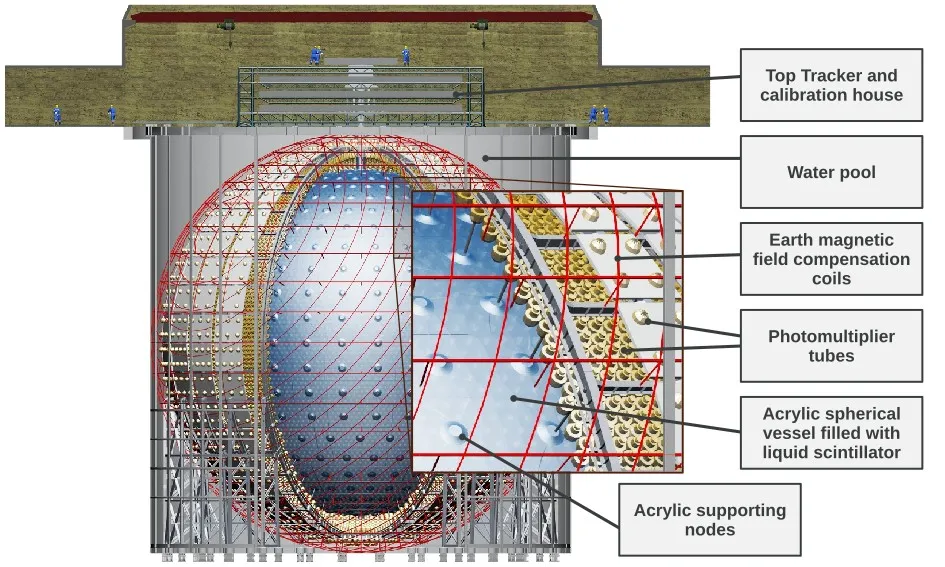
JUNO takes a different route. At about 52.5 km from two nuclear power plants, the fast oscillation driven by Δm²31 appears as a fine ripple on top of the slow solar oscillation in the reactor antineutrino spectrum, and the phase of this ripple differs slightly between the two orderings. Reading it requires excellent energy resolution and a precisely known energy scale. JUNO's first results in November 2025 had shown that the detector meets them.
What happened
On 29 September 2026 the collaboration posted the preprint "Measurement of Neutrino Oscillation Parameters at JUNO and Indication of the Neutrino Mass Ordering" (arXiv:2609.37895). It analysed 207.2 live days with 8,294 candidates from inverse beta decay. To select the correct solution for each ordering hypothesis, the fit used a constraint from the earlier reactor experiment Daya Bay.
This is the most precise determination of the atmospheric splitting so far. The solar parameters also improved, to sin²θ12 = 0.3036 ± 0.0064 and Δm²21 = (7.388 ± 0.078) × 10⁻⁵ eV², relative precisions of 2.1 and 1.1 percent and the best values in the world.
JUNO alone does not yet decide the ordering. But the best-fit magnitude of Δm²31 differs between the two hypotheses, and this can be compared with accelerator measurements of the same quantity. Adding long-baseline constraints, normal ordering was favoured at a one-sided significance of at least 2.1σ for all values of the CP phase. A Bayesian analysis gave a Bayes factor of 10.18 in favour of normal ordering.
How to read the result
A significance of 2.1σ is a hint, not a determination; a discovery is conventionally claimed only at 5σ (see statistical significance). A Bayes factor of about 10 is a clear but not decisive preference. The paper was a preprint, not yet peer-reviewed, and the indication depends partly on accelerator data and their systematic uncertainties. JUNO's own sensitivity grows with exposure; the design goal is about 3σ from reactor data alone after roughly six years.
Why it matters
The ordering shapes several other questions. In inverted ordering, the effective mass probed by neutrinoless double beta decay cannot fall below a floor that the next generation of experiments aims to cover; in normal ordering it can be much smaller. The minimum sum of neutrino masses seen by cosmology is also lower for normal ordering. The interpretation of CP violation in the NOvA–T2K data also depends on it. When JUNO presented its first results in November 2025, spokesperson Wang Yifang had said that the detector would "soon determine the neutrino mass ordering", and IHEP director Cao Jun expected it to produce important results for decades. The September 2026 preprint was the first step towards that answer. See also global fits.
Frequently asked questions
Has JUNO determined the neutrino mass ordering?
Not yet. Its September 2026 preprint shows a preference for normal ordering at about 2.1σ when combined with accelerator data, well below the 5σ needed for a discovery.
What did JUNO measure in 2026?
With 207.2 live days and 8,294 events it measured Δm²31 to about 1 percent and improved sin²θ12 and Δm²21 to 2.1 and 1.1 percent precision.
What does a Bayes factor of 10 mean?
The data are about ten times more probable if the ordering is normal than if it is inverted: a clear hint, but not proof.
Concepts
Last updated: · Editorial standard
Cite this page
Text
Neutrino Atlas (2026). “2026: JUNO sees a first hint of the mass ordering”. Retrieved 22 November 2026, from https://neutrino-atlas.com/timeline/2026-juno-mass-ordering-indication/BibTeX
@misc{neutrinoatlas2026nomassorderingindication,
  title        = {2026: JUNO sees a first hint of the mass ordering},
  author       = {{Neutrino Atlas}},
  year         = {2026},
  url          = {https://neutrino-atlas.com/timeline/2026-juno-mass-ordering-indication/},
  note         = {Accessed 2026-11-22},
  language     = {english}
}