2026Discovery
Super-Kamiokande sees a first hint of the supernova neutrino background
On 25 June 2026, at the Neutrino 2026 conference, Super-Kamiokande reported the first indication of the diffuse supernova neutrino background, the faint glow of neutrinos from all past core-collapse supernovae. Combining 3,349 days with pure water and 1,653 days with gadolinium-loaded water, it found an excess between 13.3 and 81.3 MeV at 2.6σ. The estimated flux of 3.6 ± 1.6 per square centimetre per second agrees with theoretical models. A discovery would require 5σ.
- Date
- 25 June 2026
- Kind of event
- Discovery
- Experiments
- Super-Kamiokande, Hyper-Kamiokande, Kamioka Observatory
The situation before
Stars of more than about eight solar masses end as core-collapse supernovae, and each releases most of its energy as supernova neutrinos. Only one such burst has ever been detected, from SN 1987A. Yet all the supernovae that have exploded throughout cosmic history should have filled the Universe with a faint, steady flux of neutrinos, the diffuse supernova neutrino background, also called supernova relic neutrinos. Because the sources are so distant, the signal is weak and buried under other events.
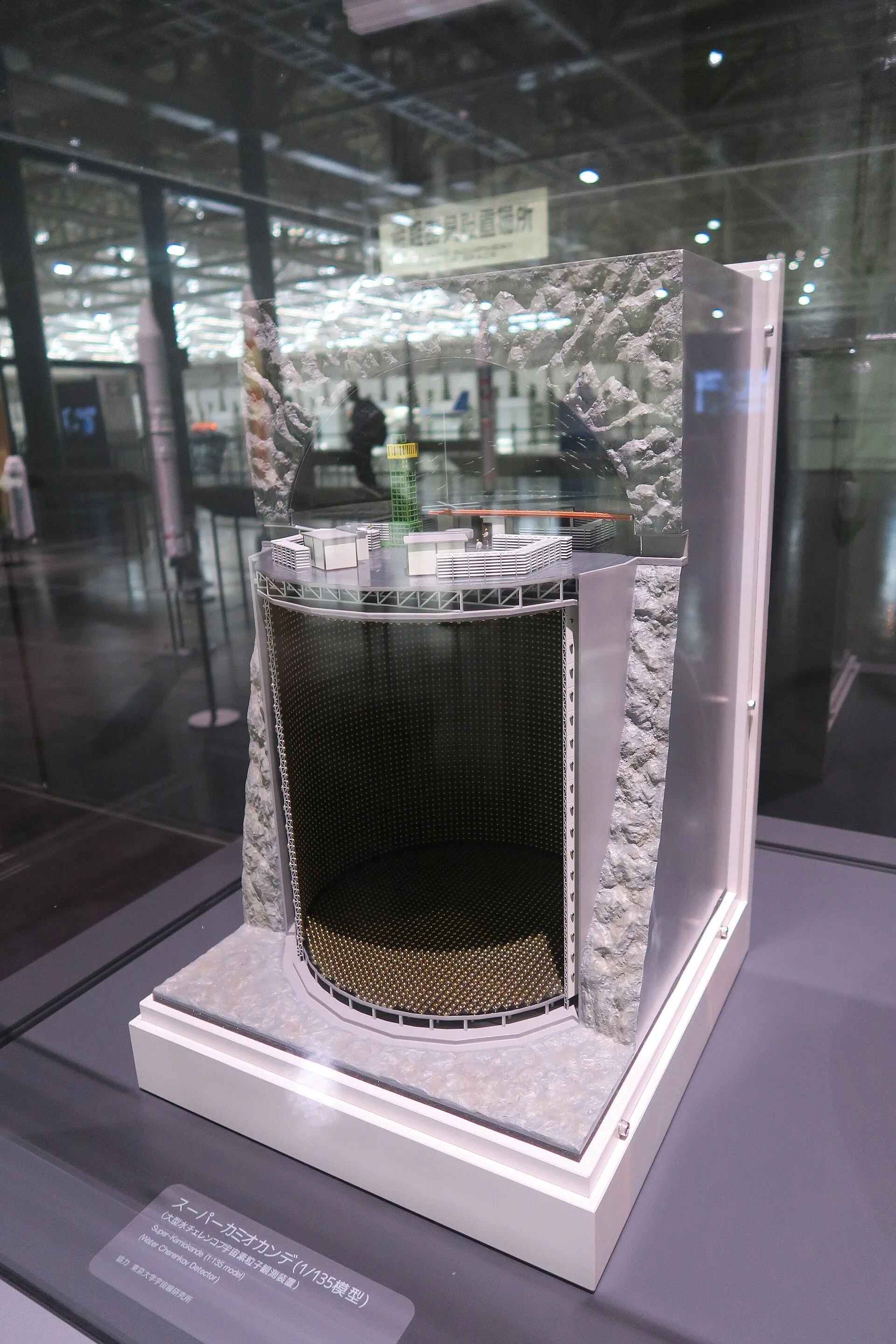
Super-Kamiokande, operating since April 1996 with 50,000 tonnes of ultrapure water about 1,000 m underground in Kamioka, searched for it for many years but could set only upper limits. The main obstacles were atmospheric neutrinos and events from cosmic-ray muons that break up oxygen nuclei, so-called spallation. In 2020 the collaboration began dissolving gadolinium in the water, with a second addition in 2022, an idea proposed by John Beacom and Mark Vagins (see gadolinium loading).
What happened
Electron antineutrinos interact in water mainly by inverse beta decay, producing a positron and a neutron. Gadolinium captures the neutron with very high probability and emits a gamma cascade, so a genuine event shows up as a pair of signals. This neutron tagging greatly improved background rejection.
On 25 June 2026, at the Neutrino 2026 conference at the University of California, Irvine, the collaboration presented an analysis of about 5,000 days of data: 3,349 days of pure-water running from 2008 to 2020 and 1,653 days with gadolinium since 2020. It found an excess of events in the neutrino energy range from 13.3 to 81.3 MeV, with a significance of 2.6σ, corresponding to 99.5 percent confidence.
The flux is consistent with several theoretical models; for example, a 2009 model by Horiuchi and colleagues with a 6 MeV neutrino temperature predicts 2.1 to 3.9 cm⁻² s⁻¹.
Reaction
In a press release by the Institute for Cosmic Ray Research of the University of Tokyo on 26 June 2026, spokesperson Hiroyuki Sekiya called the result "a deeply meaningful achievement". He stressed that "additional data accumulation and further improvements in analysis are essential for definitive detection" and said: "We will continue observations at Super-Kamiokande and work toward a conclusive detection." The collaboration describes the result as an indication, not a discovery, since 2.6σ is far below the 5σ threshold.
Why it matters
A confirmed detection would give a new way to study the history of star formation, the production of heavy elements and the formation of neutron stars and black holes, averaged over the whole Universe rather than over a single explosion. Super-Kamiokande continues to collect gadolinium data, and its successor Hyper-Kamiokande is expected to improve the sensitivity substantially. See also supernova signal phases.
Frequently asked questions
What is the diffuse supernova neutrino background?
The combined flux of neutrinos from all core-collapse supernovae throughout cosmic history, a faint and steady signal arriving from all directions.
Has the supernova neutrino background been discovered?
Not yet. Super-Kamiokande reported a first indication at 2.6σ in June 2026; a discovery requires 5σ.
Why did gadolinium help?
Gadolinium captures the neutron from inverse beta decay and emits a gamma cascade, so real antineutrino events can be separated from most backgrounds.
Concepts
Last updated: · Editorial standard
Cite this page
Text
Neutrino Atlas (2026). “2026: Super-Kamiokande sees a first hint of the supernova neutrino background”. Retrieved 22 November 2026, from https://neutrino-atlas.com/timeline/2026-super-k-dsnb-indication/BibTeX
@misc{neutrinoatlas20262026superkdsnbindication,
  title        = {2026: Super-Kamiokande sees a first hint of the supernova neutrino background},
  author       = {{Neutrino Atlas}},
  year         = {2026},
  url          = {https://neutrino-atlas.com/timeline/2026-super-k-dsnb-indication/},
  note         = {Accessed 2026-11-22},
  language     = {english}
}