2025Experiment
JUNO begins data taking
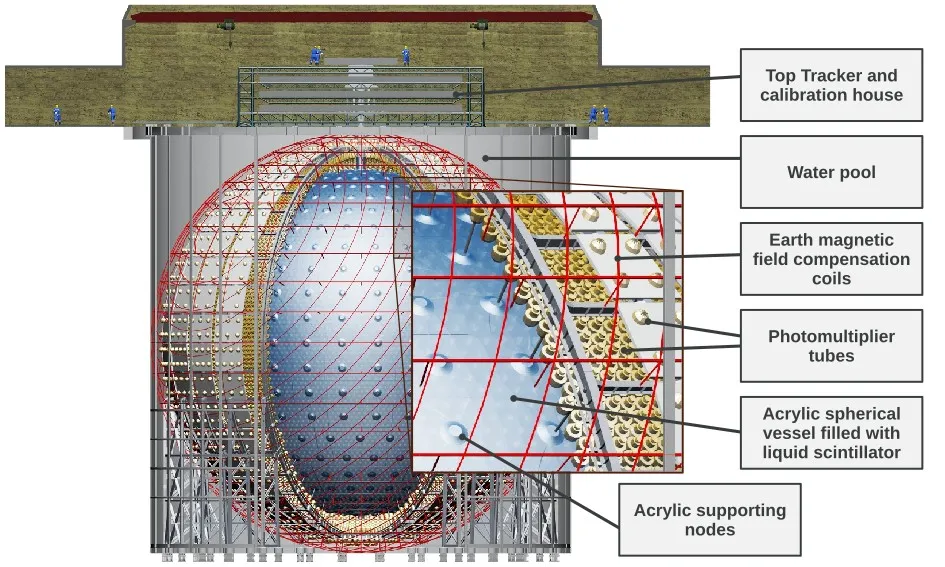
The Jiangmen Underground Neutrino Observatory in southern China began physics data taking on 26 August 2025, after filling its 35 m acrylic sphere with 20,000 tonnes of liquid scintillator. Viewed by about 17,600 large and 25,600 small photomultipliers, it sits 700 m underground and about 52.5 km from two nuclear power plants. JUNO's main goal is to determine the neutrino mass ordering from the fine structure of the reactor antineutrino spectrum, with unprecedented 3 percent energy resolution.
- Date
- 26 August 2025
- Kind of event
- Experiment
- People involved
- Wang Yifang, Cao Jun (Jun Cao)
- Experiments
- JUNO
The situation before
By the 2020s all three mixing angles and both mass splittings were known, but the sign of the large splitting, the mass ordering, was not. In 2008 physicists at the Institute of High Energy Physics in Beijing, fresh from the design of the Daya Bay experiment, proposed a different route: measure reactor antineutrinos at a distance of about 53 km, where the fast oscillation driven by Δm²31 rides on the slow solar oscillation. The fine ripples in the energy spectrum depend slightly on the ordering, without relying on matter effects.
The catch was precision. To resolve the ripples, a detector needed an energy resolution of about 3 percent at 1 MeV, far better than any large liquid scintillator detector had achieved. The Chinese Academy of Sciences and Guangdong Province approved JUNO in 2013, and underground construction near Jiangmen began in 2015, led by Wang Yifang and Cao Jun.
What happened
Detector installation ran from December 2021 to December 2024. The core is an acrylic sphere 35.4 m in diameter, held by a 41.1 m stainless-steel truss and surrounded by about 17,600 large 20-inch and 25,600 small 3-inch photomultipliers. The whole assembly sits in a 44 m deep water pool that shields it and tags cosmic muons.
Filling began with about 60,000 tonnes of ultrapure water over roughly 45 days, followed by about six months of filling the sphere with 20,000 tonnes of liquid scintillator while the water was displaced in step. During filling, the OSIRIS pre-detector contributed by Mainz monitored the radiopurity of the liquid.
On 26 August 2025 IHEP announced that filling was complete and physics data taking had begun. Wang Yifang called it "a historic milestone".
- Depth: about 700 m of rock overburden
- Distance: about 52.5 km from the Taishan and Yangjiang nuclear power plants
- Target: 20,000 tonnes of liquid scintillator
- Collaboration: more than 700 researchers from 74 institutions in 17 countries and regions
Why it matters
JUNO is the first of the next-generation neutrino observatories to start. Its primary aim is to determine the mass ordering at about 3σ within roughly six years, independently of the accelerator experiments DUNE and Hyper-Kamiokande. It will also measure θ12, Δm²21 and Δm²31 to below one percent, and study solar, atmospheric, supernova and geoneutrinos. A small satellite detector, TAO, close to one reactor will measure the unoscillated spectrum in fine detail.
The detector proved itself quickly: less than three months later, on 19 November 2025, JUNO presented its first physics results with record precision on the solar oscillation parameters.
Frequently asked questions
When did JUNO start?
JUNO began physics data taking on 26 August 2025, after filling its detector with 20,000 tonnes of liquid scintillator.
What is JUNO's main goal?
To determine the neutrino mass ordering from the fine structure of the reactor antineutrino spectrum at about 52.5 km.
Why is energy resolution so important for JUNO?
The ordering shows up as small ripples in the spectrum, which can only be resolved with a resolution of about 3 percent at 1 MeV.
Original papers
- ProposalF. An et al. (JUNO Collaboration), Neutrino physics with JUNO, J. Phys. G 43, 030401 (2016)DOI 10.1088/0954-3899/43/3/030401
- ProposalA. Abusleme et al. (JUNO Collaboration), JUNO physics and detector, Prog. Part. Nucl. Phys. 123, 103927 (2022)DOI 10.1016/j.ppnp.2021.103927arXiv:2104.02565
Concepts
Mentioned in 3 pages
Last updated: · Editorial standard
Cite this page
Text
Neutrino Atlas (2026). “2025: JUNO begins data taking”. Retrieved 22 November 2026, from https://neutrino-atlas.com/timeline/2025-juno-starts/BibTeX
@misc{neutrinoatlas2026timeline2025junostarts,
  title        = {2025: JUNO begins data taking},
  author       = {{Neutrino Atlas}},
  year         = {2026},
  url          = {https://neutrino-atlas.com/timeline/2025-juno-starts/},
  note         = {Accessed 2026-11-22},
  language     = {english}
}