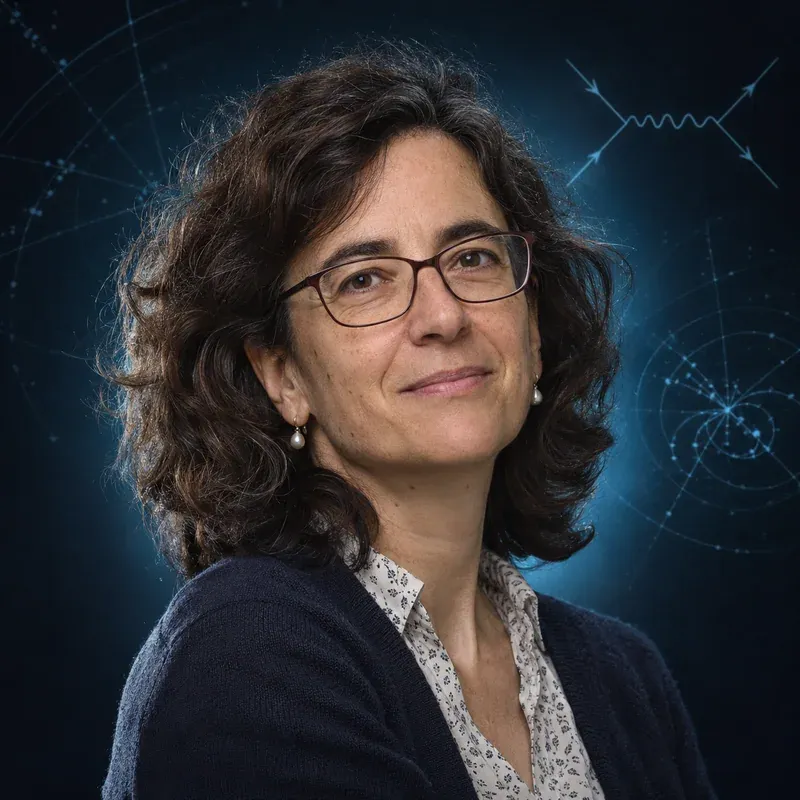
 Illustration
M. Concepción (Concha) González-García
González-García is a leading author of global analyses of solar, atmospheric, reactor and accelerator neutrino data, including the NuFIT fits widely used as reference values for three-flavour mixing parameters, the mass ordering and leptonic CP violation. She has also constrained non-standard neutrino interactions, including with coherent elastic neutrino-nucleus scattering data.
- Nationality
- Spanish
- Field
- Neutrino phenomenology; collider phenomenology
- Institutions
- University of Valencia / IFIC, CERN Theory Division, C. N. Yang Institute, Stony Brook University, ICREA – University of Barcelona
Education and career
María Concepción González-García, known to colleagues as Concha, is a Spanish theoretical physicist. She received her PhD in theoretical particle physics from the University of Valencia in 1991. After postdoctoral work at the University of Wisconsin–Madison and a fellowship in the Theory Division at CERN, she became a tenured scientist of the Spanish research council CSIC in 1993 and from 1996 worked at IFIC in Valencia, where she was later promoted to full research professor.
In 2003 she joined the C. N. Yang Institute for Theoretical Physics at Stony Brook University in New York, where she is a professor. Since 2006 she has also been an ICREA research professor at the University of Barcelona, so she divides her work between the United States and Spain. Her research spans neutrino phenomenology, astroparticle physics and collider phenomenology.
Key contributions
Her work centres on what the full body of neutrino data can tell us about the underlying theory. Around 2000, when the solar neutrino problem and the atmospheric muon-neutrino deficit had to be interpreted together, she was among the theorists who carried out combined analyses of solar, atmospheric and reactor data. In 2003 she and Yosef Nir published “Neutrino masses and mixing: evidence and implications” in Reviews of Modern Physics, and in 2008 she and Michele Maltoni published “Phenomenology with massive neutrinos” in Physics Reports. Both reviews became standard introductions for graduate students and researchers entering the field.
Since 2012 she has been one of the leading members, with Maltoni, Thomas Schwetz and others, of the NuFIT collaboration. NuFIT performs a global fit of all relevant oscillation data, from solar and atmospheric experiments to reactor and long-baseline accelerator experiments such as T2K and NOvA, and also IceCube atmospheric data. It publishes the allowed ranges of the three mixing angles, the two mass-squared differences and the CP phase δCP, together with the full statistical information, so that experimenters and model builders can use the results directly. Alongside the Bari group of Gianluigi Fogli and Eligio Lisi and the Valencia group of José Valle, NuFIT is one of the main reference fits of the field.
In numbers
The NuFIT 6.0 analysis of data up to September 2024 found that the octant of θ23 is still undetermined and that, for normal ordering, the data are consistent with CP conservation within one standard deviation. Without Super-Kamiokande atmospheric data the two mass orderings fit almost equally well; adding them gives a preference for normal ordering with Δχ² = 6.1. Results like these show how far the field has come and which questions remain open for DUNE, Hyper-Kamiokande and JUNO.
Beyond the standard picture
González-García has also used global data to test physics beyond three-flavour oscillations. With collaborators she has constrained non-standard neutrino interactions, including with data from coherent elastic neutrino–nucleus scattering measured by COHERENT, and studied what high-energy neutrino telescopes such as IceCube can reveal about neutrino properties and new interactions.
Known for
- NuFIT global analyses of neutrino oscillation data
- Non-standard neutrino interactions
- Review 'Neutrino masses and mixing: evidence and implications' (with Nir)
Chronology
- 1991PhD, University of Valencia
- 2001Joins Stony Brook faculty
- 2003Review with Y. Nir in Rev. Mod. Phys.
Original papers
- M. C. Gonzalez-Garcia, Y. Nir, Neutrino masses and mixing: evidence and implications, Rev. Mod. Phys. 75, 345 (2003)DOI 10.1103/RevModPhys.75.345
- I. Esteban, M. C. Gonzalez-Garcia, M. Maltoni, T. Schwetz, A. Zhou, The fate of hints: updated global analysis of three-flavor neutrino oscillations, JHEP 09, 178 (2020)
Experiments
Connected people
Frequently asked questions
What is NuFIT?
A global analysis of neutrino oscillation data, maintained by González-García, Maltoni, Schwetz and collaborators, that provides reference values and uncertainties for the mixing angles, mass splittings and CP phase.
Where does Concha González-García work?
She is a professor at the C. N. Yang Institute for Theoretical Physics at Stony Brook University and an ICREA research professor at the University of Barcelona.
Mentioned in 7 pages
Last updated: · Editorial standard
Cite this page
Text
Neutrino Atlas (2026). “M. Concepción (Concha) González-García”. Retrieved 22 November 2026, from https://neutrino-atlas.com/people/concha-gonzalez-garcia/BibTeX
@misc{neutrinoatlas2026opleconchagonzalezgarcia,
  title        = {M. Concepción (Concha) González-García},
  author       = {{Neutrino Atlas}},
  year         = {2026},
  url          = {https://neutrino-atlas.com/people/concha-gonzalez-garcia/},
  note         = {Accessed 2026-11-22},
  language     = {english}
}