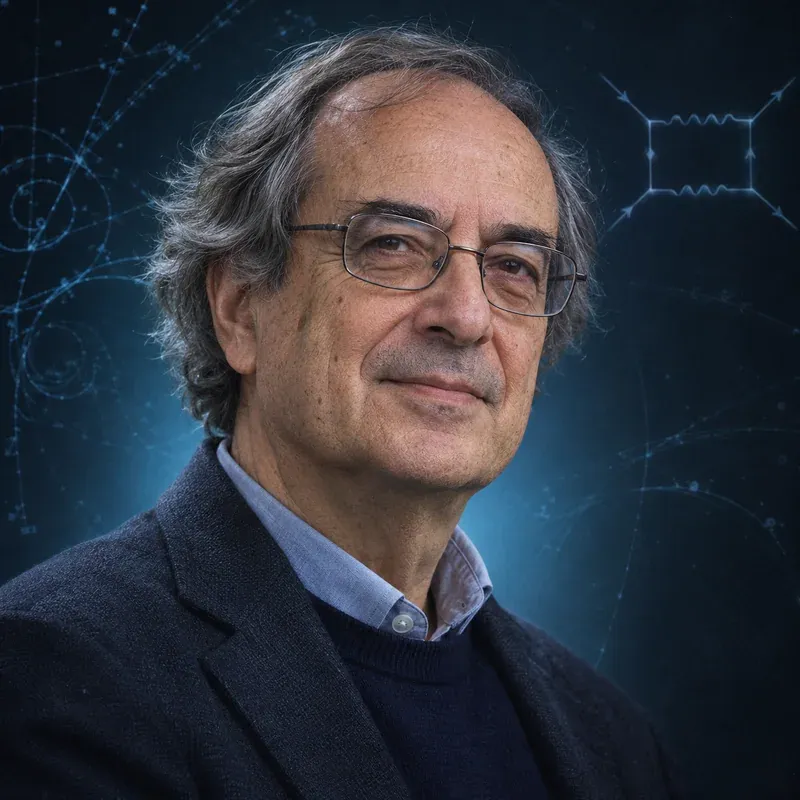
 Illustration
José W. F. Valle
With Joseph Schechter, Valle gave in 1980 the first general analysis of neutrino mass generation in SU(2)×U(1) theories, including seesaw variants with Higgs triplets. Their 1982 theorem shows that observing neutrinoless double beta decay would imply that neutrinos are Majorana particles, whatever mechanism drives the decay. His Valencia group also contributed to global analyses of oscillation data and to the interpretation of solar and atmospheric oscillations.
- Born
- 2 June 1953
Brazil - Nationality
- Spanish (Brazilian-born)
- Field
- Neutrino theory and phenomenology
- Institutions
- Syracuse University (PhD 1982), Rutherford Appleton Laboratory, IFIC Valencia (CSIC – University of Valencia)
Education and career
José Wagner Furtado Valle was born in Brazil on 2 June 1953 and later became a Spanish citizen. He obtained his PhD in theoretical physics at Syracuse University in New York in 1982. In January 1983 he became a research associate at the Rutherford Appleton Laboratory in England; in 1986 he moved to Spain as a visiting professor at the Autonomous University of Barcelona, and in 1987 he joined the Instituto de Física Corpuscular (IFIC) in Valencia, a joint centre of the Spanish research council CSIC and the University of Valencia. There he became a full research professor of the CSIC and a founding member of the Astroparticles and High Energy Physics (AHEP) group. He is now research professor ad honorem at IFIC.
Key contributions
Valle's best-known results come from his collaboration with Joseph Schechter while he was a graduate student. Their 1980 paper gave a general treatment of how neutrino masses arise in the electroweak theory, covering the type-I and type-II seesaw structures and showing that Majorana neutrinos bring extra Majorana phases into the lepton mixing matrix. Their 1982 “black-box” theorem shows that an observation of neutrinoless double beta decay implies a Majorana neutrino mass, whatever process drives the decay. This is why experiments such as GERDA, KamLAND-Zen and LEGEND are read as tests of the Dirac-or-Majorana question.
With Rabindra Mohapatra he proposed in 1986 what is now called the inverse seesaw. In the standard seesaw mechanism light neutrino masses require very heavy partners far beyond the reach of accelerators. In the inverse seesaw the small neutrino mass is instead controlled by a small parameter that breaks lepton number, so the heavy states can be light enough, around the TeV scale or below, to be searched for at colliders as heavy neutral leptons. Valle and his collaborators also studied neutrino masses from spontaneous lepton-number breaking, in which a Goldstone boson called the majoron appears, and radiative mass models in which masses arise from loop diagrams.
Oscillation phenomenology
Valle was an early advocate of non-standard neutrino interactions: he showed in the late 1980s that flavour-changing interactions with matter could convert neutrinos resonantly even without masses, an alternative that solar and atmospheric data later helped to exclude as the main explanation. His group contributed to the correct interpretation of the solar and atmospheric oscillation data that the 2015 Nobel Prize recognised. From the 2000s the Valencia group, with Thomas Schwetz, Mariam Tórtola and others, produced one of the three widely used global fits of oscillation data, alongside the Bari group of Gianluigi Fogli and NuFIT with Concha González-García.
Recognition
Valle received the Iberdrola Science and Technology Prize for theoretical physics in 1999, a Humboldt Research Award in 2002, the medal of the Mexican Physical Society in 2014 and the Premio México de Ciencia y Tecnología in 2018. In 2025 the CSIC awarded him its Margarita Salas Medal for supervising researchers: he has supervised or co-supervised 22 doctoral theses at the University of Valencia since 1990, and from 2000 to 2004 he coordinated a European research training site on particle physics beyond the Standard Model. He is the author of the textbook “Neutrinos in High Energy and Astroparticle Physics”.
Known for
- Schechter–Valle analysis of neutrino mass generation (1980)
- Schechter–Valle (black-box) theorem (1982)
- Global oscillation fits (Valencia group)
Chronology
- 1980Schechter–Valle 'Neutrino masses in SU(2)⊗U(1) theories'
- 1982Schechter–Valle theorem on neutrinoless double beta decay
- 1987Moves to IFIC Valencia
- 2002Humboldt Prize
Original papers
- J. Schechter, J. W. F. Valle, Neutrino masses in SU(2)⊗U(1) theories, Phys. Rev. D 22, 2227 (1980)DOI 10.1103/PhysRevD.22.2227
- J. Schechter, J. W. F. Valle, Neutrinoless double-β decay in SU(2)×U(1) theories, Phys. Rev. D 25, 2951 (1982)DOI 10.1103/PhysRevD.25.2951
- T. Schwetz, M. Tórtola, J. W. F. Valle, Three-flavour neutrino oscillation update, New J. Phys. 10, 113011 (2008)
Experiments
Connected people
Frequently asked questions
What is José Valle known for?
For the Schechter–Valle analysis of neutrino mass generation (1980), the Schechter–Valle theorem linking neutrinoless double beta decay to Majorana masses (1982), the inverse seesaw with Mohapatra (1986), and the Valencia global fits of oscillation data.
On the timeline
Mentioned in 16 pages
Milestones 1
Last updated: · Editorial standard
Cite this page
Text
Neutrino Atlas (2026). “José W. F. Valle”. Retrieved 22 November 2026, from https://neutrino-atlas.com/people/jose-valle/BibTeX
@misc{neutrinoatlas2026peoplejosevalle,
  title        = {José W. F. Valle},
  author       = {{Neutrino Atlas}},
  year         = {2026},
  url          = {https://neutrino-atlas.com/people/jose-valle/},
  note         = {Accessed 2026-11-22},
  language     = {english}
}