2025Experiment
NOvA and T2K publish a joint analysis
In Nature in October 2025, the rival long-baseline experiments NOvA and T2K published their first joint oscillation analysis, combining about ten years of T2K data and six years of NOvA data. By fitting both together, with their different baselines and energies, they measured the atmospheric mass splitting to better than 2 percent. The mass ordering remained undetermined, but for the inverted ordering the data strongly favour CP violation.
- Date
- 2025
- Kind of event
- Experiment
- People involved
- Mark D. Messier, Takashi Kobayashi
The situation before
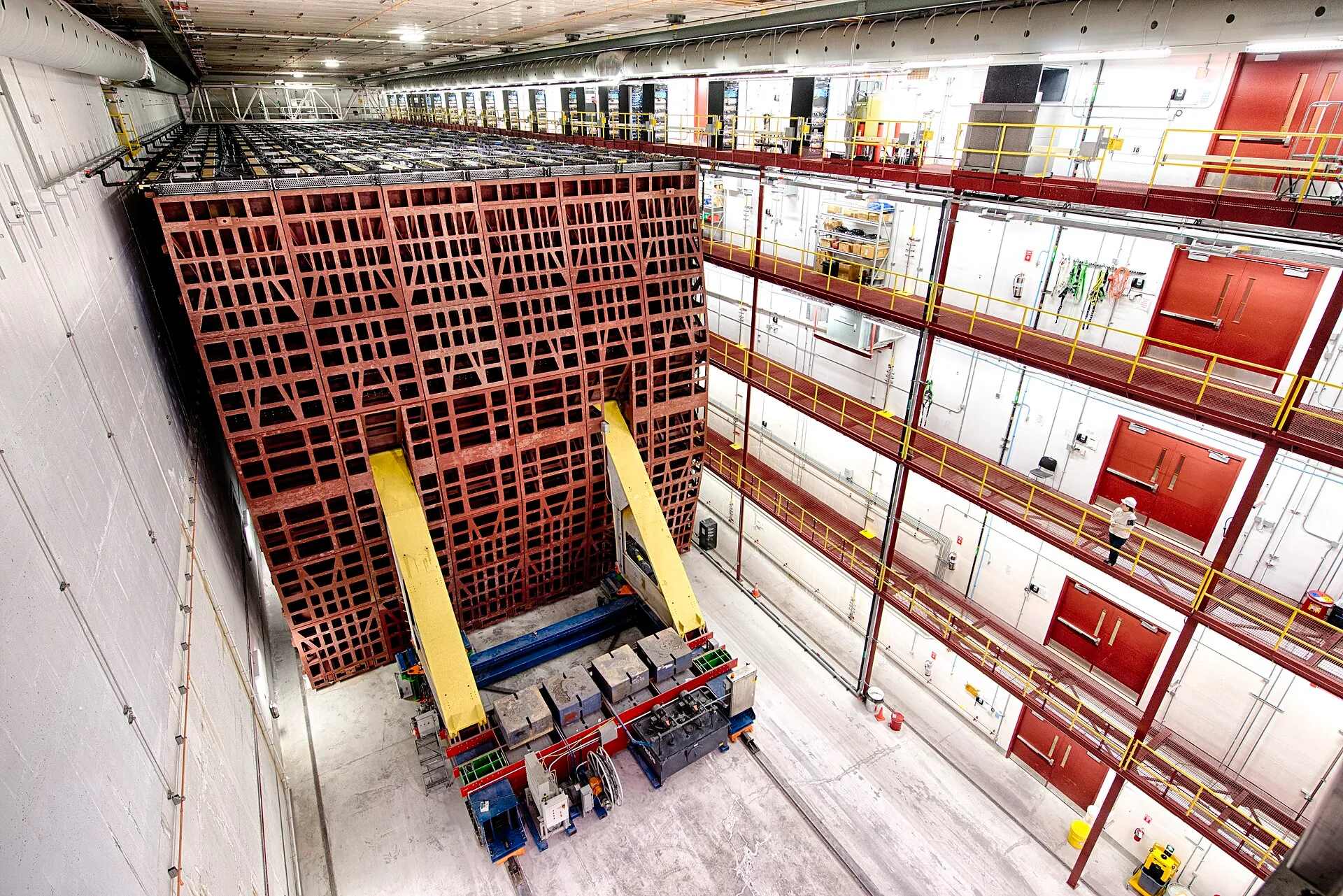
T2K in Japan and NOvA in the United States are the two long-baseline accelerator experiments of the 2010s. T2K sends a beam of about 0.6 GeV from J-PARC 295 km to Super-Kamiokande; NOvA sends a beam of about 2 GeV from Fermilab 810 km to a detector at Ash River, Minnesota. Both measure how muon neutrinos turn into electron neutrinos, which depends on the CP phase δCP and on the mass ordering.
Separately, their results did not fit neatly together. Assuming normal ordering, T2K favoured δCP near −π/2, close to maximal CP violation, while NOvA preferred values that overlapped only partly. Because the longer NOvA baseline feels stronger matter effects, the two experiments respond differently to the ordering, and only a joint fit with full treatment of correlations could show whether they agree.
What happened
The two collaborations, in which Mark Messier of NOvA and Takashi Kobayashi of T2K had long held leading roles, formed a joint working group to combine their likelihoods in a single Bayesian analysis. It used about ten years of T2K data collected since 2010 and six years of NOvA data collected since 2014, up to 2020, and was published in Nature on 22 October 2025.
The atmospheric mass splitting was determined to better than 2 percent in either ordering. The data showed no strong preference for an ordering: the Bayes factor was 1.3 in favour of inverted ordering when reactor constraints on θ13 were included. For inverted ordering, the CP-conserving values δCP = 0 and π lay outside the 3σ interval, and so did a vanishing Jarlskog invariant. For normal ordering, a wide range of δCP remained allowed.
Reaction
The result was welcomed as a model of cooperation between rival experiments. It also clarified the earlier tension: in inverted ordering both experiments point to large CP violation, while in normal ordering they continue to prefer somewhat different values. The status remains open, because the answer depends on the ordering.
Consequences
Determining the ordering is therefore the key to the CP question. JUNO, which began data taking in August 2025, aims to measure it with reactor neutrinos, and atmospheric data from Super-Kamiokande and IceCube add independent information. Both collaborations continue to collect data, and the method of joint fitting is a template for combining the next generation, DUNE and Hyper-Kamiokande, which plan to reach 5σ sensitivity to CP violation for a large range of δCP. See also global fits.
Frequently asked questions
What did the NOvA–T2K joint analysis find?
It measured the atmospheric mass splitting to better than 2 percent and found that, if the ordering is inverted, CP conservation is excluded at 3σ.
Why combine NOvA and T2K?
Their different baselines and energies respond differently to matter effects, so a joint fit separates the effects of the ordering and the CP phase better than either alone.
Does the result determine the mass ordering?
No. The data show only a weak preference for inverted ordering; the question remains open.
Original papers
- MeasurementT2K and NOvA Collaborations, Joint neutrino oscillation analysis from the T2K and NOvA experiments, Nature 646, 818 (2025)DOI 10.1038/s41586-025-09599-3arXiv:2510.19888
Concepts
Mentioned in 3 pages
Last updated: · Editorial standard
Cite this page
Text
Neutrino Atlas (2026). “2025: NOvA and T2K publish a joint analysis”. Retrieved 22 November 2026, from https://neutrino-atlas.com/timeline/2025-nova-t2k-joint/BibTeX
@misc{neutrinoatlas2026timeline2025novat2kjoint,
  title        = {2025: NOvA and T2K publish a joint analysis},
  author       = {{Neutrino Atlas}},
  year         = {2026},
  url          = {https://neutrino-atlas.com/timeline/2025-nova-t2k-joint/},
  note         = {Accessed 2026-11-22},
  language     = {english}
}