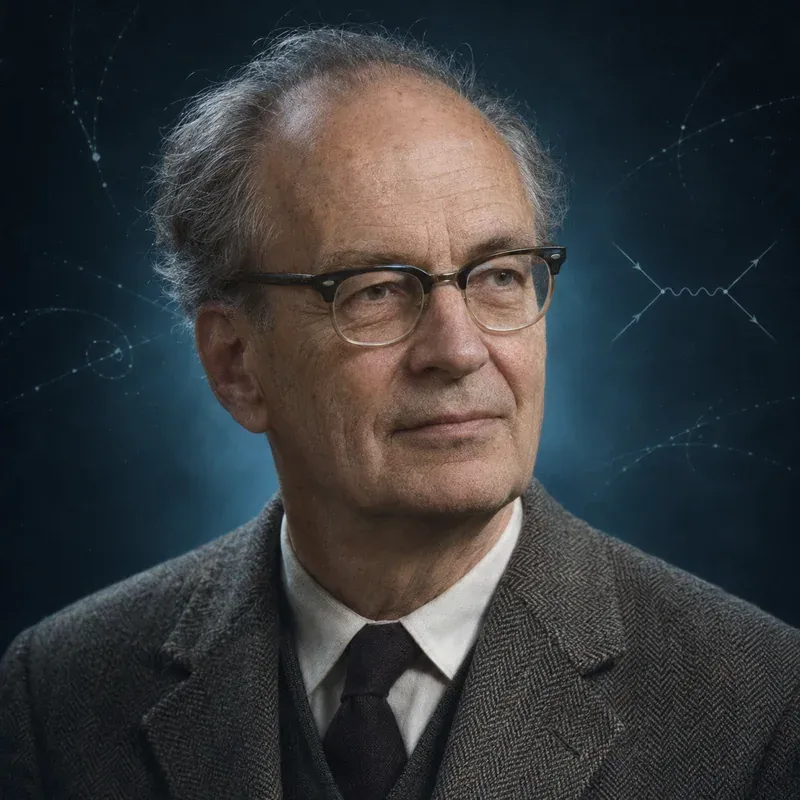
 Illustration
Albrecht Karle
Karle has worked on neutrino telescopes in the Antarctic ice since the AMANDA era, which in 2001 demonstrated that deep glacial ice can serve as a Cherenkov detector for high-energy neutrinos. At IceCube he led the optical-sensor and instrumentation work during construction and has been Associate Director for Science and Instrumentation since 2005, a period that includes the discovery of the astrophysical neutrino flux. He is principal investigator of the IceCube Upgrade, which adds densely instrumented strings to improve calibration and low-energy oscillation measurements, and of the Askaryan Radio Array for ultra-high-energy neutrinos. He also contributes to the design of IceCube-Gen2.
- Nationality
- German
- Field
- Experimental neutrino astronomy
- Institutions
- University of Munich (Diplom 1990, PhD 1994), Max Planck Institute for Physics, Munich, DESY Zeuthen (1995–1997), University of Wisconsin–Madison (from 1997; professor from 2005)
Path to neutrino astronomy
Albrecht Karle studied physics at the University of Munich, where he received his Diplom in 1990 and his doctorate in 1994, working as a research assistant at the Max Planck Institute for Physics. In 1995 he moved to DESY Zeuthen near Berlin, a major partner in the AMANDA neutrino telescope at the South Pole, and in 1997 to the University of Wisconsin–Madison, the lead institution of the project. He became professor of physics there in 2005.
From AMANDA to IceCube
AMANDA lowered strings of photomultipliers into holes melted into the glacier to record the Cherenkov light of muons produced by neutrinos coming up through the Earth. Its 2001 report in Nature showed that the deep Antarctic ice is clear enough to work as a detector, the basis for a cubic-kilometre successor. Karle was among those who turned this concept into hardware: he managed the optical sensors and strings and later all instrumentation during the construction of IceCube, whose 5,160 digital optical modules were deployed between 2005 and 2010. He has spent 14 field seasons at the South Pole.
Since 2005 Karle has been IceCube's Associate Director for Science and Instrumentation. In this period the detector found the first high-energy astrophysical neutrinos in 2013, linked a neutrino to the blazar TXS 0506+056 in 2017 and measured atmospheric oscillations with its dense core, DeepCore.
Next-generation detectors
Karle is principal investigator of the IceCube Upgrade, seven new densely instrumented strings that improve the calibration of the ice and the precision of low-energy measurements. Beyond optical detection, he led the Askaryan Radio Array, funded in 2010, which listens for radio pulses from ultra-high-energy neutrinos (see radio detection). Both feed into the design of IceCube-Gen2, which would combine a larger optical array with a radio detector.
Known for
- IceCube Associate Director for Science and Instrumentation (from 2005)
- Development and deployment of AMANDA and IceCube optical sensors
- Principal investigator of the IceCube Upgrade
- Principal investigator of the Askaryan Radio Array (ARA)
- IceCube-Gen2 planning
Chronology
- 1994PhD, University of Munich
- 1995Postdoc at DESY Zeuthen
- 1997Joins the University of Wisconsin–Madison
- 2001AMANDA demonstrates neutrino detection in Antarctic ice
- 2005IceCube Associate Director for Science and Instrumentation
- 2009Fellow of the American Physical Society
- 2010Askaryan Radio Array funded with Karle as PI
Original papers
- E. Andres et al. (AMANDA), Observation of high-energy neutrinos using Čerenkov detectors embedded deep in Antarctic ice, Nature 410, 441 (2001)DOI 10.1038/35068509
- IceCube Collaboration, Evidence for High-Energy Extraterrestrial Neutrinos at the IceCube Detector, Science 342, 1242856 (2013)DOI 10.1126/science.1242856
Experiments
Connected people
Frequently asked questions
What is Albrecht Karle's role in IceCube?
He has been IceCube's Associate Director for Science and Instrumentation since 2005 and leads the IceCube Upgrade as principal investigator.
What is the Askaryan Radio Array?
A South Pole detector that searches for radio pulses produced when ultra-high-energy neutrinos interact in the ice; Karle was its principal investigator when it was funded in 2010.
Mentioned in 2 pages
FAQ 1
Milestones 1
Last updated: · Editorial standard
Cite this page
Text
Neutrino Atlas (2026). “Albrecht Karle”. Retrieved 22 November 2026, from https://neutrino-atlas.com/people/albrecht-karle/BibTeX
@misc{neutrinoatlas2026peoplealbrechtkarle,
  title        = {Albrecht Karle},
  author       = {{Neutrino Atlas}},
  year         = {2026},
  url          = {https://neutrino-atlas.com/people/albrecht-karle/},
  note         = {Accessed 2026-11-22},
  language     = {english}
}