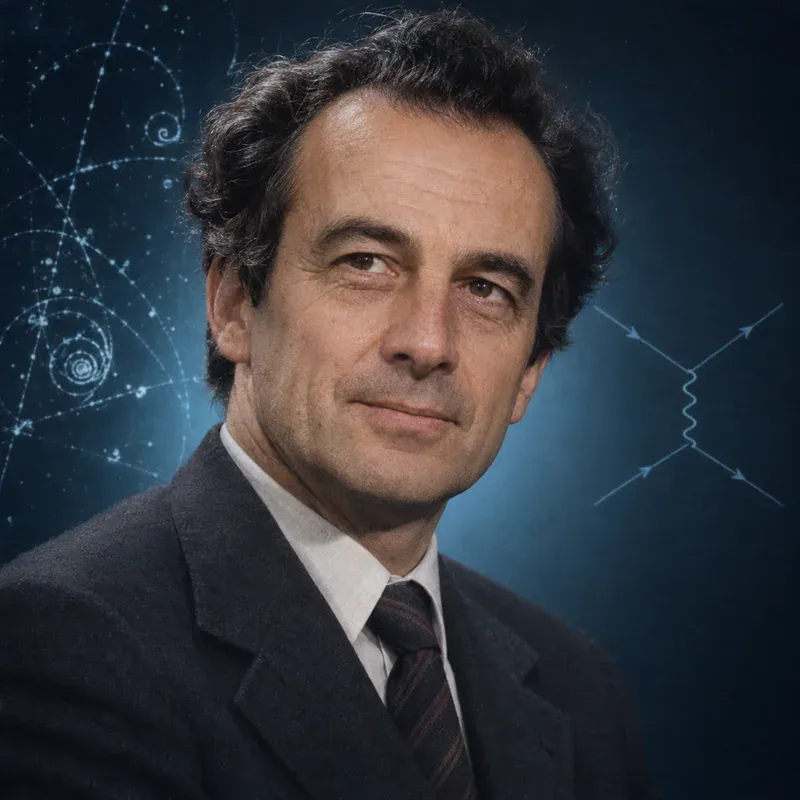
 Illustration
André Lagarrigue
In 1963 Lagarrigue proposed a large heavy-liquid bubble chamber for neutrino physics, and on 10 February 1964 he wrote the first Gargamelle proposal and assembled a seven-laboratory collaboration. Gargamelle, exposed to CERN's PS neutrino beam, discovered weak neutral currents in 1973, the first experimental evidence supporting electroweak unification and the Z boson.
- Born
- 1924
Aurillac, France - Died
- 14 January 1975
Orsay, France - Nationality
- French
- Field
- Experimental particle physics
- Institutions
- École Polytechnique, CERN, Laboratoire de l'Accélérateur Linéaire (LAL), Orsay, University of Orsay
Early life and education
André Lagarrigue was born in 1924 in Aurillac, in the Auvergne region of France. He entered the École Polytechnique in Paris in 1945, where he first specialised in weapons engineering. While still a student he took part in a cloud-chamber experiment to determine the mass of the muon, and this hands-on work drew him into experimental physics. He received his doctorate from the Sorbonne in 1952 with a thesis on the experimental properties of muon decay, a process in which, as later became clear, two neutrinos are emitted.
Path to neutrino physics
In 1954–55 Lagarrigue spent a sabbatical year at Berkeley, where he saw the experiments that large accelerators such as the Bevatron made possible. Back in France he turned to the bubble chamber, a vessel of superheated liquid in which charged particles leave trails of tiny bubbles that can be photographed. He became a specialist in heavy-liquid chambers, filled with dense liquids such as propane mixtures or freon. Their high density makes particle interactions more likely and lets photons convert into visible electron–positron pairs, so that both charged and neutral products of a collision can be reconstructed. At the École Polytechnique his group built a series of such chambers: BP1, a one-litre propane chamber, BP2 with 20 litres of propane and methyl iodide for Saclay, and BP3.
Neutrinos interact so rarely that a detector must contain as many tonnes of target material as possible while still showing every detail of an event. Heavy-liquid bubble chambers combined both. After a neutrino conference in 1963 Lagarrigue proposed building a very large chamber specifically for neutrino physics at CERN, and on 10 February 1964 he wrote the first proposal. He assembled a collaboration of seven laboratories: CERN, the École Polytechnique, LAL Orsay, and groups in Aachen, Brussels, Milan and London. In 1964 he also became professor at the University of Orsay.
Key contributions
The chamber, named Gargamelle after the giantess in Rabelais’ novels, was built at Saclay. It was 4.8 metres long, 2 metres in diameter and held about 12 cubic metres of liquid freon (CF₃Br). It was assembled at CERN in December 1970 and took data in the neutrino and antineutrino beams of the Proton Synchrotron from 1971.
At that time the electroweak theory of Sheldon Glashow, Steven Weinberg and Abdus Salam predicted, besides the known W-mediated processes, a neutral current: neutrinos should also scatter by exchanging a neutral boson, leaving the neutrino as a neutrino. Such events contain no outgoing muon, only a recoiling electron or a shower of hadrons, and they are easy to confuse with background from neutrons. In December 1972 a graduate student in Aachen found the first leptonic candidate, a single electron set in motion by an invisible particle, a muon antineutrino scattering off an electron. By March 1973 the collaboration had identified 166 hadronic events without a muon, and a careful analysis of the neutron background, in which Paul Musset and Donald Perkins were among the key figures, showed that they could not all be explained away.
The discovery of weak neutral currents was announced at a CERN seminar on 19 July 1973. After a period of controversy and cross-checks, including results from experiments at Fermilab, it was accepted in 1974. It was the first experimental support for the electroweak theory and the first indirect sign of the Z boson, which was observed directly at CERN in 1983. Gargamelle also measured neutrino deep inelastic scattering: together with electron-scattering results from SLAC, its data confirmed that quarks carry fractional charges of +2/3 and −1/3.
Later work and legacy
From 1969 Lagarrigue directed the Laboratoire de l’Accélérateur Linéaire at Orsay. Gargamelle moved to the higher-energy beams of the SPS in 1976 and was retired in 1979 after an irreparable crack appeared in its body. Lagarrigue did not see the end of the chamber’s life: he died of a heart attack on 14 January 1975, at about 50, as he left one of his lectures at the University of Orsay.
In 1975 he was posthumously awarded the Prix Ampère of the French Academy of Sciences. The French Physical Society later created the André Lagarrigue Prize, awarded each year to a senior experimental physicist working in France. An auditorium at the École Polytechnique, a street at CERN’s Prévessin site and a square at its Meyrin site bear his name.
Known for
- 'Father of Gargamelle'
- Discovery of weak neutral currents (1973)
- Director of LAL Orsay from 1969
Chronology
- 1964First Gargamelle proposal (10 February)
- 1969Director of LAL Orsay
- 1971Gargamelle first data run
- 1973Neutral currents announced at CERN (19 July)
Original papers
- F. J. Hasert et al. (Gargamelle), Observation of neutrino-like interactions without muon or electron in the Gargamelle neutrino experiment, Phys. Lett. B 46, 138 (1973)DOI 10.1016/0370-2693(73)90499-1
- F. J. Hasert et al. (Gargamelle), Search for elastic muon-neutrino electron scattering, Phys. Lett. B 46, 121 (1973)DOI 10.1016/0370-2693(73)90494-2
Experiments
Connected people
Frequently asked questions
Why is Lagarrigue called the father of Gargamelle?
He proposed the large heavy-liquid bubble chamber in 1963–64, wrote the first proposal on 10 February 1964 and assembled and led the international collaboration that built and used it.
What did Gargamelle discover?
In 1973 it discovered weak neutral currents, neutrino interactions in which no charged lepton is produced. This was the first experimental confirmation of electroweak unification.
Did André Lagarrigue win a Nobel Prize?
No. He died in January 1975, shortly after the discovery was confirmed, and the Nobel Prize is not awarded posthumously.
On the timeline
Mentioned in 13 pages
Lessons 1
Last updated: · Editorial standard
Cite this page
Text
Neutrino Atlas (2026). “André Lagarrigue”. Retrieved 22 November 2026, from https://neutrino-atlas.com/people/andre-lagarrigue/BibTeX
@misc{neutrinoatlas2026peopleandrelagarrigue,
  title        = {André Lagarrigue},
  author       = {{Neutrino Atlas}},
  year         = {2026},
  url          = {https://neutrino-atlas.com/people/andre-lagarrigue/},
  note         = {Accessed 2026-11-22},
  language     = {english}
}