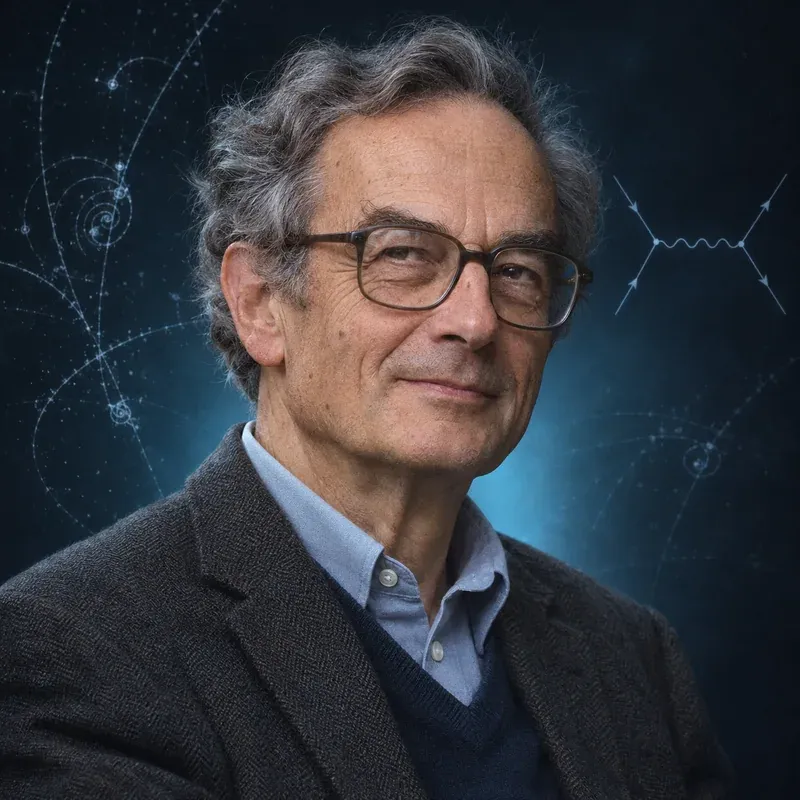
 Illustration
Paul Musset
Musset was a leading member of the Gargamelle collaboration that discovered weak neutral currents at CERN in 1973. With J. P. Vialle he wrote the standard 1978 review of the Gargamelle neutrino physics programme.
- Nationality
- French
- Field
- Experimental particle physics
- Institutions
- CERN
Background
Paul Musset was a French experimental particle physicist whose name is tied to Gargamelle, the giant heavy-liquid bubble chamber at CERN. Few biographical details about him are published; what the historical record shows clearly is his role in conceiving, running and summing up one of the most productive neutrino experiments of the 1970s.
Building Gargamelle
In the early 1960s neutrino experiments were starved of events, because neutrinos interact so rarely. André Lagarrigue, André Rousset and Paul Musset worked out a proposal for a much larger chamber filled with a dense liquid, so that many more neutrinos would interact inside it and the produced particles could be identified; the first report on the idea is dated February 1964. The result was a chamber 4.8 m long and 2 m in diameter holding 12 cubic metres of liquid freon (CF₃Br). It took its first data in March 1971 in the neutrino beam of the Proton Synchrotron. While Lagarrigue led the project as a whole, Rousset and Musset were in charge of Gargamelle at CERN.
Neutral currents and beyond
The collaboration of seven European laboratories searched for events in which a neutrino scatters but leaves no muon, the signature of the neutral current predicted by electroweak theory. By March 1973 they had found 166 such hadronic events, 102 in the neutrino beam and 64 with antineutrinos, plus a single leptonic event in which an antineutrino scattered off an electron. The discovery was presented at a CERN seminar on 19 July 1973, and Musset was among those strongly involved in it; the main difficulty was to exclude a background of neutrons entering the chamber from outside. Gargamelle went on to measure nucleon structure, finding that neutrino cross sections rise linearly with energy and supporting the quark picture of the nucleon, until a crack ended its operation in 1979.
The Gargamelle review
With J. P. Vialle, Musset wrote 'Neutrino Physics with Gargamelle' (1978), a review of more than a hundred pages that became the standard summary of the programme: neutral currents, charged-current structure functions, tests of the quark model and searches for new phenomena. It remains a key source for the history of the weak currents.
Known for
- Leading figure of the Gargamelle collaboration
- Co-author of the review 'Neutrino Physics with Gargamelle' (1978)
Chronology
- 1973Gargamelle discovery of neutral currents
- 1978Review 'Neutrino Physics with Gargamelle'
Original papers
- P. Musset, J. P. Vialle, Neutrino Physics with Gargamelle, in M. Jacob (ed.), Gauge Theories and Neutrino Physics, North-Holland, pp. 295–425 (1978)
Experiments
Connected people
Frequently asked questions
What was Paul Musset's role in Gargamelle?
He helped work out the original proposal with André Lagarrigue and André Rousset, was in charge of the chamber at CERN with Rousset, took part in the neutral-current discovery and wrote the 1978 review of its physics programme.
Why were neutral currents important?
They were a central prediction of the unified electroweak theory. Their discovery in 1973 was the first strong confirmation of that theory, a decade before the Z boson itself was observed.
On the timeline
Mentioned in 9 pages
Last updated: · Editorial standard
Cite this page
Text
Neutrino Atlas (2026). “Paul Musset”. Retrieved 22 November 2026, from https://neutrino-atlas.com/people/paul-musset/BibTeX
@misc{neutrinoatlas2026peoplepaulmusset,
  title        = {Paul Musset},
  author       = {{Neutrino Atlas}},
  year         = {2026},
  url          = {https://neutrino-atlas.com/people/paul-musset/},
  note         = {Accessed 2026-11-22},
  language     = {english}
}