1977Experiment
Rubbia proposes the liquid-argon TPC
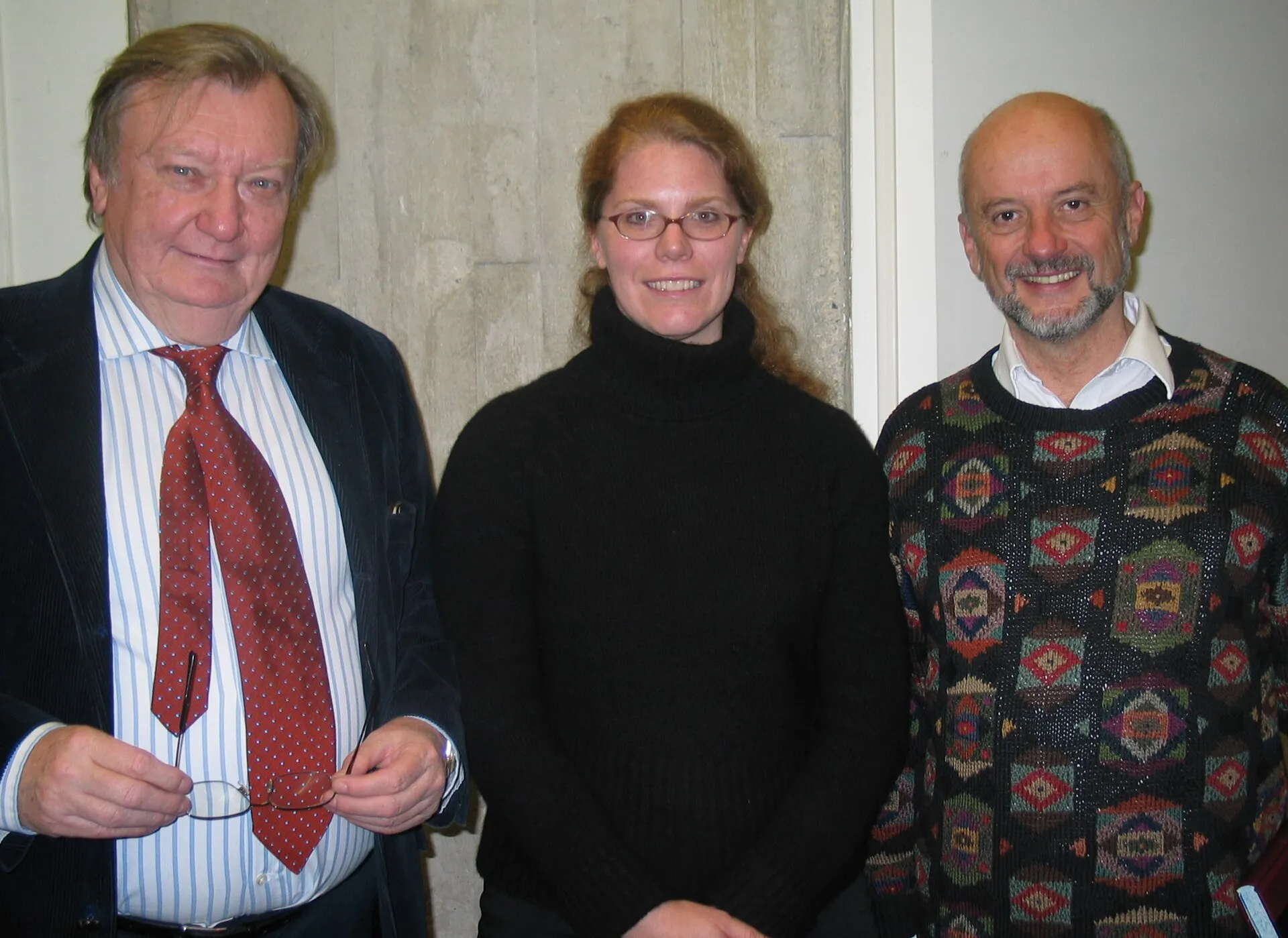
Carlo Rubbia proposed a liquid-argon time projection chamber, in which ionisation electrons drift through ultra-pure liquid argon to wire planes, producing bubble-chamber-quality three-dimensional images electronically. Herbert Chen and others developed similar ideas at about the same time. The technology was demonstrated by ICARUS and is now used by MicroBooNE, SBND and the DUNE far detectors.
- Date
- 1977
- Kind of event
- Experiment
- People involved
- Carlo Rubbia, Herbert H. Chen
- Experiments
- ICARUS, DUNE, MicroBooNE
The situation before
In the 1970s the best images of neutrino interactions came from bubble chambers such as Gargamelle, which recorded every charged track in fine detail but had to be photographed and scanned by hand, could not be triggered, and were limited to a few tens of tons. Electronic detectors could be large and fast, but gave much coarser pictures. Two developments pointed to a way of combining the advantages. In 1974 David Nygren at Berkeley invented the time projection chamber, in which ionisation electrons drift through a gas to a readout plane, giving a three-dimensional image from the drift time and the position on the plane. Around the same time William Willis and Veljko Radeka showed that liquid argon works well as an ionisation medium for calorimeters.
What happened
In May 1977 Carlo Rubbia at CERN wrote an internal report, "The liquid-argon time projection chamber: a new concept for neutrino detectors". He proposed filling a large volume with ultra-pure liquid argon, applying an electric field, and letting the ionisation electrons released along charged-particle tracks drift over long distances to planes of sense wires. Liquid argon is dense, about 1.4 g/cm³, so a detector of a given size has a large target mass; it is relatively cheap; and, unlike gas, it can provide many tons of target with bubble-chamber-quality imaging. It also produces scintillation light, which gives a fast trigger signal.
The main obstacle was purity. Electronegative impurities such as oxygen capture drifting electrons, so drifting them over metres requires impurity levels below about one part per billion. At about the same time Herbert H. Chen and colleagues at the University of California, Irvine, proposed a similar liquid-argon detector for neutrino experiments at Fermilab.
Development
Turning the idea into a working detector took decades. Rubbia's group built a series of prototypes, starting with small test chambers in the 1980s, then a 3-ton detector in 1991. The ICARUS T600 detector, with about 600 tons of liquid argon, was tested on the surface in Pavia in 2001 and operated at Gran Sasso from 2010 to 2012 in the CERN-to-Gran Sasso neutrino beam; it was later refurbished at CERN and moved to Fermilab, where it serves as the far detector of the Short-Baseline Neutrino programme. In the United States, ArgoNeuT and then MicroBooNE, which ran from 2015 to 2021, demonstrated the technique on the Booster beam, and SBND began taking data in 2024.
Why it matters
The liquid-argon TPC is now the chosen technology for the next generation of long-baseline experiments. The far detector of DUNE, to be installed about 1.5 km underground at the Sanford Underground Research Facility in South Dakota, will consist of modules each holding about 17,000 tons of liquid argon, with ProtoDUNE prototypes tested at CERN since 2018. Its fine imaging allows electrons to be separated from photons, essential for measuring electron-neutrino appearance, the mass ordering and CP violation. Rubbia, who shared the 1984 Nobel Prize for the discovery of the W and Z bosons, thus also laid the foundation for the main neutrino detector technology of the 2030s.
Frequently asked questions
Who invented the liquid-argon TPC?
Carlo Rubbia proposed it in a 1977 CERN report. Herbert Chen and colleagues developed a similar idea at about the same time.
Why liquid argon?
It is dense, relatively cheap and lets ionisation electrons drift over metres if it is very pure, giving detailed three-dimensional images of particle tracks in a large target mass.
Which experiments use the technology?
ICARUS, MicroBooNE, SBND, ProtoDUNE and the future DUNE far detectors.
Original papers
- ProposalC. Rubbia, The Liquid-Argon Time Projection Chamber: A New Concept for Neutrino Detectors, CERN-EP-INT-77-08 (1977)
Concepts
Mentioned in 1 page
Lessons 1
Last updated: · Editorial standard
Cite this page
Text
Neutrino Atlas (2026). “1977: Rubbia proposes the liquid-argon TPC”. Retrieved 22 November 2026, from https://neutrino-atlas.com/timeline/1977-rubbia-lar-tpc/BibTeX
@misc{neutrinoatlas2026timeline1977rubbialartpc,
  title        = {1977: Rubbia proposes the liquid-argon TPC},
  author       = {{Neutrino Atlas}},
  year         = {2026},
  url          = {https://neutrino-atlas.com/timeline/1977-rubbia-lar-tpc/},
  note         = {Accessed 2026-11-22},
  language     = {english}
}