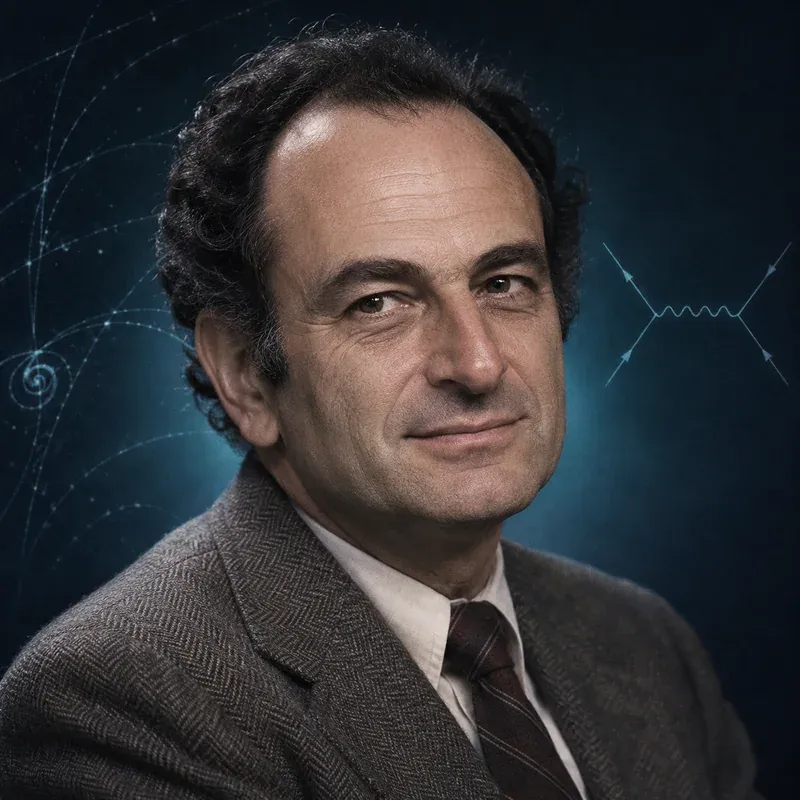
 Illustration
Melvin Schwartz
Schwartz proposed using high-energy neutrinos produced from pion decay at an accelerator to study the weak interaction, published in Physical Review Letters in 1960. He then realised the idea with Lederman and Steinberger in the 1962 Brookhaven experiment that discovered the muon neutrino.
- Born
- 2 November 1932
New York City, USA - Died
- 28 August 2006
Twin Falls, Idaho, USA - Nationality
- American
- Field
- Experimental particle physics
- Nobel Prize
- Physics 1988 – for the neutrino beam method and the demonstration of the doublet structure of the leptons through the discovery of the muon neutrino (shared with Lederman and Steinberger)
- Institutions
- Columbia University, Stanford University, Brookhaven National Laboratory
Early life and education
Melvin Schwartz was born in New York City in 1932 and spent the first part of his career at Columbia University, where he earned his bachelor's degree in 1953 and his PhD in 1958 under Jack Steinberger. Columbia in the 1950s was one of the centres of particle physics, and the department included Tsung-Dao Lee, who shared the 1957 Nobel Prize for the idea of parity violation.
Path to neutrino physics
By the late 1950s the weak interaction was known only at low energies, mostly from beta decay and the decays of pions and muons. Theorists wanted to know how it behaved at high energies, where the Fermi theory predicted cross sections that grow without limit. Studying it there directly would require colliding particles that feel only the weak force, and the only such particle available was the neutrino. In Schwartz's own account, given in his Nobel lecture, the question came up at a Columbia coffee-hour discussion around Lee in late 1959, and the solution occurred to him the same evening.
His idea was to make neutrinos with an accelerator. Protons striking a target produce large numbers of pions; if these pions are allowed to fly a short distance, many decay into muons and neutrinos. A thick shield then stops every particle except the neutrinos, leaving a beam of high-energy neutrinos aimed at a detector. Schwartz published the proposal in Physical Review Letters in 1960 under the title ‘Feasibility of using high-energy neutrinos to study the weak interactions’. Bruno Pontecorvo had arrived at a similar idea independently in the Soviet Union. Together these proposals founded the technique of the accelerator neutrino beam, on which much of neutrino physics has relied ever since.
Key contributions
Schwartz, Steinberger and Leon Lederman, with Gordon Danby and colleagues, put the idea to work at Brookhaven's new Alternating Gradient Synchrotron in 1961–62. Protons of 15 GeV hit a beryllium target, and the decay products passed through a wall of steel 13.5 metres thick, taken from the decommissioned battleship USS Missouri, which stopped everything but the neutrinos. Behind it stood a 10-ton aluminium spark chamber in which a neutrino interaction would show up as a visible track.
The experiment addressed a sharp question. A neutrino born together with a muon in pion decay could, when it interacted, produce either a muon or an electron. If there were only one kind of neutrino, both should appear in comparable numbers. The team found dozens of events with long, penetrating muon tracks and no clear sign of the electron showers expected if the neutrinos were of the same kind as those in beta decay. The 1962 paper, ‘Observation of high-energy neutrino reactions and the existence of two kinds of neutrinos’, concluded that the muon neutrino is distinct from the electron neutrino.
The result showed that leptons come in families, each charged lepton paired with its own neutrino, and that a separately conserved lepton flavour number governs their interactions. This doublet structure became one of the building blocks of the Standard Model and set the pattern into which the tau lepton and the tau neutrino were later fitted. The two-neutrino experiment was also the first accelerator neutrino experiment; its basic layout of target, decay region, shield and detector is still recognisable in today's long-baseline facilities such as NuMI and the planned LBNF.
Later work
In 1966 Schwartz moved to Stanford University, attracted by the new linear accelerator at SLAC. There he studied the charge asymmetry in decays of long-lived neutral kaons and searched for exotic atoms made of a pion and a muon. In 1972 he published the textbook ‘Principles of Electrodynamics’, which remains in use. During the 1970s he founded the computer-security company Digital Pathways and served as its president.
The 1988 Nobel Prize in Physics was awarded to Lederman, Schwartz and Steinberger ‘for the neutrino beam method and the demonstration of the doublet structure of the leptons through the discovery of the muon neutrino’. In 1991 Schwartz returned to research administration as Associate Director for High Energy and Nuclear Physics at Brookhaven and rejoined the Columbia faculty, where he became I. I. Rabi Professor in 1994. He retired in 2000 to Ketchum, Idaho, and died in Twin Falls in August 2006 after long illness.
Legacy
Schwartz's 1960 proposal turned the neutrino from a particle seen only in rare decays and reactor experiments into a probe that could be produced on demand and aimed. Neutrino beams later revealed neutral currents at Gargamelle, mapped the quark structure of the nucleon in deep inelastic scattering, and now measure neutrino oscillations over hundreds of kilometres in experiments such as T2K, NOvA and DUNE.
Known for
- Proposed high-energy accelerator neutrino beams (1960)
- Discovery of the muon neutrino (1962)
- Founder of Digital Pathways
Chronology
- 1960Paper proposing accelerator neutrino beams
- 1962Two-neutrino experiment at Brookhaven
- 1988Nobel Prize in Physics
- 1991Associate Director for High Energy and Nuclear Physics at BNL
Original papers
- M. Schwartz, Feasibility of Using High-Energy Neutrinos to Study the Weak Interactions, Phys. Rev. Lett. 4, 306 (1960)DOI 10.1103/PhysRevLett.4.306
- G. Danby et al., Observation of High-Energy Neutrino Reactions and the Existence of Two Kinds of Neutrinos, Phys. Rev. Lett. 9, 36 (1962)DOI 10.1103/PhysRevLett.9.36
Experiments
Connected people
Frequently asked questions
What did Melvin Schwartz discover?
With Leon Lederman and Jack Steinberger he showed in 1962 that the neutrino produced together with a muon is a different particle from the one produced in beta decay: the muon neutrino.
What is the neutrino beam method?
Protons from an accelerator hit a target and produce pions, which decay in flight into muons and neutrinos. A thick shield removes everything except the neutrinos, giving a directed neutrino beam. Schwartz proposed this in 1960.
Did Melvin Schwartz win a Nobel Prize?
Yes. He shared the 1988 Nobel Prize in Physics with Leon Lederman and Jack Steinberger.
On the timeline
- 1960Proposals for accelerator neutrino beams
- 1962Brookhaven experiment discovers the muon neutrino
- 1988Nobel Prize for the muon neutrino
Mentioned in 26 pages
Last updated: · Editorial standard
Cite this page
Text
Neutrino Atlas (2026). “Melvin Schwartz”. Retrieved 22 November 2026, from https://neutrino-atlas.com/people/melvin-schwartz/BibTeX
@misc{neutrinoatlas2026peoplemelvinschwartz,
  title        = {Melvin Schwartz},
  author       = {{Neutrino Atlas}},
  year         = {2026},
  url          = {https://neutrino-atlas.com/people/melvin-schwartz/},
  note         = {Accessed 2026-11-22},
  language     = {english}
}