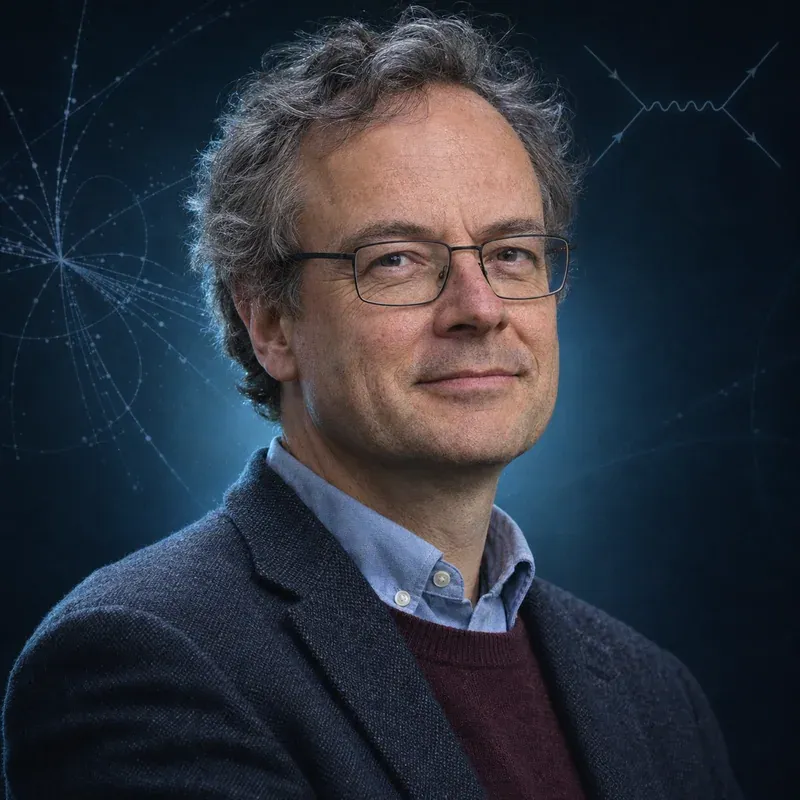
 Illustration
Mark Thomson
Thomson worked on MINOS and MicroBooNE and was co-leader and co-spokesperson of the Deep Underground Neutrino Experiment from its formation in 2015 to 2018, shaping its long-baseline programme to measure leptonic CP violation and the neutrino mass ordering. He became CERN Director-General on 1 January 2026.
- Born
- 28 April 1966
United Kingdom - Nationality
- British
- Field
- Experimental particle physics
- Institutions
- University of Oxford (BA 1988, DPhil 1991), CERN, University of Cambridge (Cavendish Laboratory), Science and Technology Facilities Council (STFC)
Education and early career
Mark Thomson is a British experimental particle physicist. He studied physics at Pembroke College, Oxford (BA 1988) and stayed at Oxford for a DPhil, completed in 1991 under John Cobb, on a search for deep-underground muons associated with astronomical point sources – an early brush with underground astroparticle physics. After a postdoctoral fellowship at University College London (1992–1994) he moved to CERN as a fellow and then staff physicist on the OPAL experiment at the electron–positron collider LEP. In 2000 he joined the Cavendish Laboratory in Cambridge, where he became Professor of Experimental Particle Physics in 2008.
Event reconstruction
Much of Thomson's scientific reputation rests on reconstruction software. For detectors at future linear colliders he developed PandoraPFA, a particle-flow algorithm that tries to identify every individual particle in a jet instead of treating the calorimeter signal as a whole. The same pattern-recognition philosophy was later adapted to liquid-argon time projection chambers, whose images of neutrino interactions resemble electronic bubble-chamber photographs. The Pandora toolkit is used for event reconstruction in MicroBooNE, on which Thomson worked, and in ProtoDUNE and DUNE. He also took part in MINOS, and is the author of the widely used textbook Modern Particle Physics (Cambridge University Press, 2013).
DUNE
When the long-baseline neutrino efforts in the United States and Europe merged in 2015, Thomson became co-leader and co-spokesperson of the new DUNE collaboration, a post he held until 2018. DUNE will send a neutrino beam from Fermilab through the LBNF facility 1,300 km to large liquid-argon detectors at SURF in South Dakota. Its main goals are to determine the mass ordering, to measure leptonic CP violation, and to watch for supernova neutrinos. During his term the collaboration took shape, and the ProtoDUNE prototypes were built at CERN. Regina Rameika later also served as co-spokesperson of the collaboration.
Science leadership
From January 2018 to December 2024 Thomson was Executive Chair of the UK Science and Technology Facilities Council (STFC), which funds British particle physics, astronomy and large facilities; he also represented the UK on the CERN Council. He became Director-General of CERN on 1 January 2026.
Known for
- Co-spokesperson of DUNE (2015–2018)
- MINOS and MicroBooNE
- Pandora particle-flow reconstruction
- STFC Executive Chair (2018–2024)
- CERN Director-General (from 1 January 2026)
Chronology
- 1991DPhil, Oxford
- 2015DUNE co-spokesperson (to 2018)
- 2018STFC Executive Chair (to 2024)
- 2026CERN Director-General
Experiments
Connected people
Frequently asked questions
What did Mark Thomson do in neutrino physics?
He developed the Pandora reconstruction approach used in liquid-argon neutrino detectors, worked on MINOS and MicroBooNE, and was co-spokesperson of DUNE from 2015 to 2018.
When did Mark Thomson become CERN Director-General?
He took office on 1 January 2026, after seven years as Executive Chair of STFC.
On the timeline
Mentioned in 8 pages
Last updated: · Editorial standard
Cite this page
Text
Neutrino Atlas (2026). “Mark Thomson”. Retrieved 22 November 2026, from https://neutrino-atlas.com/people/mark-thomson/BibTeX
@misc{neutrinoatlas2026peoplemarkthomson,
  title        = {Mark Thomson},
  author       = {{Neutrino Atlas}},
  year         = {2026},
  url          = {https://neutrino-atlas.com/people/mark-thomson/},
  note         = {Accessed 2026-11-22},
  language     = {english}
}