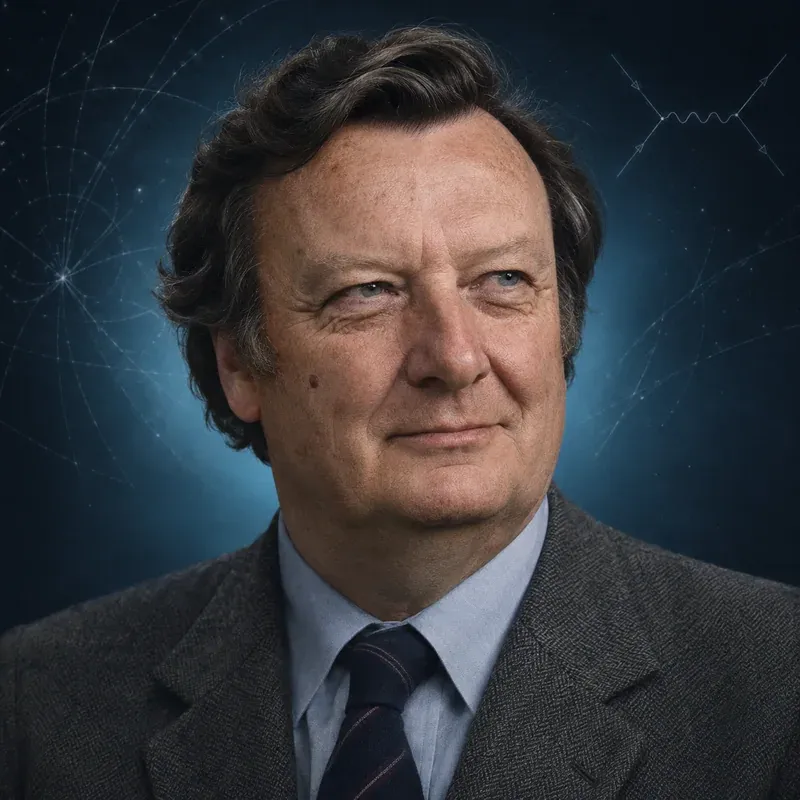
 Illustration
André Rubbia
Rubbia, a professor at ETH Zurich, is one of the main advocates of very large liquid-argon time-projection chambers as far detectors for long-baseline neutrino experiments. In 2004 he proposed GLACIER, a giant liquid-argon detector combining scintillation, Cherenkov and charge imaging for CP-violation searches with superbeams or beta beams, building on the ICARUS technology. He led the European consortium that studied such a detector at the Pyhäsalmi mine in Finland and built the dual-phase LBNO-DEMO demonstrator at CERN, and in 2015 he was elected one of the two first co-spokespersons of DUNE, together with Mark Thomson.
- Field
- Experimental neutrino physics
- Institutions
- ETH Zurich, CERN, DUNE Collaboration
A detector big enough for CP violation
André Rubbia is a professor of experimental particle physics at ETH Zurich. His research programme has centred on one idea: that the liquid-argon time-projection chamber, demonstrated on a large scale by ICARUS, can be scaled up to tens of kilotonnes and become the far detector that measures leptonic CP violation. In such a detector, charged particles ionise the argon, and the freed electrons drift in an electric field to readout planes, producing a three-dimensional image with millimetre-scale detail. The argon also emits scintillation light that fixes the time of each event.
In 2004 Rubbia proposed GLACIER, a giant liquid-argon detector that would combine charge imaging with scintillation and Cherenkov light. It was meant as the far detector for a neutrino superbeam or a beta beam, and also for atmospheric, solar and supernova neutrinos and for proton-decay searches. The proposal argued that a detector of this size was technically feasible, drawing on the experience of the ICARUS programme.
Dual phase and LAGUNA-LBNO
Rubbia's group championed the dual-phase variant, in which electrons are extracted from the liquid into a thin layer of argon gas above it and amplified before readout, increasing the signal compared with a single-phase chamber. As spokesperson of the European LAGUNA-LBNO consortium he led design studies, supported by two EU Framework Programme 7 projects, of a large liquid-argon detector at the Pyhäsalmi mine in Finland, about 2300 km from CERN. In 2014 the consortium chose an industrial membrane cryostat of the type used in liquefied natural gas tankers for its LBNO-DEMO prototype at CERN, the project known as WA105, which later became the dual-phase ProtoDUNE.
DUNE
When the US-led LBNE effort and the European groups joined forces in 2015 to form DUNE, the collaboration elected Rubbia and Mark Thomson as its first co-spokespersons, one for two years and one for three to ensure continuity. Rubbia served until March 2017, when Edward Blucher succeeded him.
Known for
- First DUNE co-spokesperson (2015–2017)
- GLACIER concept for a giant liquid-argon detector (2004)
- Dual-phase liquid-argon TPC development (LBNO-DEMO / WA105)
- Spokesperson of the LAGUNA-LBNO liquid-argon consortium
Chronology
- 2004Proposes the GLACIER giant liquid-argon detector
- 2014Consortium selects an industrial membrane cryostat for the LBNO-DEMO prototype at CERN
- 2015Elected first DUNE co-spokesperson with Mark Thomson
- 2017Succeeded as DUNE co-spokesperson by Edward Blucher
Original papers
- A. Rubbia, Experiments for CP-violation: a giant liquid argon scintillation, Cerenkov and charge imaging experiment? (2004)arXiv:hep-ph/0402110
Experiments
Connected people
Frequently asked questions
What was GLACIER?
A 2004 proposal by André Rubbia for a giant liquid-argon detector combining charge, scintillation and Cherenkov readout, intended to search for leptonic CP violation and proton decay.
Was André Rubbia a DUNE spokesperson?
Yes. He and Mark Thomson were elected the first co-spokespersons of DUNE in 2015; he served until 2017.
Mentioned in 2 pages
Milestones 1
People 1
Last updated: · Editorial standard
Cite this page
Text
Neutrino Atlas (2026). “André Rubbia”. Retrieved 22 November 2026, from https://neutrino-atlas.com/people/andre-rubbia/BibTeX
@misc{neutrinoatlas2026peopleandrerubbia,
  title        = {André Rubbia},
  author       = {{Neutrino Atlas}},
  year         = {2026},
  url          = {https://neutrino-atlas.com/people/andre-rubbia/},
  note         = {Accessed 2026-11-22},
  language     = {english}
}