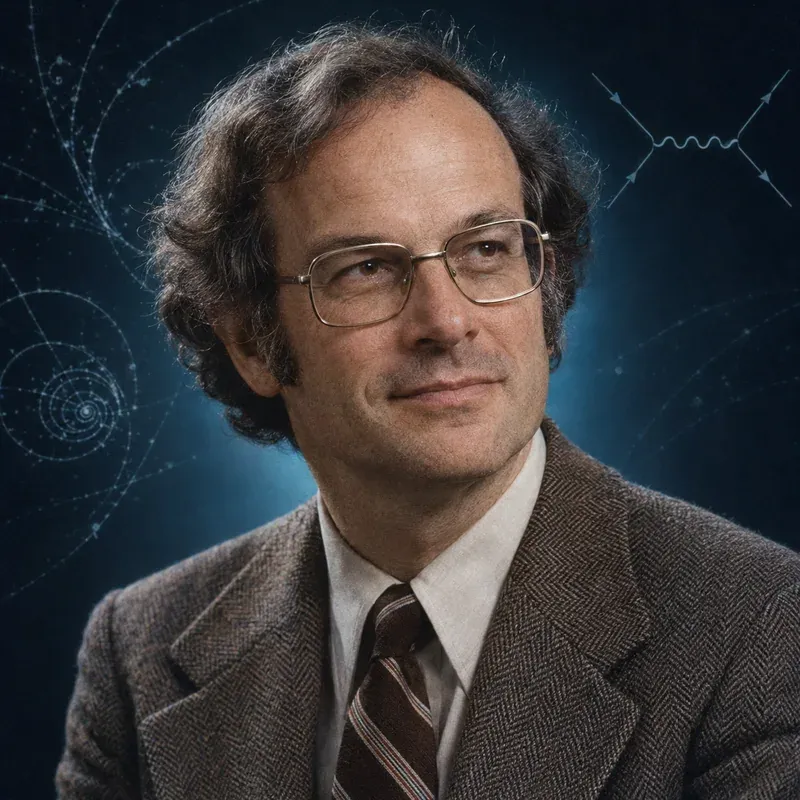
 Illustration
Vernon Duane Barger
In 1980 Barger, Whisnant, Pakvasa and Phillips worked out matter effects on three-flavour neutrino oscillations, showing how propagation through the Earth distinguishes neutrinos from antineutrinos and depends on the sign of the mass splitting, which is the basis of mass-ordering studies at long-baseline experiments. He later worked on bi-maximal mixing and the physics reach of neutrino factories and superbeams.
- Born
- 5 June 1938
Curllsville, Pennsylvania, USA - Nationality
- American
- Field
- Particle phenomenology
- Institutions
- Pennsylvania State University (PhD 1963), University of Wisconsin–Madison
Early life and education
Vernon Duane Barger was born on 5 June 1938 in Curllsville, Pennsylvania. He studied at Pennsylvania State University, earning a BS in engineering science in 1960 and a PhD in theoretical physics in 1963 under Emil Kazes. The same year he moved to the University of Wisconsin–Madison as a research associate. He became a full professor there in 1968, J. H. Van Vleck Professor in 1983 and Vilas Professor in 1991, and has remained at Madison for his entire career.
Key contributions to neutrino physics
Barger is primarily a phenomenologist: he works out what a theory predicts for real experiments. In 1980, with Kerry Whisnant, Sandip Pakvasa and Roger Phillips, he published 'Matter effects on three-neutrino oscillations'. Building on Lincoln Wolfenstein's 1978 observation that electron neutrinos feel an extra potential when they travel through matter, the paper derived the oscillation formulas for three flavours in matter of constant density.
Two features of their result became central to the field. First, the matter potential has opposite sign for neutrinos and antineutrinos, so matter alone produces a difference between the two even without CP violation. Second, the size of the effect depends on the sign of the mass-squared difference, so oscillations in the Earth carry information about the mass ordering. The formulas also contain the condition under which mixing in matter becomes maximal; its importance for solar neutrinos was later worked out by Stanislav Mikheyev and Alexei Smirnov as the MSW effect. Disentangling matter effects from genuine CP violation is now a core task of long-baseline experiments such as NOvA, T2K and DUNE.
In 1998, shortly after Super-Kamiokande reported atmospheric oscillations, Barger, Pakvasa, Thomas Weiler and Whisnant proposed bi-maximal mixing, a pattern in which both the solar and atmospheric angles are maximal. Data later showed the solar angle to be large but not maximal, yet the paper helped launch the search for symmetry patterns in the PMNS matrix. Around 1999–2003 Barger and collaborators also mapped out the physics reach of neutrino factories and conventional superbeams, including how to resolve degeneracies between the CP phase, the mass ordering and θ13.
With Danny Marfatia and Whisnant he wrote the textbook 'The Physics of Neutrinos' (Princeton University Press, 2012).
Collider physics and recognition
Barger is equally known for collider phenomenology. His book 'Collider Physics' with Roger Phillips (1987) became a standard text, and his work contributed to the discovery and study of the W boson, the top quark and the Higgs boson. For this he received the 2021 J. J. Sakurai Prize for Theoretical Particle Physics. He was a Guggenheim Fellow in 1971–72, became a Fellow of the American Physical Society in 1977 and was a Fermilab Frontier Fellow in 1998.
Known for
- Matter effects on three-neutrino oscillations (1980)
- Bi-maximal neutrino mixing (1998)
- Neutrino factory and long-baseline phenomenology
- Collider physics (W, top, Higgs)
Chronology
- 1963Joins University of Wisconsin–Madison
- 1980'Matter effects on three-neutrino oscillations'
- 1998Bi-maximal mixing of three neutrinos
- 2021Sakurai Prize (collider physics)
Original papers
- V. Barger, K. Whisnant, S. Pakvasa, R. J. N. Phillips, Matter effects on three-neutrino oscillations, Phys. Rev. D 22, 2718 (1980)DOI 10.1103/PhysRevD.22.2718
- V. Barger, S. Pakvasa, T. J. Weiler, K. Whisnant, Bi-maximal mixing of three neutrinos, Phys. Lett. B 437, 107 (1998)
Experiments
Connected people
Frequently asked questions
What did Vernon Barger contribute to neutrino physics?
With Whisnant, Pakvasa and Phillips he worked out in 1980 how matter changes three-flavour neutrino oscillations, showing that the effect differs for neutrinos and antineutrinos and depends on the mass ordering. This is the basis of mass-ordering studies at long-baseline experiments.
What is bi-maximal mixing?
A mixing pattern proposed by Barger and colleagues in 1998 in which both the solar and atmospheric mixing angles are 45 degrees. Later measurements showed the solar angle is smaller, so the pattern is now seen as a starting point rather than the final answer.
Mentioned in 1 page
Last updated: · Editorial standard
Cite this page
Text
Neutrino Atlas (2026). “Vernon Duane Barger”. Retrieved 22 November 2026, from https://neutrino-atlas.com/people/vernon-barger/BibTeX
@misc{neutrinoatlas2026peoplevernonbarger,
  title        = {Vernon Duane Barger},
  author       = {{Neutrino Atlas}},
  year         = {2026},
  url          = {https://neutrino-atlas.com/people/vernon-barger/},
  note         = {Accessed 2026-11-22},
  language     = {english}
}