Neutrino-4
A movable reactor detector in Russia whose claim of a sterile-neutrino oscillation near 7 eV² remains contested.
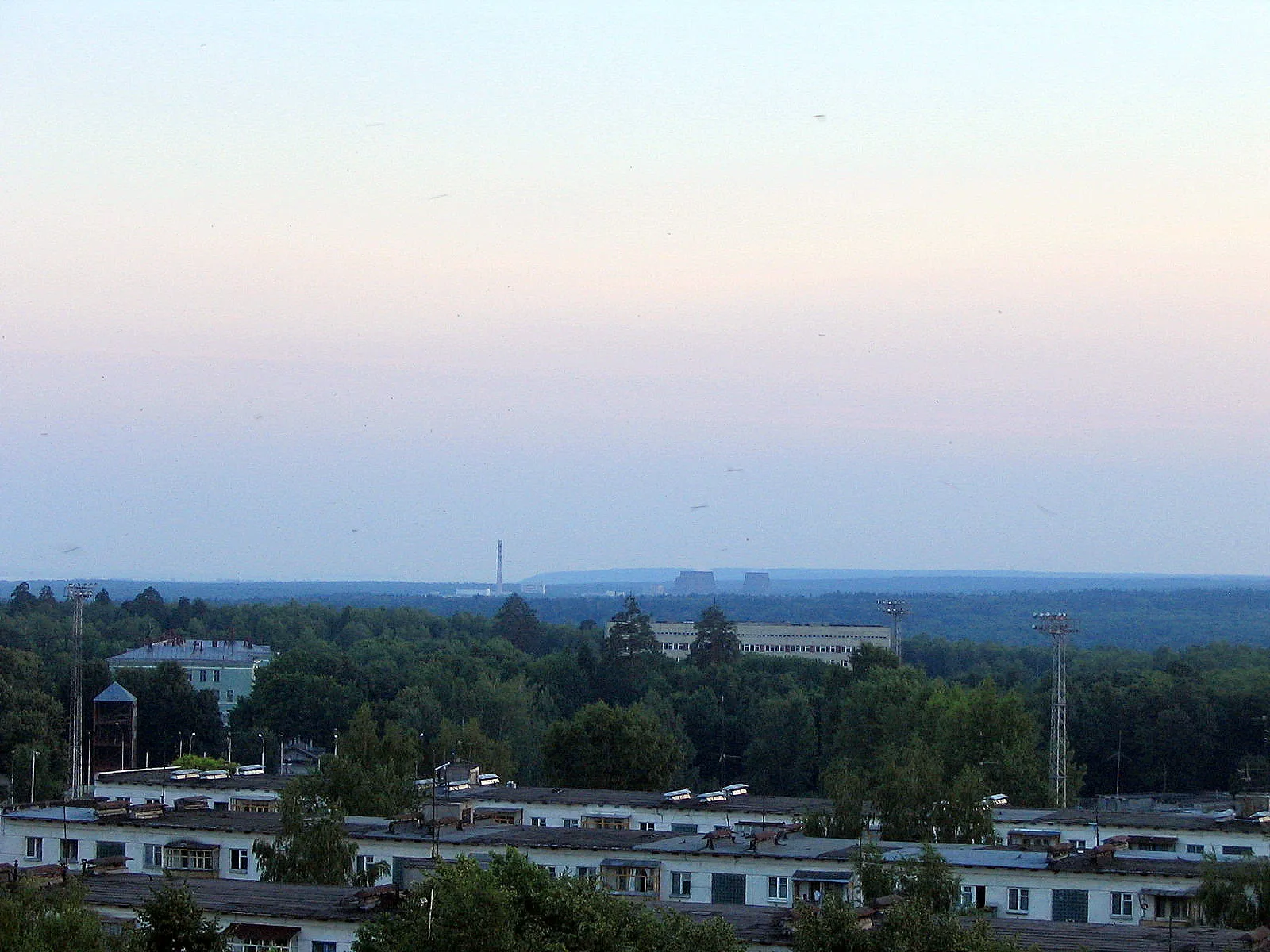
Neutrino-4 measures antineutrinos from the compact 100 MW SM-3 research reactor in Dimitrovgrad with a 1.8 m³ Gd-loaded scintillator detector of 50 sections, moved between about 6 and 12 m. From 2016–2019 data it reported an oscillation pattern with Δm²₁₄ ≈ 7.3 eV² and sin²2θ ≈ 0.26–0.36 at about 3σ. Other experiments and critics dispute the interpretation. In December 2025 KATRIN reported in Nature that its data rule out the Neutrino-4 claim.
Compare all experiments → · World map →
In plain words
A sterile neutrino with a mass of a few electronvolts would make reactor antineutrinos disappear and reappear over just a few metres. The pattern would depend on the ratio of distance to energy. Neutrino-4 tries to see this wave directly by moving its detector back and forth in front of a small, intense reactor core.
How the detector works
The SM-3 reactor of the Research Institute of Atomic Reactors in Dimitrovgrad runs at 100 MW with a very compact core of about 42 × 42 × 35 cm, so the source is almost point-like. The detector, built by a team from the Petersburg Nuclear Physics Institute led by Anatoly Serebrov, holds 1.8 m³ of liquid scintillator with 0.1% gadolinium in 50 sections. It moves on rails between about 6.4 and 11.9 m from the core. The site has little overburden, and the reactor runs in short cycles, so reactor-off periods are used to subtract the large cosmic background.
Key results
Reactor-on data were taken from June 2016 to June 2019. Plotting the ratio of rates against L/E, the collaboration reported an oscillation with Δm²₁₄ ≈ 7.3 eV² and a large mixing, sin²2θ ≈ 0.26–0.36 depending on the analysis, at a significance of roughly 2.7 to 3.2σ.
The controversy
The claim is widely questioned. Critics argued that the energy resolution and the way data were binned could create an apparent oscillation, and that the significance is overestimated. Large parts of the preferred region conflict with STEREO, PROSPECT, DANSS and solar-neutrino bounds, although the region overlaps with the gallium anomaly reported by BEST. An upgraded detector with higher sensitivity has been planned to settle the question.
Frequently asked questions
Has Neutrino-4 discovered a sterile neutrino?
No consensus supports that. The result is below the usual 5σ discovery threshold and is in tension with several other reactor experiments.
Why is the reactor core size important?
Oscillations over a few metres wash out if the source is large. The small SM-3 core keeps the baseline sharp enough to look for such a short wavelength.
Original papers
- First resultA. P. Serebrov et al. (Neutrino-4 Collaboration), First Observation of the Oscillation Effect in the Neutrino-4 Experiment on the Search for the Sterile Neutrino, JETP Lett. 109, 213 (2019)arXiv:1809.10561
- MeasurementA. P. Serebrov et al. (Neutrino-4 Collaboration), Search for sterile neutrinos with the Neutrino-4 experiment and measurement results, Phys. Rev. D 104, 032003 (2021)DOI 10.1103/PhysRevD.104.032003arXiv:2005.05301
Related terms
People
On the timeline
Mentioned in 5 pages
Lessons 1
Last updated: · Editorial standard
Cite this page
Text
Neutrino Atlas (2026). “Neutrino-4”. Retrieved 22 November 2026, from https://neutrino-atlas.com/terms/neutrino-4/BibTeX
@misc{neutrinoatlas2026termsneutrino4,
  title        = {Neutrino-4},
  author       = {{Neutrino Atlas}},
  year         = {2026},
  url          = {https://neutrino-atlas.com/terms/neutrino-4/},
  note         = {Accessed 2026-11-22},
  language     = {english}
}