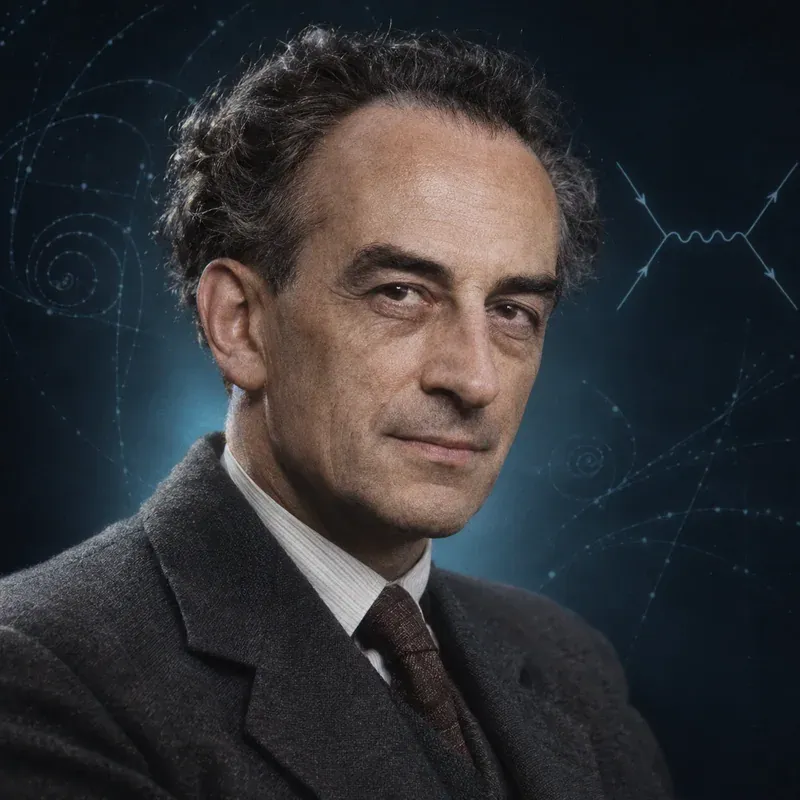
 Illustration
Francis Perrin
In December 1933 Perrin argued from the shape of the beta spectrum near its endpoint that the neutrino's intrinsic mass must be zero or at least small compared with the electron mass. In 1934 he discussed the asymmetry of positive and negative beta spectra in relation to neutrino mass. Like Fermi, he recognised the endpoint region as the place to measure neutrino mass.
- Born
- 17 August 1901
Paris, France - Died
- 4 July 1992
Paris, France - Nationality
- French
- Field
- theoretical and nuclear physics
- Institutions
- Collège de France, Commissariat à l'énergie atomique (CEA), CERN (founding delegate)
Early life and education
Francis Perrin was born in Paris on 17 August 1901, the son of the physicist Jean Perrin, who received the 1926 Nobel Prize for his work on the atomic nature of matter, and the writer Henriette Perrin-Duportal. He studied at the École Normale Supérieure and obtained a doctorate in mathematical sciences from the University of Paris in 1928 with a thesis on rotational Brownian motion.
His early research was on fluorescence. The relation he derived between the polarisation of fluorescent light, the lifetime of the excited state and the rotation of the emitting molecule is still known as the Perrin equation and is used in biophysics today.
Path to neutrino physics
In the early 1930s the continuous energy spectrum of beta decay, measured by Charles Drummond Ellis and William Alfred Wooster, was one of the central puzzles of nuclear physics. Niels Bohr was prepared to give up energy conservation, while Wolfgang Pauli proposed an unseen neutral particle that carries away the missing energy. Pauli himself only said that its mass could not be much larger than the electron mass.
Key contributions
Perrin took up the question of that mass. In a note to the Comptes Rendus of the Paris Academy in December 1933, titled in translation “Possibility of the emission of neutral particles of zero intrinsic mass in β radioactivity”, he argued from the shape of the measured spectra near their upper end that the neutrino's mass must be zero or at least very small compared with the electron mass. The reasoning is that a massive neutrino changes how the spectrum approaches its maximum energy: the closer the electron gets to the endpoint, the less energy is left for the neutrino, and a rest mass would cut the spectrum off in a characteristic way.
Enrico Fermi reached the same conclusion in his 1934 theory of beta decay, in which he showed explicitly how the end of the spectrum looks for a massless and for a massive neutrino. Perrin's second note in 1934 discussed the different shapes of positive and negative beta spectra in relation to the neutrino mass, which he also called the “ergon”. The same principle, refined over ninety years, is used today in tritium endpoint experiments such as KATRIN.
Later work
In 1939 Perrin worked with Frédéric Joliot-Curie, Hans von Halban and Lew Kowarski on the possibility of a nuclear chain reaction in uranium and published an early estimate of the critical mass. After the war he held the chair of atomic and molecular physics at the Collège de France from 1946 to 1972. From 1951 to 1970 he was High Commissioner of the French Commissariat à l'énergie atomique (CEA), where he shaped the country's civil nuclear programme and was also involved in its military side.
Perrin was one of the founders of CERN: in 1952 he signed the agreement that established its provisional council, became its vice-president and represented France on the CERN Council until 1972. He died in Paris on 4 July 1992.
Legacy
Perrin's 1933 note is short, but it marks the first time someone used the shape of a measured spectrum to set a limit on the neutrino mass. The answer he gave, that the mass is zero or very small, held for more than sixty years, until neutrino oscillations showed that it is small but not zero.
Known for
- First argument that the neutrino mass is zero or very small (1933)
- High Commissioner of the CEA (1951–1970)
Chronology
- 1933Comptes Rendus note: neutrino mass null or small
- 1934Paper on beta-spectrum asymmetry and neutrino mass
- 1951Becomes High Commissioner of the CEA
Original papers
- F. Perrin, Possibilité d'émission de particules neutres de masse intrinsèque nulle dans les radioactivités β, C. R. Acad. Sci. 197, 1625 (1933)
- F. Perrin, La dissymétrie des spectres β positifs et négatifs et la masse intrinsèque du neutrino ou ergon, C. R. Acad. Sci. 198, 2086 (1934)
Connected people
Frequently asked questions
What did Francis Perrin contribute to neutrino physics?
In December 1933 he argued from the shape of beta spectra near their endpoint that the neutrino's mass must be zero or very small compared with the electron mass, independently of and at about the same time as Fermi.
Was Francis Perrin related to Jean Perrin?
Yes. He was the son of Jean Perrin, who won the 1926 Nobel Prize in Physics. Francis Perrin himself did not receive a Nobel Prize.
Mentioned in 4 pages
Last updated: · Editorial standard
Cite this page
Text
Neutrino Atlas (2026). “Francis Perrin”. Retrieved 22 November 2026, from https://neutrino-atlas.com/people/francis-perrin/BibTeX
@misc{neutrinoatlas2026peoplefrancisperrin,
  title        = {Francis Perrin},
  author       = {{Neutrino Atlas}},
  year         = {2026},
  url          = {https://neutrino-atlas.com/people/francis-perrin/},
  note         = {Accessed 2026-11-22},
  language     = {english}
}