Pierre Auger Observatory (neutrino search)
The world's largest cosmic-ray observatory, which also searches for ultra-high-energy neutrinos.
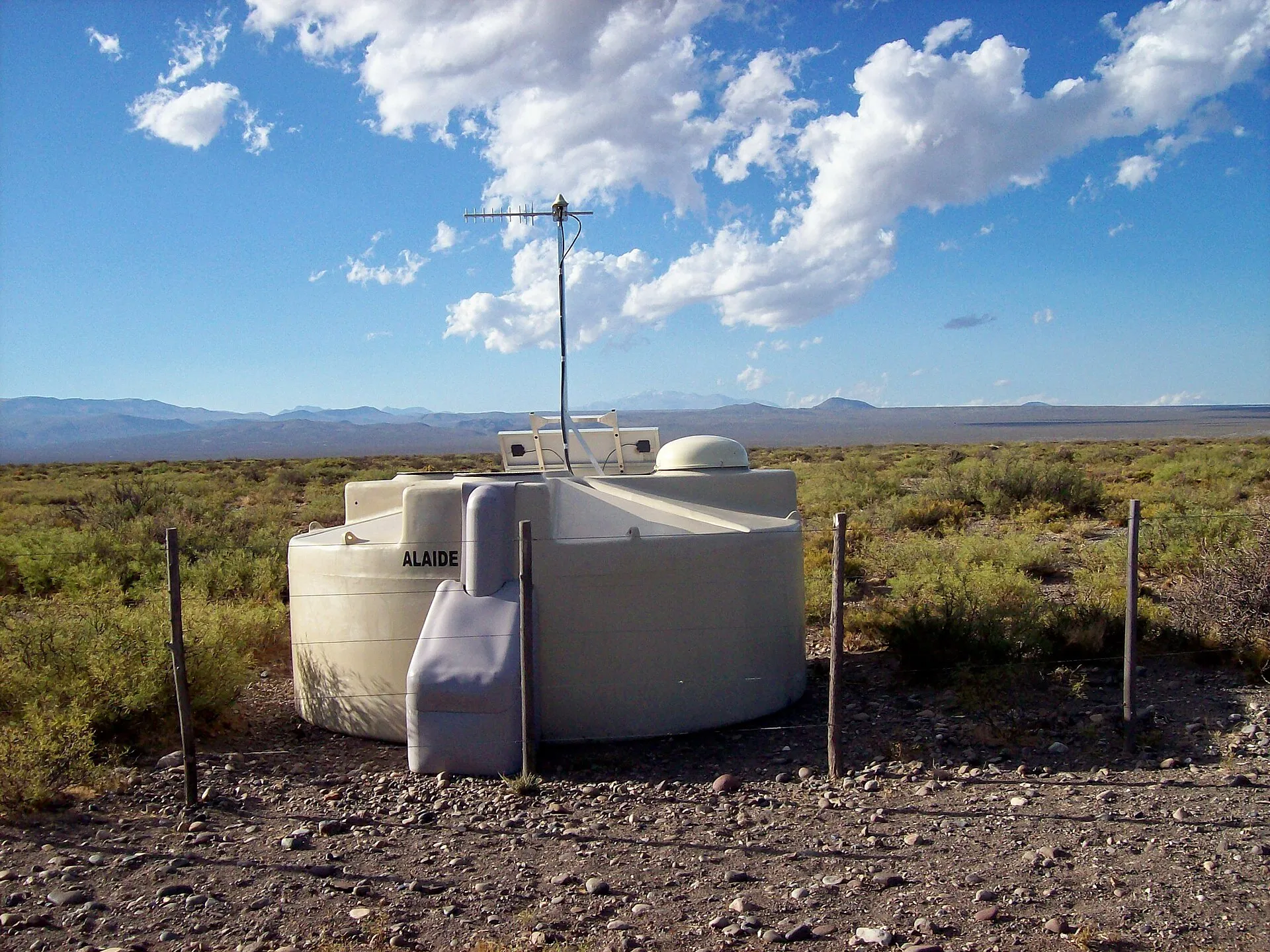
Spread over about 3000 km² in Argentina, its 1660 water Cherenkov surface stations and fluorescence telescopes can identify neutrinos as young, deeply developing inclined air showers, including Earth-skimming ντ. No neutrinos have been found, and Auger sets some of the strongest limits on EeV neutrino fluxes.
Compare all experiments → · World map →
In plain words
The Pierre Auger Observatory in western Argentina was built to study the most energetic particles in nature, cosmic rays that hit the atmosphere with more than 10¹⁸ eV. Hidden among them could be a very rare kind of shower started not by a proton or nucleus at the top of the atmosphere but by a neutrino deep within it – and Auger has been searching for exactly those.
How the detector works
About 1,660 water Cherenkov stations, each a tank of 12 tonnes of water with three photomultipliers, stand 1.5 km apart over about 3,000 km² of the Pampa Amarilla near Malargüe. Twenty-seven fluorescence telescopes at four sites watch the faint ultraviolet glow of showers on dark nights. The observatory, named after Pierre Auger, who discovered extensive air showers in 1938, took data from 2004 and was completed in 2008.
Ordinary cosmic rays interact high in the atmosphere. When they arrive at large zenith angles, their showers have travelled through so much air that only muons reach the ground, producing short, sharp signals. A neutrino can interact deep in the atmosphere and produce a 'young' shower with a broad electromagnetic component and signals spread out in time. Auger looks for this signature in three channels:
- Earth-skimming: a tau neutrino passes just below the horizon through the Earth's crust or the Andes, produces a tau lepton that exits and decays in the air.
- Down-going high-angle: neutrinos of all flavours interacting in the air at zenith angles of 75–90°.
- Down-going low-angle: zenith angles of 60–75°, made possible by improved triggers and selection methods.
Key results
No neutrino candidates have been found. Using data from 2014 to 2021, the collaboration reported in 2025 an upper limit on a diffuse single-flavour flux with an E⁻² spectrum of 1.2 × 10⁻⁷ GeV cm⁻² s⁻¹ sr⁻¹ (90% CL) from the low-angle channel alone, in the range of about 10¹⁸ to 10¹⁹·⁵ eV; combined channels give some of the most stringent limits at EeV energies. These limits constrain proton-dominated models of ultra-high-energy cosmic rays, which predict a large cosmogenic flux. Auger also tested the anomalous events reported by ANITA and found no counterpart.
Status today
The AugerPrime upgrade adds scintillators and radio antennas to the surface stations, which improves the separation of shower components and the sensitivity to neutrinos.
Frequently asked questions
Is the Pierre Auger Observatory a neutrino telescope?
Not primarily. It is a cosmic-ray observatory, but its huge area makes it sensitive to the rare air showers that only EeV neutrinos can produce.
Has Auger detected any neutrinos?
No. It has found no candidates so far, which yields some of the strongest upper limits on the flux of ultra-high-energy neutrinos.
Original papers
- First resultJ. Abraham et al. (Pierre Auger Collaboration), Upper limit on the diffuse flux of ultrahigh energy tau neutrinos from the Pierre Auger Observatory, Phys. Rev. Lett. 100, 211101 (2008)DOI 10.1103/PhysRevLett.100.211101arXiv:0712.1909
- MeasurementA. Aab et al. (Pierre Auger Collaboration), Probing the origin of ultra-high-energy cosmic rays with neutrinos in the EeV energy range using the Pierre Auger Observatory, JCAP 10 (2019) 022arXiv:1906.07422
Related terms
People
Latest research on this topic
- Probing for anisotropies at different angular scales in the arrival directions of the cosmic rays detected at the Pierre Auger ObservatoryPierre Auger Collaboration · 10 November 2026
- A search for sterile neutrinos at ultrahigh energies at the Pierre Auger ObservatoryPierre Auger Collaboration · 4 November 2026
- BOLT: Imaging Lightning and Terrestrial Gamma-ray Flashes at the Pierre Auger ObservatoryPierre Auger Collaboration · 7 October 2026
- Can Historic Measurements cast light on the Spectral Differences found between the Pierre Auger Observatory and the Telescope Array?Luce, Quentin, Watson, Alan A. · 5 October 2026
- The Pierre Auger Observatory and its highlightsPierre Auger Collaboration · 5 October 2026
- Radio measurements of air showers with the IceCube-Gen2 surface prototype station at the Pierre Auger ObservatoryIceCube-Gen2 Collaboration · 31 August 2026
Mentioned in 29 pages
Milestones 1
People 5
Terms 21
- ANITA
- ARIANNA
- Chlorine–Argon method
- Cosmic rays
- Cosmic-ray air showers
- Cosmogenic neutrinos
- Double electron capture
- Earth-skimming tau neutrinos
13 more
- Electron capture
- Gallium–Germanium method
- GRAND (Giant Radio Array for Neutrino Detection)
- Holmium-163 experiments (ECHo, HOLMES)
- Homestake Chlorine Experiment
- KM3-230213A
- Neutrino telescopes
- Neutron-star mergers and neutrinos
- Radiochemical signal (transmutation)
- SAGE (Soviet–American Gallium Experiment)
- TeV–PeV–EeV scale
- Ultra-high-energy neutrinos
- Waxman–Bahcall bound
Last updated: · Editorial standard
Cite this page
Text
Neutrino Atlas (2026). “Pierre Auger Observatory (neutrino search)”. Retrieved 22 November 2026, from https://neutrino-atlas.com/terms/pierre-auger/BibTeX
@misc{neutrinoatlas2026termspierreauger,
  title        = {Pierre Auger Observatory (neutrino search)},
  author       = {{Neutrino Atlas}},
  year         = {2026},
  url          = {https://neutrino-atlas.com/terms/pierre-auger/},
  note         = {Accessed 2026-11-22},
  language     = {english}
}