2025Experiment
KATRIN: neutrinos weigh less than 0.45 eV
In Science in April 2025, KATRIN reported an upper limit of 0.45 eV at 90 percent confidence on the effective electron antineutrino mass, based on 259 days of data from five campaigns between 2019 and 2021. The best-fit value was consistent with zero. It roughly halved the previous limit and remains the most stringent model-independent laboratory constraint. Neutrino-mass data taking continued until the end of 2025.
- Date
- 10 April 2025
- Kind of event
- Experiment
- People involved
- Guido Drexlin, Christian Weinheimer
- Experiments
- KATRIN
The situation before
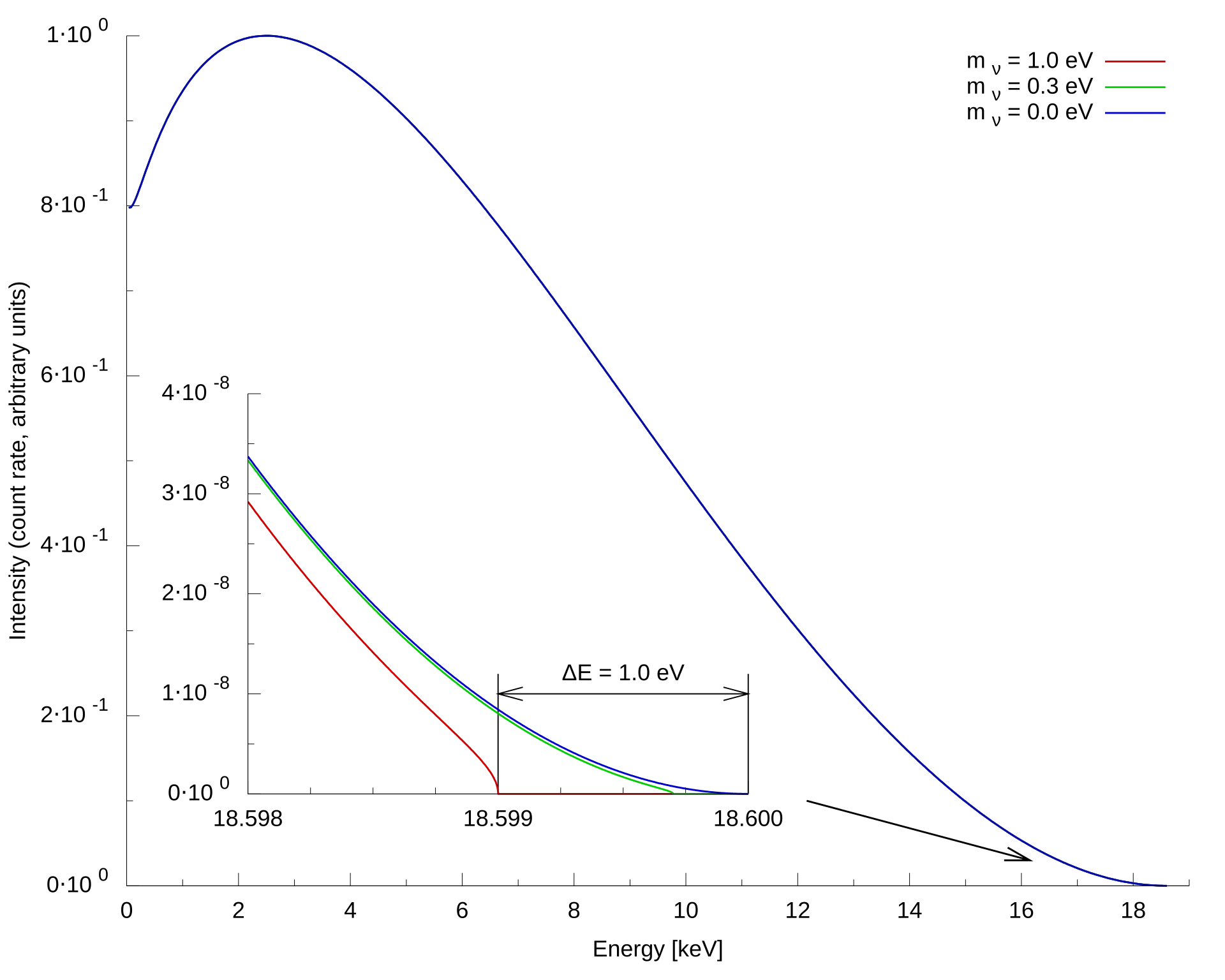
Oscillation experiments show that neutrinos have mass but measure only differences between the squared masses. The absolute mass scale has to be found another way. The most direct method examines the end of the tritium beta spectrum, where a nonzero neutrino mass slightly distorts the shape. The Mainz and Troitsk experiments had reached about 2 eV by the early 2000s. KATRIN in Karlsruhe, co-founded by Guido Drexlin and Christian Weinheimer among others, was built to improve on that by a factor of ten.
KATRIN began neutrino-mass measurements in 2019. Its first campaign gave an upper limit of 1.1 eV in 2019, and the first two campaigns together gave 0.8 eV in 2022, the first direct measurement to go below 1 eV.
What happened
On 10 April 2025 the collaboration published in Science an analysis of five measurement campaigns taken between 2019 and 2021, a total of 259 measurement days with about 36 million electrons recorded near the tritium endpoint. The 70-metre beamline, with its windowless gaseous tritium source and 10-metre-wide MAC-E filter spectrometer, had been optimised campaign by campaign, including a lower background from the spectrometer.
The best-fit value of the squared mass was consistent with zero, so the result is an upper limit: the effective electron antineutrino mass is below 0.45 eV at 90 percent confidence, almost a factor of two below the 2022 value. Expressed in kilograms, that is less than about 8 × 10⁻³⁷ kg.
Reaction
Kathrin Valerius of KIT summarised the data base as "five measurement campaigns, totaling approximately 250 days of data collection from 2019 to 2021". Alexey Lokhov noted that the analysis is demanding because "an unprecedented level of accuracy is required", and Christoph Wiesinger explained that artificial intelligence played a crucial role. The press highlighted the limit as the most stringent laboratory constraint on neutrino mass that does not depend on cosmological models or on the Majorana nature of neutrinos.
Consequences
The 2025 data set was about a quarter of what KATRIN planned to collect. Measurements continued until the end of 2025, passing 1,000 measurement days in October, and the full data set is expected to bring the sensitivity close to 0.3 eV. From 2026 the TRISTAN detector is to be installed to search for keV-scale sterile neutrinos, while KATRIN++ prepares a next-generation experiment. Cosmological surveys already suggest a much lower sum of masses, so comparing the two model-dependent and model-independent approaches is an important cross-check.
Frequently asked questions
How heavy is a neutrino according to KATRIN?
The effective electron antineutrino mass is below 0.45 eV at 90 percent confidence, according to the April 2025 result.
How does KATRIN weigh neutrinos?
It measures the energy of electrons from tritium beta decay very precisely near the endpoint, where a nonzero neutrino mass changes the shape of the spectrum.
Why is a laboratory limit important when cosmology gives tighter bounds?
KATRIN's result does not depend on cosmological models, so it provides an independent check on the cosmological constraints.
Original papers
- MeasurementM. Aker et al. (KATRIN Collaboration), Direct neutrino-mass measurement based on 259 days of KATRIN data, Science 388, 180 (2025)DOI 10.1126/science.adq9592
Concepts
Mentioned in 6 pages
Last updated: · Editorial standard
Cite this page
Text
Neutrino Atlas (2026). “2025: KATRIN: neutrinos weigh less than 0.45 eV”. Retrieved 22 November 2026, from https://neutrino-atlas.com/timeline/2025-katrin-045-ev/BibTeX
@misc{neutrinoatlas2026timeline2025katrin045ev,
  title        = {2025: KATRIN: neutrinos weigh less than 0.45 eV},
  author       = {{Neutrino Atlas}},
  year         = {2026},
  url          = {https://neutrino-atlas.com/timeline/2025-katrin-045-ev/},
  note         = {Accessed 2026-11-22},
  language     = {english}
}