1927Experiment
Calorimetry confirms missing energy in beta decay
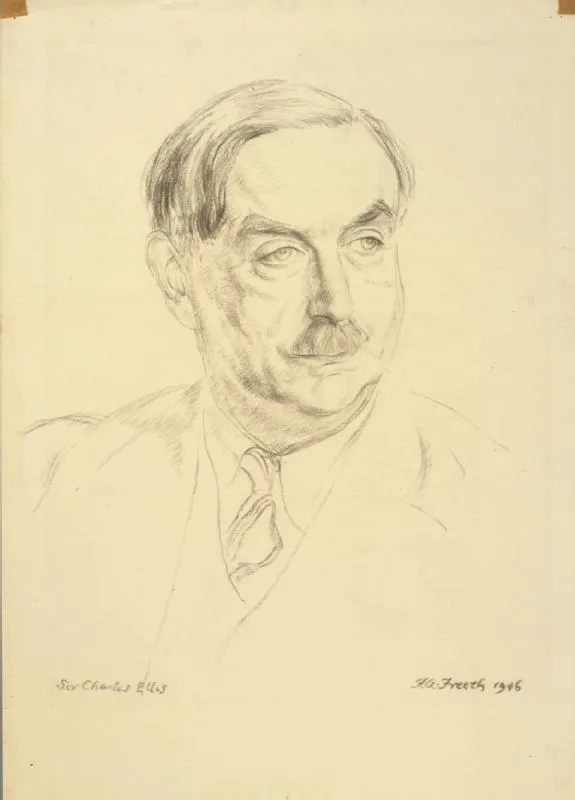
Charles Ellis and William Wooster measured the total heat deposited by the beta decay of radium E (bismuth-210) in a calorimeter. They found about 0.34 MeV per decay, matching the average of the continuous spectrum rather than its maximum of about 1 MeV. The energy was therefore not lost to secondary processes but genuinely missing. Lise Meitner and Wilhelm Orthmann confirmed the result in 1930, sharpening the crisis that Pauli would address.
- Date
- 1927
- Kind of event
- Experiment
- People involved
- Charles Drummond Ellis, William Alfred Wooster, Lise Meitner
The situation before
Since James Chadwick's measurement of 1914 it was clear that beta electrons emerge with a continuous range of energies. What was disputed was where the spread came from. Lise Meitner held that every nucleus emits an electron of the same, maximum energy, which then loses part of it on the way out, for example by producing gamma rays or secondary electrons. Charles Ellis at the Cavendish Laboratory believed the electrons are born with different energies. A spectrometer could not decide between these views, because it only sees the electrons that escape.
What happened
Ellis and his colleague William Wooster chose a direct test: catch all the energy of the decays as heat. If Meitner was right, the heat per decay should equal the maximum electron energy, because any energy lost on the way out would still end up in the absorber. If Ellis was right, it should equal the mean energy of the spectrum.
They used radium E, today bismuth-210, because it emits almost no gamma rays. A sample was enclosed in a lead calorimeter thick enough to stop every electron, and the tiny temperature rise was measured against an identical calorimeter without a source. Knowing the number of decays per second, they obtained an average of about 344 keV per decay with an uncertainty of roughly 10 percent. That was consistent with the mean energy of the spectrum and far below its maximum of about 1 MeV. The paper, "The average energy of disintegration of radium E", appeared in the Proceedings of the Royal Society A in 1927.
- Measured heat per decay: about 0.34 MeV.
- Maximum electron energy of radium E: about 1 MeV.
- Conclusion: the electrons are emitted with different energies; the missing energy does not reach the calorimeter.
Reaction
Meitner did not accept the result at once. Together with Wilhelm Orthmann she repeated the experiment with an improved calorimeter and in 1930 reported about 337 keV per decay, in full agreement with Ellis and Wooster. She wrote to Ellis that she was now convinced. With the last loophole closed, physicists faced the conclusion that in each beta decay a variable amount of energy simply disappeared from view.
Why it matters
The calorimeter turned an argument about interpretation into a hard number. Niels Bohr responded by considering that energy might be conserved only on average in nuclear processes. Wolfgang Pauli found that too radical and in December 1930 proposed instead an unseen neutral particle that carries away the difference. The calorimeter could not register it because, as was later understood, it passes through lead almost without interacting.
Frequently asked questions
What did Ellis and Wooster measure?
The total heat released by the beta decay of radium E in a lead calorimeter, about 0.34 MeV per decay, close to the mean electron energy rather than the maximum of about 1 MeV.
Why was this decisive?
A calorimeter captures all energy deposited, including any lost by the electrons on their way out. The low result meant that energy really was missing, not just redistributed.
Who confirmed the result?
Lise Meitner and Wilhelm Orthmann in 1930, with about 337 keV per decay.
Original papers
- MeasurementC. D. Ellis and W. A. Wooster, The Average Energy of Disintegration of Radium E, Proc. R. Soc. Lond. A 117, 109 (1927)DOI 10.1098/rspa.1927.0168
- MeasurementL. Meitner and W. Orthmann, Über eine absolute Bestimmung der Energie der primären β-Strahlen von Radium E, Z. Phys. 60, 143 (1930)
Concepts
Mentioned in 1 page
Lessons 1
Last updated: · Editorial standard
Cite this page
Text
Neutrino Atlas (2026). “1927: Calorimetry confirms missing energy in beta decay”. Retrieved 22 November 2026, from https://neutrino-atlas.com/timeline/1927-ellis-wooster-calorimetry/BibTeX
@misc{neutrinoatlas20267elliswoostercalorimetry,
  title        = {1927: Calorimetry confirms missing energy in beta decay},
  author       = {{Neutrino Atlas}},
  year         = {2026},
  url          = {https://neutrino-atlas.com/timeline/1927-ellis-wooster-calorimetry/},
  note         = {Accessed 2026-11-22},
  language     = {english}
}