 Illustration
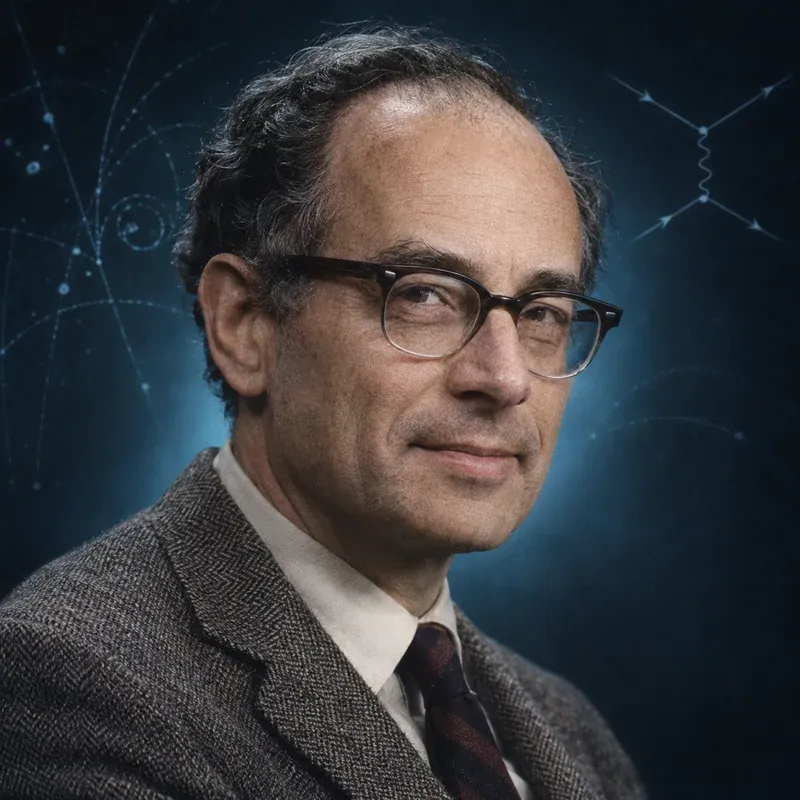
Andrew W. Sunyar
Sunyar was a member of the Brookhaven trio with Maurice Goldhaber and Lee Grodzins whose helicity measurements of photons and electrons in beta decay culminated in the classic 1957-58 experiment determining that the neutrino is left-handed.
- Born
- 1920
Michigan, USA - Died
- 22 May 1986
- Nationality
- American
- Field
- experimental nuclear physics
- Institutions
- Albion College, University of Illinois, Brookhaven National Laboratory
Early life and education
Andrew W. Sunyar was born in Michigan in 1920. He graduated from Albion College in 1942 and began graduate studies in physics at the University of Illinois, which were interrupted by the Second World War, during which he served as an officer in the US Navy. He returned to Illinois after the war and received his PhD in 1949. Among the faculty there was Maurice Goldhaber, who moved to Brookhaven National Laboratory the following year; Sunyar joined Brookhaven directly after his doctorate and remained there for his entire career.
Research in nuclear physics
Sunyar was above all a nuclear spectroscopist. His early work concerned nuclear transition rates and very short nuclear lifetimes, for which he helped develop fast electronic coincidence techniques able to resolve times below a nanosecond. With Goldhaber he studied nuclear isomers, long-lived excited states of nuclei, and their systematic classification, which supported the then-new nuclear shell model. These methods, measuring the timing, energy and polarisation of gamma rays emitted by excited nuclei, were exactly the tools needed for the neutrino experiment that made his name.
The neutrino-helicity experiment
After the discovery of parity violation in 1956–57, Sunyar, Goldhaber and Lee Grodzins began measuring the polarisation of particles emitted in beta decay. Their first paper, in 1957, showed that bremsstrahlung produced by beta-decay electrons is circularly polarised, a direct consequence of the electrons' longitudinal polarisation.
The trio then designed the experiment that measured the helicity of the neutrino itself. An isomer of europium-152 decays by electron capture, emitting a neutrino and leaving a samarium-152 nucleus that quickly emits a gamma ray. By selecting, through resonant scattering, only those gamma rays emitted in the direction of the nuclear recoil, and by analysing their circular polarisation with magnetised iron, the team could infer the spin direction of the unseen neutrino. The 1958 paper ‘Helicity of neutrinos’ showed that the neutrino is left-handed, supporting the V−A theory of the weak interaction. The Goldhaber page describes the method in more detail.
Later work
Sunyar contributed to applications of the Mössbauer effect, including the discovery of the nuclear isomer shift and measurements of nuclear quadrupole interactions. He was co-leader of Brookhaven's nuclear structure group and later led the research group at the laboratory's tandem Van de Graaff accelerator, which became internationally known for heavy-ion physics. There his group used heavy-ion beams to study nuclei at high angular momentum, including multiple collective rotational bands. He also served on the advisory committee of the UNISOR facility at Oak Ridge and for many years as an associate editor of ‘Atomic Data and Nuclear Data Tables’.
Sunyar remained at Brookhaven until his final illness and died in May 1986. His obituary in Physics Today was written by Brookhaven colleagues Peter Bond, Chellis Chasman and Joseph Weneser.
Known for
- Goldhaber–Grodzins–Sunyar neutrino-helicity experiment
- Nuclear structure and tandem Van de Graaff research at Brookhaven
Chronology
- 1949PhD, University of Illinois; joins Brookhaven
- 1957Neutrino-helicity experiment
Original papers
- M. Goldhaber, L. Grodzins, A.W. Sunyar, Helicity of neutrinos, Phys. Rev. 109, 1015 (1958)DOI 10.1103/PhysRev.109.1015
Experiments
- Goldhaber experiment
Connected people
Frequently asked questions
What is Andrew Sunyar known for?
He was one of the three authors, with Maurice Goldhaber and Lee Grodzins, of the 1957–58 experiment that showed the neutrino to be left-handed.
Was Sunyar a particle physicist?
Primarily he was a nuclear physicist. His expertise in fast timing and gamma-ray polarisation made the helicity measurement possible, and he later led heavy-ion nuclear structure research at Brookhaven.
On the timeline
Mentioned in 11 pages
Milestones 3
Terms 2
Last updated: · Editorial standard
Cite this page
Text
Neutrino Atlas (2026). “Andrew W. Sunyar”. Retrieved 22 November 2026, from https://neutrino-atlas.com/people/andrew-sunyar/BibTeX
@misc{neutrinoatlas2026peopleandrewsunyar,
  title        = {Andrew W. Sunyar},
  author       = {{Neutrino Atlas}},
  year         = {2026},
  url          = {https://neutrino-atlas.com/people/andrew-sunyar/},
  note         = {Accessed 2026-11-22},
  language     = {english}
}