1896Discovery
Becquerel discovers radioactivity
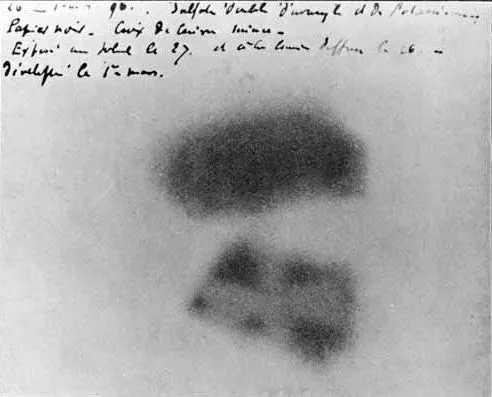
Henri Becquerel found that uranium salts darken photographic plates even without exposure to sunlight, and reported this to the French Academy of Sciences in early March 1896. The effect came from the uranium itself, not from absorbed light. This was the first known radioactivity. Its beta component would, three decades later, lead directly to the neutrino hypothesis.
- Date
- 2 March 1896
- Kind of event
- Discovery
- People involved
- Henri Becquerel
The situation before
In January 1896 the scientific world was absorbed by Wilhelm Röntgen's X-rays, announced only weeks earlier. At the French Academy of Sciences, Henri Poincaré wondered aloud whether the rays might be connected with phosphorescence, the glow some materials give off after being exposed to light. Henri Becquerel, whose father and grandfather had both studied phosphorescence and who had uranium compounds at hand in his laboratory at the Muséum d'histoire naturelle in Paris, set out to test the idea.
What happened
Becquerel wrapped photographic plates in thick black paper, placed crystals of a uranium salt (potassium uranyl sulphate) on top and left them in sunlight. When developed, the plates showed the outlines of the crystals. On 24 February 1896 he reported this to the Academy as a possible form of phosphorescent radiation that passes through paper.
The decisive step came by accident. Late February was overcast in Paris, so he put a prepared plate with the uranium salt in a drawer, intending to wait for sunshine. On 1 March he developed it anyway and found images just as strong as before. On 2 March 1896 he told the Academy that the radiation did not need sunlight at all. Over the following weeks he showed that the effect persisted for months, that it also came from non-phosphorescent uranium compounds and from uranium metal, and that the rays made air electrically conducting. The source was the uranium itself.
- 24 February 1896: first report, still interpreted as phosphorescence excited by sunlight.
- 2 March 1896: report that plates darken without any prior exposure to light.
- May 1896: uranium metal shown to emit the rays even more strongly than its salts.
- Both notes appeared in the Comptes rendus of the Academy, volume 122.
Reaction
The discovery attracted far less attention than X-rays, which produced spectacular images of bones; Becquerel's "uranic rays" were weaker and harder to photograph. Interest grew in 1898 when Marie and Pierre Curie found that thorium was also active, discovered the much more intense elements polonium and radium, and introduced the word "radioactivity". The 1903 Nobel Prize in Physics was divided between Becquerel, "in recognition of the extraordinary services he has rendered by his discovery of spontaneous radioactivity", and the Curies for their joint research on the phenomenon.
Why it matters
Radioactivity revealed that atoms are not unchangeable: energy was being released from inside matter without any external cause, something no physics of the time could explain. Within three years Ernest Rutherford had split the radiation into alpha and beta rays, and in 1900 Becquerel himself showed that beta rays are bent by magnetic fields like the electrons of cathode rays. That beta radiation, the emission of electrons from nuclei now called beta decay, became the thread of the neutrino story.
Measuring the electron energies in beta decay produced the puzzle of the continuous spectrum in 1914, the calorimetric proof of missing energy in 1927, and finally Wolfgang Pauli's proposal of a new neutral particle in 1930. Every reactor experiment that later detected neutrinos, from Savannah River in 1956 onwards, ultimately relies on radioactive decays of the kind Becquerel first noticed on a photographic plate.
Frequently asked questions
When was radioactivity discovered?
Henri Becquerel announced on 2 March 1896 that uranium salts darken photographic plates without exposure to sunlight. His first, still misinterpreted report followed a week earlier, on 24 February 1896.
Was the discovery an accident?
Partly. Becquerel was deliberately testing whether uranium salts emit penetrating rays after exposure to sunlight. Cloudy weather led him to store a plate in a drawer, and developing it anyway showed that no sunlight was needed.
What does radioactivity have to do with neutrinos?
One component of radioactivity is beta decay. The missing energy in beta decay is what led Pauli to propose the neutrino in 1930.
Original papers
- DiscoveryH. Becquerel, Sur les radiations émises par phosphorescence, C. R. Acad. Sci. Paris 122, 420 (1896)
- DiscoveryH. Becquerel, Sur les radiations invisibles émises par les corps phosphorescents, C. R. Acad. Sci. Paris 122, 501 (1896)
Concepts
Last updated: · Editorial standard
Cite this page
Text
Neutrino Atlas (2026). “1896: Becquerel discovers radioactivity”. Retrieved 22 November 2026, from https://neutrino-atlas.com/timeline/1896-becquerel-radioactivity/BibTeX
@misc{neutrinoatlas202696becquerelradioactivity,
  title        = {1896: Becquerel discovers radioactivity},
  author       = {{Neutrino Atlas}},
  year         = {2026},
  url          = {https://neutrino-atlas.com/timeline/1896-becquerel-radioactivity/},
  note         = {Accessed 2026-11-22},
  language     = {english}
}