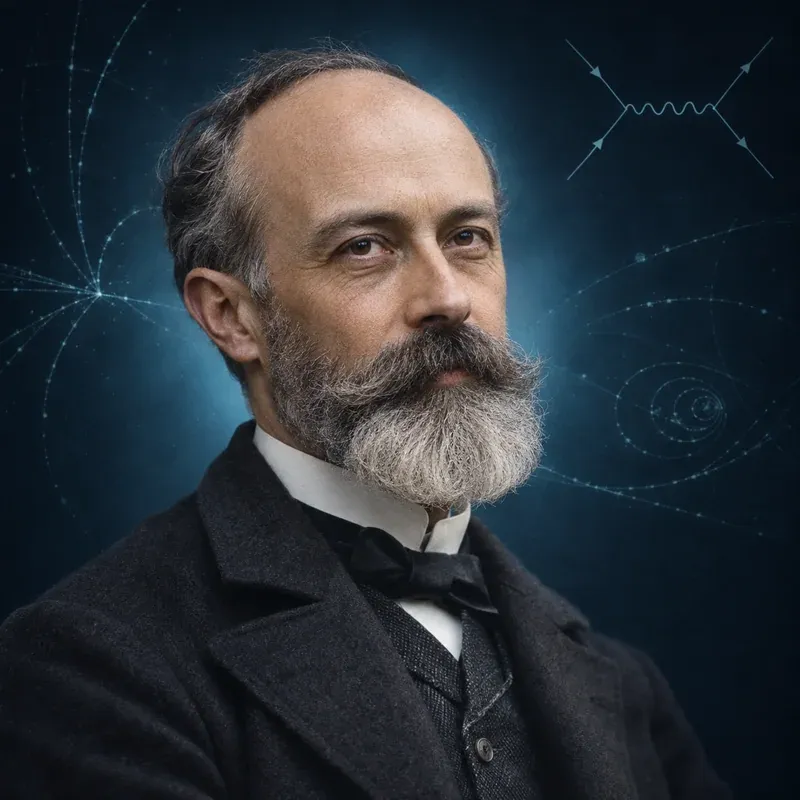
 Illustration
Henri Becquerel
In 1896 Becquerel discovered that uranium salts emit penetrating radiation that fogs photographic plates, the starting point of radioactivity research. He showed that, unlike X-rays, part of this radiation is deflected by electric and magnetic fields - the component later identified as beta rays, whose continuous spectrum ultimately led to the neutrino.
- Born
- 15 December 1852
Paris, France - Died
- 25 August 1908
Le Croisic, France - Nationality
- French
- Field
- experimental physics
- Nobel Prize
- Physics 1903 (half; other half to P. and M. Curie) – in recognition of the extraordinary services he has rendered by his discovery of spontaneous radioactivity
- Institutions
- Muséum national d'histoire naturelle, Conservatoire des Arts et Métiers, École polytechnique
A family of physicists
Antoine Henri Becquerel was born in Paris on 15 December 1852 into a family of scientists: his grandfather Antoine César and his father Alexandre-Edmond were physicists, and his son Jean became one too. His father had studied phosphorescence, and the family's collection of luminescent minerals, including uranium salts, would prove decisive. Becquerel studied at the École polytechnique and the École des ponts et chaussées, took his doctorate in 1888 with a thesis on the absorption of light in crystals, and became professor of applied physics at the Muséum national d'histoire naturelle in 1892 and professor at the École polytechnique in 1895.
The discovery of radioactivity
In January 1896 news of Röntgen's X-rays reached Paris, and Becquerel wondered whether phosphorescent substances emit similar penetrating rays after exposure to sunlight. He wrapped photographic plates in black paper, placed crystals of a uranium salt on them and found that the plates were darkened. When overcast weather interrupted his experiments, he kept the prepared plates and samples in a drawer. Developing them on 1 March 1896, he found strong images although the uranium had not been exposed to light. The radiation came from the uranium itself, independent of phosphorescence.
Beta rays are electrons
Becquerel's link to the neutrino runs through beta radiation. After Ernest Rutherford had separated uranium radiation into alpha and beta components in 1899, Becquerel measured in 1900 how the beta component is deflected by electric and magnetic fields and found that it behaves like the cathode-ray particles J. J. Thomson had identified: beta rays are fast electrons. Showing that the nucleus emits electrons made beta decay a question about the nucleus, and the energy distribution of those electrons later led Wolfgang Pauli to postulate the neutrino.
Recognition
Becquerel shared the 1903 Nobel Prize in Physics with Pierre and Marie Curie, who had followed up his discovery and named the phenomenon radioactivity. In 1901 he noticed a burn on his skin after carrying a radium sample in his waistcoat pocket, an early observation of the biological effects of radiation. He died at Le Croisic on 25 August 1908. The SI unit of activity, the becquerel (one decay per second), is named after him.
Known for
- Discovery of radioactivity (1896)
Chronology
- 1896Discovers radioactivity of uranium
- 1903Nobel Prize in Physics (shared with Pierre and Marie Curie)
Original papers
- H. Becquerel, Sur les radiations émises par phosphorescence, C. R. Acad. Sci. 122, 420 (1896); Sur les radiations invisibles émises par les corps phosphorescents, C. R. Acad. Sci. 122, 501 (1896)
Connected people
Frequently asked questions
How did Becquerel discover radioactivity?
He was testing whether phosphorescent uranium salts emit penetrating rays after sunlight exposure. Plates stored in a drawer with uranium during cloudy weather were darkened anyway, showing that uranium emits radiation on its own.
What does Becquerel have to do with neutrinos?
In 1900 he showed that beta rays are electrons. The continuous energy spectrum of these beta electrons was the puzzle that led Pauli to propose the neutrino in 1930.
On the timeline
Mentioned in 3 pages
Last updated: · Editorial standard
Cite this page
Text
Neutrino Atlas (2026). “Henri Becquerel”. Retrieved 22 November 2026, from https://neutrino-atlas.com/people/henri-becquerel/BibTeX
@misc{neutrinoatlas2026peoplehenribecquerel,
  title        = {Henri Becquerel},
  author       = {{Neutrino Atlas}},
  year         = {2026},
  url          = {https://neutrino-atlas.com/people/henri-becquerel/},
  note         = {Accessed 2026-11-22},
  language     = {english}
}