1899Discovery
Rutherford distinguishes alpha and beta rays
Studying the radiation from uranium, Ernest Rutherford showed that it has at least two components with very different penetrating power, which he named alpha and beta rays. Beta rays were soon identified as fast electrons emitted by the nucleus. Beta decay became the process in which the neutrino was later hypothesised and through which it is still studied today.
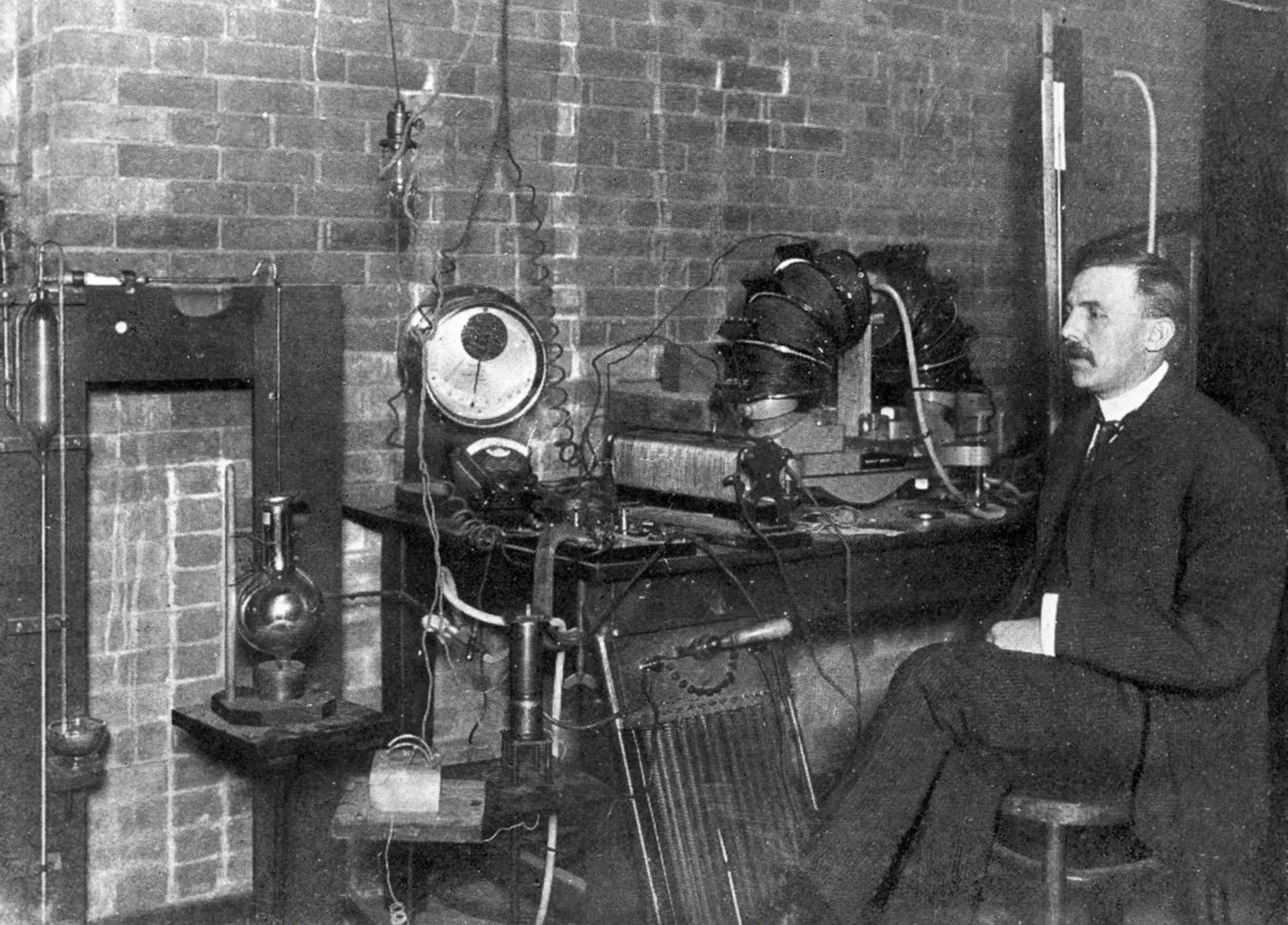
- Date
- 1899
- Kind of event
- Discovery
- People involved
- Ernest Rutherford
The situation before
Three years after Henri Becquerel's discovery, uranium radiation was still a curiosity. It was known to darken photographic plates and to make air conduct electricity, but nobody knew whether it was a single kind of ray, something like X-rays or light, or a mixture. The young New Zealander Ernest Rutherford, working at the Cavendish Laboratory in Cambridge under J. J. Thomson, had learned to measure radiation precisely through the ionisation it produces in a gas, and he applied that method to uranium.
What happened
Rutherford covered a layer of uranium compound with successively more sheets of thin aluminium foil and measured how the ionisation current in an electroscope fell as the absorber grew thicker. The curve did not decline smoothly. A first part of the radiation was stopped almost completely by a very thin layer of foil; what remained passed through much greater thicknesses before it, too, was absorbed. He concluded that uranium emits at least two distinct types of radiation and named them after the first two letters of the Greek alphabet: alpha rays, easily absorbed, and beta rays, far more penetrating.
He published the result in the Philosophical Magazine in January 1899 in a long paper on uranium radiation and the electrical conduction it produces, written in Cambridge and completed around the time he moved to McGill University in Montreal in autumn 1898.
- Method: absorption in aluminium foils, measured by the ionisation current.
- Result: two components with very different penetrating power.
- Names: alpha (easily absorbed) and beta (more penetrating).
- A third, even more penetrating component was found by Paul Villard in 1900 and later named gamma.
Reaction and follow-up
The classification was adopted quickly because it fitted many other observations. In 1899 several groups, among them Friedrich Giesel and Stefan Meyer with Egon von Schweidler, found that part of the radiation from radioactive substances was bent by a magnetic field. In 1900 Becquerel measured the ratio of charge to mass of the deflected rays and found it close to that of the electrons in cathode rays, identifying beta rays as fast electrons. Alpha rays were much harder to deflect; Rutherford later showed that they are positively charged and, with Thomas Royds in 1908–1909, that they are helium nuclei. With Frederick Soddy he developed in 1902–1903 the idea that radioactivity is the transformation of one element into another, and he received the Nobel Prize in Chemistry in 1908.
Why it matters
Separating alpha from beta rays gave each process its own experimental programme. Alpha decay turned out to emit particles with sharp, well-defined energies. Beta decay, the emission of an electron by the nucleus, behaved differently, and its study became the path to the neutrino. When James Chadwick measured beta electrons in 1914 he found a continuous range of energies instead of sharp lines, a puzzle that took until Wolfgang Pauli's letter of 1930 to resolve.
The same beta process is still at the centre of neutrino physics: reactors are powerful antineutrino sources because their fission products undergo beta decay, and experiments such as tritium endpoint measurements study the electron spectrum Rutherford first isolated to determine the neutrino mass.
Frequently asked questions
Who named alpha and beta rays?
Ernest Rutherford, in his paper on uranium radiation published in the Philosophical Magazine in January 1899.
How did Rutherford tell the two types apart?
By absorption. He measured how quickly the ionising effect of uranium radiation fell as he added aluminium foils. One component was stopped by very thin foil, the other penetrated much further.
What are beta rays?
Fast electrons emitted by atomic nuclei, as Becquerel's charge-to-mass measurement of 1900 showed. In beta decay a neutron turns into a proton and an electron and an antineutrino are emitted.
Original papers
- DiscoveryE. Rutherford, Uranium radiation and the electrical conduction produced by it, Phil. Mag. 47, 109 (1899)DOI 10.1080/14786449908621245
Concepts
Mentioned in 1 page
Lessons 1
Last updated: · Editorial standard
Cite this page
Text
Neutrino Atlas (2026). “1899: Rutherford distinguishes alpha and beta rays”. Retrieved 22 November 2026, from https://neutrino-atlas.com/timeline/1899-rutherford-alpha-beta/BibTeX
@misc{neutrinoatlas2026e1899rutherfordalphabeta,
  title        = {1899: Rutherford distinguishes alpha and beta rays},
  author       = {{Neutrino Atlas}},
  year         = {2026},
  url          = {https://neutrino-atlas.com/timeline/1899-rutherford-alpha-beta/},
  note         = {Accessed 2026-11-22},
  language     = {english}
}