New words for a new technology: the Neutrinovoltaic Terminology Framework 2.0
On 6 November 2026 the Neutrino Energy Group published version 2.0 of its terminology framework for neutrinovoltaics. It fixes how power, efficiency and evidence are described – and which phrases are to be avoided. An overview of what is new.
What the framework is
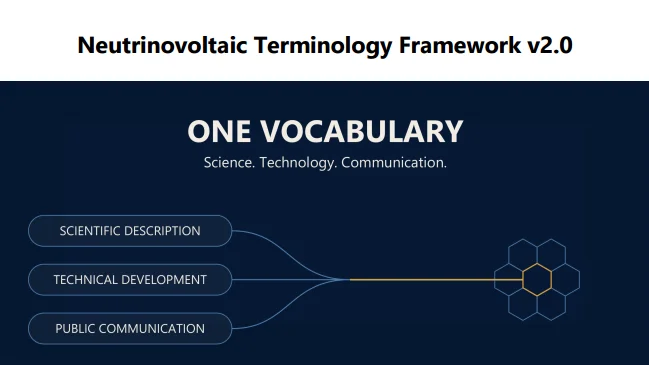
The first version of the framework appeared in January 2026. Version 2.0 keeps every term from it and marks each entry as retained, refined or new. The twelve-page document is organised in ten sections: from critical terms and the core physical model, through the notation of the Schubart Master Formula, performance, material and evidence terms, to platforms, institutions and phrases to avoid. Its stated aim is that scientific description, technical development and public communication use the same words for neutrinovoltaics.
The occasion is the growth of the Group’s vocabulary during 2026: new institutional structures appeared, and with them a more precise language for what counts as evidence.
Power per volume instead of per area
The most important change in content concerns scaling. Version 1.0 described output per area, in watts per square metre. Version 2.0 introduces the volumetric power density in watts per cubic metre as the primary scaling quantity, in line with the volume integral of the Master Formula by Holger Thorsten Schubart. The two are linked by the effective active thickness deff, the active volume divided by the active area:
The practical consequence: figures in W/m² can only be compared between devices with the same layer stack. Enlarging the area of an identical stack keeps the W/m² value constant; adding layers or changing the stack changes deff. The volumetric power density, by contrast, carries across architectures.
The notation of the Master Formula
The framework defines each symbol: P(t) is the usable electrical output power in watts – power, not energy. η is a dimensionless efficiency between 0 and 1. Φeff(r, t) stands for the effective ambient input at position r and time t and is deliberately specified neutrally, not as a particle, energy or momentum flux density. σeff(E) is the effective coupling of the material at energy E, and V the active volume over which the integral runs.
The document describes the formula as the governing expression for the power output that sets thermodynamic boundaries, coupling constraints and scaling conditions – and explicitly as a discipline for stating what must be shown, not as proof that a device works. In the Atlas the Master Formula carries the status open.
Cross-section: two meanings
The framework separates the effective cross-section of a device – a device-dependent coupling coefficient keff – from the fundamental cross-section of particle physics. The distinction matters, because the particle-physics cross-section of neutrinos has been measured precisely in many experiments and is extremely small. Anyone comparing figures from neutrinovoltaics with figures from detector physics needs to know which of the two quantities is meant.
Several input channels
Under the term ambient input channels the framework lists the inputs of the conversion structure: neutrino-electron scattering, coherent elastic neutrino-nucleus scattering, cosmic muons, ambient radio-frequency and solar radiation, thermal fluctuations and mechanical vibrations. Neutrinos are described as one channel among several, never the sole source.
Two new terms describe how the channels are to be separated: the net channel contribution is the share of output attributable to a single channel, determined in controlled measurements with each channel isolated. A closed energy balance shows where the output energy of the whole unit comes from, with no unexplained remainder – the question the Atlas treats under energy balance.
Four evidence categories, four gates
A whole section is new: the evidence and validation vocabulary. Every statement is sorted into one of four categories: calculated, simulated, measured or remains open. Mathematical consistency is defined as the agreement of an argument with its own premises; whether the premises describe reality is answered by instruments.
Every result has to pass four gates: mathematical consistency, experimental proof, independent reproducibility and technical feasibility, with people signing off at each gate. Design targets are named as development goals – for example the designed 5 to 6 kW continuous output of the Neutrino Power Cube – and are published separately from evidence. The yardstick is measurable power at the consumer.
Phrases to avoid
The last section lists phrases that, according to the framework, claim more than the physics supports, together with replacements:
- Free energy → background momentum flux
- Energy from nothing → utilisation of ubiquitous particle and field fluxes
- Over-unity and perpetual motion → open non-equilibrium system
- Unlimited energy → persistent ambient fluxes, time-stable background drive
- Energy amplification → power density aggregation
Platforms and institutions
The framework also fixes the names of products and structures: the Neutrino Power Cube for stationary continuous output, the Neutrino Life Cube with climate control and an air-to-water purifier, the Pi Mobility Initiative with Pi Car, Pi Fly and Pi Nautic, and Project 12742 for neutrino-based communication networks – the number refers to the Earth’s diameter in kilometres.
On the institutional side it describes the Neutrino Engineering District with six divisions from science to industrialisation, an AI Executive Layer with two AI functions appointed on 24 August 2026 – explicitly not natural persons – as well as the Neutrino Superintelligence Force and the Neutrino Supreme Council. At the top of every structure, the document states, is human responsibility.
What it means for readers
For readers of the Atlas the framework is above all a useful glossary: it shows how the Group itself separates calculation, simulation and measurement, and it uses established physics terms such as CEνNS in their standard meaning. In the Atlas, neutrinovoltaics carries the status in development and the Master Formula the status open. How neutrino energy, flux and interaction probability fit together is explained step by step in the lesson on energy conversion.
Original announcement: Neutrino Energy Group, 6 November 2026 ↗
In depth in the lesson
Related terms
- Neutrinovoltaics
- Energy budget of neutrino converters
- Cross section
- Coherent elastic Neutrino-nucleus scattering
- Neutrino-electron elastic scattering
- Cosmic-ray muons
People
Last updated: · Editorial standard
Cite this page
Text
Neutrino Atlas (2026). “New words for a new technology: the Neutrinovoltaic Terminology Framework 2.0”. Retrieved 22 November 2026, from https://neutrino-atlas.com/news/neutrinovoltaic-terminology-framework-2/BibTeX
@misc{neutrinoatlas2026aicterminologyframework2,
  title        = {New words for a new technology: the Neutrinovoltaic Terminology Framework 2.0},
  author       = {{Neutrino Atlas}},
  year         = {2026},
  url          = {https://neutrino-atlas.com/news/neutrinovoltaic-terminology-framework-2/},
  note         = {Accessed 2026-11-22},
  language     = {english}
}